
Cynthia Phillips was mesmerized when she saw the latest pictures of her favorite moon. Here at last was a fresh look at Europa, an icy satellite of Jupiter. The moon resembles a truffle drizzled haphazardly with strips of melted white chocolate, as if the universe had rushed to finish a baking-show challenge. The images gave us a new sense of Europa’s topography, its collection of ridges and troughs appearing more intricate than ever. The lighting was different this time, Phillips told me, and the shadows brought out dramatic shapes in the terrain.
The images were taken by a Jupiter-observing spacecraft as it swept past Europa last week, coming within just 222 miles (358 kilometers) of the frozen surface. Phillips, a planetary geologist at NASA’s Jet Propulsion Laboratory, immediately reached for the Europa globe on her desk and began comparing the real-world views with the topography stretched over the plastic orb. The last probe to come this close to Europa was disposed of in 2003, when NASA deliberately plunged it into Jupiter’s atmosphere after the mission started running low on fuel. “We haven’t seen Europa’s surface in this level of detail for 20 years,” Phillips said.
Europa might be the best place to search for life elsewhere in the solar system. Scientists are almost certain that beneath the Jovian moon’s frozen surface is a salty ocean with more water than all of Earth’s oceans combined. And such a watery subsurface environment could provide a comfortable home for small Europan life forms.
[Read: Jupiter’s frozen moon is studded with 50-foot blades of ice]
Two years from now, another NASA spacecraft will depart for the Jupiter system, specifically designed to study Europa. The probe will swing past the moon dozens of times, sometimes coasting just 16 miles (25 kilometers) above the surface. Each pass will bring scientists closer to understanding the workings of this celestial truffle and its mysterious interior. Beneath that frosty coating could be the answer to one of our biggest questions: Is there life anywhere else in the universe?
Europa is enveloped in a thick coat of water ice. (Some other moons in our solar system have ice made of methane and nitrogen—the cosmos is a weird place.) The criss-crossing lines visible in the new pictures are actually cracks and fissures in that frozen exterior. Scientists suspect that they’re caused by the stretching and squashing that Europa experiences as it orbits giant Jupiter. The moon’s terrain is sprinkled with chemical compounds such as sodium chloride and magnesium sulfate—more commonly known to Earthlings as table salt and Epsom salt—and they could indicate briny waters below.
A close-up view of Europa’s textured surface (NASA / JPL-Caltech / SWRI / MSSS
Scientists got their best evidence that a Europan ocean might exist two decades ago, when that earlier NASA spacecraft detected a magnetic connection between Europa and Jupiter that could easily be explained by the presence of a salty, global sea. This deep into the solar system, Europa’s underground ocean wouldn’t feel the warmth of the sun; it would stay liquid because of Jupiter’s gravitational tugging. In recent years, telescopes have detected signs of plumes of water vapor spewing out of the cracks and into space. Scientists believe that Europa’s ocean could be as old as the moon itself, about 4 billion years or so, which would give life plenty of time and a stable environment in which to evolve, Phillips said.
[Read: Europa’s mysterious glow]
The data suggest that Europa has a rocky mantle—the layer between the moon’s crust and core—and when rock and water come together, magical things can happen: Chemical interactions between them are known to produce hydrogen-rich materials for tiny creatures to metabolize. “On our own planet, hydrothermal systems at the seafloor provide energy for communities of microorganisms,” Samantha Trumbo, a planetary scientist at Cornell who studies icy ocean worlds like Europa, told me.
The upcoming NASA mission, named Clipper—a nod to the speedy, lightweight vessels favored by 19th-century merchants—will study nearly every bit of the Europan surface. If it gets lucky, the spacecraft could fly through some plume particles, take a sip, and analyze the contents. Alyssa Rhoden, a planetary geophysicist at the Southwest Research Institute who studies Europa, is most excited about a Clipper instrument designed to detect warmer-than-usual spots on the moon’s surface. “When you look at Europa’s surface, you can see a lot of pits where the surface seems to have dropped down a little bit, places where the surface has been disrupted,” Rhoden told me. “We think that that’s happening from heating coming from below.” That signature could simply indicate the presence of melted bits of ice near the frigid crust—or it could mean a roiling sea has floated toward the surface, perhaps bringing any tiny inhabitants with it.
[Read: Exploring the oceans of the outer solar system]
The Clipper mission is not meant to find definitive proof that life exists on Europa, only explore whether the moon has the right conditions and chemistry to make life possible. Evidence of life will require more missions, guided by Clipper’s data, that could land on the Europan surface and drill into the ice. NASA is also searching for life elsewhere in the solar system, notably on Mars, where a rover is collecting samples from a dried-up river delta. But Europa is a more tantalizing target, and so are the other ocean moons sprinkled across the solar system, such as Enceladus and Titan, which orbit Saturn, and Triton, around Neptune. The Mars mission is designed to search for signs of fossilized life that existed several billion years ago, when water once flowed on the planet. “It’s quite possible that Mars could have had life in the past, in a warmer-weather era, and it’s possible that there are subsurface pockets on Mars that could have remnants of this living biosphere,” Phillips said. “But on somewhere like Europa, life could exist there now.”
And what might humanity, by way of carefully engineered machines, find on Europa, once we’ve figured out which melty bits to inspect? “I would love for there to be Europan whales swimming around in that ocean,” Phillips said with a laugh. But alien life, if it exists, is likely to be small and simple. Energy sources are limited in the Europan depths, and scientists don’t think the environment can support the development of more complex organisms, Phillips said. Still, even the discovery of a single microbe would mark an explosive event in human history. It would mean that life had managed to spring up in two different places around the same star—in a universe absolutely brimming with stars. If it happened more than once here, in our own solar system, it’s likely happened elsewhere in the cosmos, around someone else’s sun. This is why scientists are so eager to catch a glimpse of Europa, and prepare as much as they can for the exploration to come. “We all want it to be water,” Rhoden said. “We all want it to be a cool plumbing system in the shell with lots of activity, and someday we’ll get down there and find little Europan sea urchins clinging to the bottom of the ice.”
Skip The Scoop | Seek Understanding
Tom Reed Won’t Seek Re-election, Rules Out Cuomo Challenge
Representative Tom Reed won’t seek re-election to the U.S. House, the New York Republican said in a statement Sunday night in which he apologized to a lobbyist who accused him of touching her inappropriately.
‘Dominoes are falling:’ Religious liberty advocates hail end to Minnesota church restrictions
Capacity limits lifted on Minnesota places of worship, but social distancing still required. Thomas More Society wants more states to follow suit.
Trump Says Biden Border Agenda Has Turned ‘A National Triumph Into a National Disaster’
Former President Donald Trump has again criticized the Biden administration’s handling of the crisis at the U.S. southern border after Homeland Security Secretary Alejandro Mayorkas spent Sunday morning defending his handling of the situation in a slew of television interviews. Mayorkas appeared on multiple programs across major news networks on Sunday to address questions about the burgeoning crisis that saw an influx of unaccompanied children with numbers reaching new highs not seen since the last crisis in 2019. He sought to shift the blame of the crisis on the Trump administration, saying that the previous government had “dismantled the orderly, humane, and efficient way of allowing children to make their claims under United States law in their own country,” according to his interview with NBC. Trump appeared to respond to Mayorkas’s comments in a statement sent via email later on Sunday, where he reiterated his criticism that the Biden administration had transformed “national triumph into a national …
University Abruptly Suspends Diversity Classes: ‘Students Have Been Humiliated and Degraded’
by Jennifer Kabbany
Amid rumors of a video that shows a student being targeted during a diversity lesson at Boise State University, administrators have abruptly suspended all of the school’s general education classes called, “University Foundations 200: Foundations of Ethics and Diversity.”
“We have been made aware of a series of concerns, culminating in allegations that a student or students have been humiliated and degraded in class on our campus for their beliefs and values,” states a March 16 memo from President Marlene Tromp to the campus community.“This is never acceptable; it is not what Boise State stands for; and we will not tolerate this behavior,” Tromp stated. “…Given the weight of cumulative concerns, we have determined that, effective immediately, we must suspend UF 200.”
She goes on to note that academic leadership will determine next steps “to ensure that everyone is still able to complete the course.”
Tromp’s decision came around the same time as Idaho lawmakers passed a state education budget that takes away about $409,000 from Boise State University because of its social justice curriculum, Idaho Ed News reports.
Tromp’s memo does not mention the alleged video. Boise State’s spokesperson Mike Sharp told The College Fix on Friday “we have not seen any video of the alleged incident.”
However, the Idaho Freedom Foundation has published screenshots of since-deleted tweets from a BSU assistant professor of English who stated that a “student in a university foundations class taped a zoom discussion on white privilege, in which apparently a white student was made to feel uncomfortable, and sent the video to ID state legislature, who are ‘enraged.’ BSU suspended all UF 200 classes mid semester as a result.”Idaho Freedom Foundation’s Anna Miller told The College Fix in a telephone interview Friday that her group has submitted public records act requests for copies of student complaints over UF 200 — as well as for a copy of the alleged video.
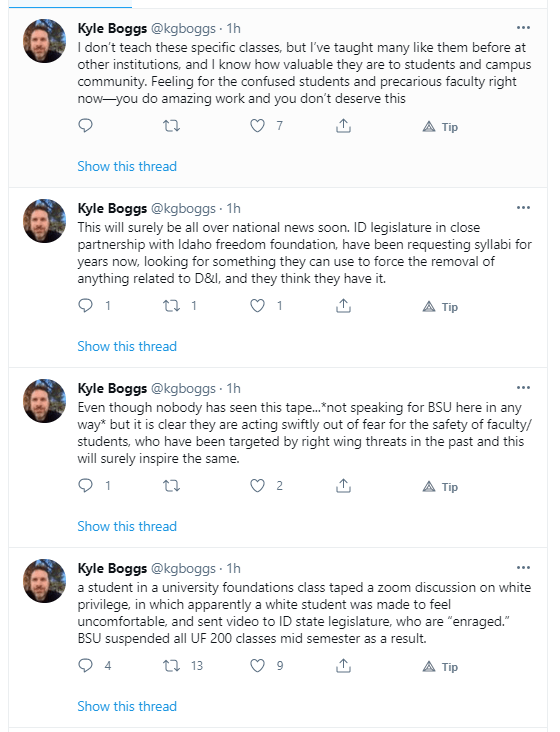
Asked if she believes such a video exists, Miller said yes.
“There is no reason that they would have taken such drastic action unless something really drastic had happened,” Miller said.
Miller is co-author of a December 2020 report titled “Social justice ideology in Idaho higher education” and said UF 200 has been a cause of concern for quite some time.
“In our report we mapped out that general education courses the students are required to take are infused with social justice ideology,” Miller told The Fix.
In a piece Miller penned March 18 for the foundation’s website, she asks: “How extensive is the social justice rot?”
“Our report on social justice ideology shows that Boise State is building a social justice university. This ideology asserts that all whites and especially males as oppressors, and that racial minorities are permanent victims,” Miller wrote.
“Social Justice institutions like Boise State then construct an environment that seeks to shame and vent hatred on the oppressors and elevate and insulate the oppressed from any kind of criticism.”
– – –
Jennifer Kabbany is editor of The College Fix. She previously worked as a daily newspaper reporter and columnist for a decade in Southern California, and prior to that held editorial positions at The Weekly Standard, Washington Times and FrontPageMagazine. She is also a Robert Novak Journalism Fellowship recipient and has contributed to National Review.
Photo “University of Idaho” by University of Idaho.
The post University Abruptly Suspends Diversity Classes: ‘Students Have Been Humiliated and Degraded’ appeared first on The Georgia Star News.
Border agents releasing asylum-seeking migrants into US without court date
Border Patrol agents in the Rio Grande Valley are releasing asylum-seeking migrants into the US without issuing them court dates amid an influx of unlawful crossings along the border, a report said Sunday. The measure is meant to bypass the hours-long process of giving the migrants a “notice to appear,” which requires tedious paperwork, several…
Biden Says He Will Visit Southern Border ‘At Some Point’
President Joe Biden said on Sunday that he will visit the U.S. southern border “at some point” as his administration continues to struggle with addressing the influx of illegal immigration. Biden made the comments to reporters after stepping off the Marine One at the White House. The United States is currently facing a significant surge in illegal border crossings, in particular from unaccompanied minors. While families and single adults are being expelled at the border, the administration is still accepting unaccompanied minors who arrive illegally, Homeland Security Secretary Alejandro Mayorkas said. The president, who vowed to reverse his predecessor’s immigration policies during his campaign, has recently pleaded to Central American migrants to stay put in their “town or city or community” instead of making the dangerous trip to illegally cross into the United States. Upon taking office, Biden reversed several Trump-era immigration policies, including his predecessor’s key Migrant Protection Protocol, which sought to …
As Putin lobs counter-digs, can relationship with Biden be saved?
The fracas between the two heads of state began last week, when Biden agreed during an interview that Putin is a ‘killer.’
President Biden Trips Over His Own Feet, Gets Back Up, Falls Again

Dude. This is just sad.
I have two regrets about this video. One is YouTube copyright rules. Otherwise, I would have it on a twenty-minute loop with Chumbawamba singing “I GET KNOCKED DOWN, BUT I GET UP AGAIN.” Probably some fart sounds too. The other regret is that this didn’t happen during lunchtime in the 8th grade. I would have started the loudest “D!CK” chant ever recorded. There’s a chance that as an adult I may have started a d!ck chant watching this video just now. I am unable confirm nor deny doing that. But my cat is looking at me funny.
I’m going to enjoy watching how the media circles the wagons around this. Oldheads will remember that President Gerald Ford fell once and comedian Chevy Chase made an entire career out of it. That probably won’t be the case on SNL this weekend, since Biden is a Democrat. Even though yesterday he (allegedly, accidentally) forgot which one of them was president. The week before, he stumbled on the name of his defense secretary. Biden regularly looks confused as people shout questions at him. Everyone trips once in a while. It’s more common when you’re a 78-year-old man. Add all these things together and make him a Republican, the chyron for CNN would say “Elder Abuse.” Instead, it will be about Republicans “seizing” on the president of the United States forgetting how to walk.
It just sucks that Donald Trump doesn’t have Twitter. He totally would have tweeted, “HAVE A GOOD TRIP, SLEEPY JOE! SEE YOU NEXT FALL! MAGA!”
CROWDER 911: How to Train your Joe Biden | Louder With Crowder
youtu.be
Need a quick laugh? Check out and subscribe to our CrowderBits YouTube channel for Louder with Crowder skits, opens, and parody videos!
Fair game? Kamala Harris trends after Biden stumbles then falls headed to Air Force One
The following article, Fair game? Kamala Harris trends after Biden stumbles then falls headed to Air Force One, was first published on BizPac Review.

President Biden started to run up the stairs of Air Force One on Friday before stumbling twice and then falling down. Social media proceeded to meltdown and […]
Continue reading Fair game? Kamala Harris trends after Biden stumbles then falls headed to Air Force One …
Biden Falls Three Times Getting on Air Force One
President Joe Biden fell three times while boarding Air Force One at Joint Base Andrews today. An aide says Biden is “doing fine” and that it was very windy at the time. Biden was heading to Georgia. (Source: Bloomberg)
Reuters first to report Chinese EV trio eye HK listings this year to raise combined $5 billion
Reuters was first to report that three U.S.-listed Chinese electric vehicle (EV) makers – Li Auto Inc, Nio Inc and Xpeng Inc – plan to list in Hong Kong as soon as this year, tapping a growing investor base closer to home. The trio each aim to sell at least 5% of enlarged share capital in the Asian hub, Reuters sources said. The plans come as the trio increase capital raising efforts to fund technology development and expand sales networks, to better compete in the world’s biggest EV market where U.S. peer Tesla Inc is boosting sales of its China-made vehicles.
The post Reuters first to report Chinese EV trio eye HK listings this year to raise combined $5 billion appeared first on Reuters News Agency.
Hacker Group Says It Accessed Tesla’s, Others’ Internal Video Feeds
Hackers said they accessed surveillance footage at several companies and public agencies by breaching the network of security-camera vendor Verkada.
Volkswagen CEO Says He Wants to ‘Overtake’ Tesla
Green policies are making the electric vehicle space a hot market. Volkswagen’s CEO says he wants to “get close and then overtake” Tesla. The German automaker is going full-speed ahead with electric vehicles to do it. Volkswagen is ramping up battery production, but soaring lithium prices amid low supply could slow down their plans.
The post Volkswagen CEO Says He Wants to ‘Overtake’ Tesla appeared first on NTD.
Feds probing nearly two dozen crashes involving Tesla cars
The National Highway Traffic Safety Administration said it’s running 23 ongoing probes of Tesla crashes.
China to Restrict Tesla Use by Military and State Personnel
People familiar with the effort cited concerns that Tesla cars could be a source of national security leaks.
Chinese military bans Tesla cars, cites security concerns over onboard cameras
Chinese owners of Tesla electric cars will not be able to take them onto Chinese military property.
Secret Trials in China for Spavor and Kovrig Are ‘Disappointing,’ Trudeau Says
Prime Minister Justin Trudeau says the trials being held “without transparency” for the two Canadians who have been detained in China for two years are “disappointing.” Michael Spavor was tried in court Friday but no verdict was announced. Michael Kovrig’s trial is scheduled for Monday. “It is disappointing that the trial that Michael Spavor went through and possibly the trial that Michael Kovrig will go through on Monday are happening in secret without transparency, without access by Canadian consular officials,” Trudeau said during a press briefing on Friday. Trudeau said his government has been working with allies to pressure Beijing for their release and will continue to do so. “China needs to understand that it is not just about two Canadians, it is about the respect for the rule of law and relationships with a broad range of Western countries that is at play, with the arbitrary detention and coercive diplomacy …
Upcoming Protests to Focus on Health, Environmental Impacts of 5G Satellites
Demonstrations will be held Friday and Saturday, March 19 – 20, to protest the deployment of 5G — a technology that poses health risks, encourages debris-generating satellite collisions, causes depletion of the ozone layer by the huge number of launches planned and is a major factor in the weaponization of space.
The “5G SpaceX Satellite Protest” will take place March 19 at the headquarters of SpaceX in Hawthorne, California. SpaceX, of which Elon Musk is founder and CEO.
Details about the protest can be found here.
On March 20, a “5G Global Protest Day” will take place with protests planned around the world. Details can be found here.
SpaceX is deeply involved in launching the small satellites being placed in low-earth orbit for 5G. Last week, the company launched a rocket carrying another 60 satellites, and it plans to send up tens of thousands in the next few years under its Starlink program.
Last year, the Federal Communications Commission (FCC) granted SpaceX permission to erect up to one million antennas on earth to serve as transceivers linked to the satellites.
“The planet is calling out to us,” said Julie Levine, coordinator of 5G Free California. “If ever there was an existential crisis on earth, we are in it now. Please join us in taking action.”
Telecommunications companies are advertising heavily to promote 5G, described as the fifth-generation of wireless, to consumers. And with the military component a large factor, there has also been a big push by the Pentagon.
Dafna Tachover, director of the Children’s Health Defense Stop 5G and Wireless Harms Project, said: “Science on the health risks of wireless radiation has been accumulating for decades. Heedless of the dangers, government and the telecom industry continue to propagate wireless technologies and infrastructure, helped along by captive regulatory agencies and successful effort, including legislative, to silence public debate about health effects.”
Tachover added: “At the same time, media campaigns and apps designed to addict the public — and especially children — have been effective in generating consumer enthusiasm. As a result, the wireless transformation has been hugely profitable.”
According to epidemiologist Dr. Devra Davis, founder and president of the Environmental Health Trust:
“Proposed 5G wireless installations transmit radiofrequency emissions that cause environmental pollution linked to cancer, DNA damage, neurological damage and other adverse health and environmental effects, including on birds, bees and trees, according to internationally recognized authoritative research. The prestigious institutions that have conducted these studies include the U.S. National Toxicology Program, the nation’s premier testing institute, and the Ramazzini Institute, a foremost testing center in Italy.”
Davis noted that an immediate moratorium on 5G has been called for by more than 400 scientists and supported by thousands of medical doctors, as cited in a court challenge last year by Environmental Health Trust to the FCC’s actions — and inaction — on 5G.
Moreover, Davis said, “Wired technologies such as fiber or coaxial cable are far superior to wireless as they are faster, more reliable, more resilient, more energy-efficient and more easily defended from cyber-attacks. Above all, wired connections are significantly less hazardous to our health and to other life forms with whom we share this planet.”
In a Scientific American article, Dr. Joel Moskowitz, director of the Center for Family and Community Health in the School of Public Health at the University of California, Berkeley, wrote:
“The latest cellular technology, 5G, will employ millimeter waves for the first time, in addition to microwaves that have been used for older cellular technologies, 2G through 4G. Given limited reach, 5G will require cell antennas every 100 to 200 meters, exposing many people to millimeter wave radiation.”
In “We Have No Reason to Believe 5G Is Safe,” Moskowitz noted “we have considerable evidence about the harmful effects of 2G and 3G” and “little is known about the effects of exposure to 4G, a 10-year-old technology, because governments have been remiss in funding this research.”
Moskowitz asks: “As a society, should we invest hundreds of billions of dollars deploying 5G, a cellular technology that requires the installation of 800,000 or more new cell antenna sites in the U.S. close to where we live, work and play?”
According to “What 5G Means to the Military,” published Dec. 2, 2020, on the Military & Aerospace Electronics website:
“Emerging fifth-generation wireless communications — better-known as 5G — will be far more than quick-connect phone calls and fast movie downloads, particularly for the U.S. military. 5G holds the promise of ubiquitous high-speed data connectivity; vastly improved intelligence, surveillance and reconnaissance; fast and secure command and control; more efficient logistics; swarming unmanned vehicles; and wide use of virtual reality and augmented reality.”
The article further states: “The promise of 5G is for instant situational awareness anywhere on earth, smart hypersonic weapons with re-targeting on-the-fly, rich access to mission-critical data on the leading edge of the battlefield.”
The “re-targeting on-the-fly” is critical for the newly developed hypersonic missiles — the first test of which occurred last March 19, 2020, from the U.S. military’s Pacific Missile Range Facility on Kauai, Hawaii. Hypersonic missiles fly at some 3,600 miles per hour or one mile per second. A “re-targeting on-the-fly” thus needs to happen with great speed. The hypersonic missiles are “nuclear-capable.”
The U.S. is seeking to acquire “volumes of hundreds or even thousands” of “stealthy” hypersonic missiles, according to an article published in a May 2020 issue of Aviation Week & Space Technology.
“Military experts foresee that the 5G system will play an essential role for the use of hypersonic weapons — missiles, including those bearing nuclear warheads, which travel at a speed superior to Mach 5 … in order to guide them on variable trajectories, changing direction in a fraction of a second to avoid interceptor missiles,” according to “The Hidden Military Use of 5G Technology,” by Manlio Dinucci. The original article was published in the Italian web newspaper, Il Manifesto. Telesur published a version of the article in English in December 2019.
Dinucci cites a report, “Defense Applications of 5G Network Technology, ”published by the Defense Science Board, a federal committee that provides scientific advice for the Pentagon. According to Dinucci, the report states: “The emergence of 5G technology, now commercially available, offers the Department of Defense the opportunity to take advantage, at minimal cost, of the benefits of this system for its own operational requirements.”
On Oct. 8, 2020, the U.S. Department of Defense (“DOD) announced $600 million in awards for 5G experimentation and testing at five U.S. military test sites. According to the DOD, the awards represented “the largest full-scale tests for dual-use applications in the world.”
The term “dual-use” is common in the U.S. space program to describe a program that has both a civilian and military purpose. The DOD press release stated: “The Department of Defense is at the forefront of cutting edge 5G testing and experimentation, which will strengthen the Nation’s warfighting capabilities as well as U.S. economic competitiveness in this critical field.”
The DOD identified the five 5G test sites as: Hill Air Force Base in Utah; Joint Base Lewis-McChord in Washington; Marine Corps Logistics Base in Georgia; Naval Base San Diego in California; and Nellis Air Force Base in Nevada.
A Feb. 23 article on the Defense One website, “Pentagon Looks to Tap 5G in Space,” summed up the military’s 5G drive this way: “Space Force officials and others in the Air Force office responsible for enterprise data transport intend to tap ‘rapidly emerging 5G technologies to support space data transport terrestrially, in space, and in the space-ground links,’ according to a request for information published by the latter Thursday.”
As for the military component of 5G, Bruce Gagnon, coordinator of the Global Network Against Weapons & Nuclear Power in Space, said in an interview:
“It is no surprise that the corporate media is pushing 5G so widely and eagerly — without the slightest bit of critical thought. The Pentagon knows that faster speeds from 5G will enable greater space surveillance, targeting and offensive military operations as a result.
“Launches of tens of thousands of 5G satellites will ensure that every person on Earth will have a satellite over their head 24/7. Imagine the surveillance and targeting capabilities that would become available. And the taxpayer is fronting much of the money. The DOD and NASA are awarding hundreds of billions of dollars to the likes of Elon Musk of Space X and other private launch corporations to hoist the 5G satellites into the heavens.”
According to Gagnon, there is another downside to all these 5G satellite launches: “With each launch, the resulting toxic rocket fuel is punching a larger hole in our planetary ozone layer which exacerbates the climate crisis. In addition, the orbital parking lots, which are already quite crowded, are quickly filling up, which will become a point of conflict in the near future as other nations become agitated that the U.S. is grabbing most of the parking spaces in the increasingly contested orbits.”
Gagnon said there is presently no national or international regulation over the use of space. Not only is this a worry because of the resulting increase in dangerous space debris, “but one must recognize that humankind is creating a deadly new arena of competition and military confrontation,” he said.
“It is up to all of us,” Gagnon said,“to speak out and demand that NASA, the FCC, the United Nations and the Pentagon quickly undertake a process of fair regulation of space launch operations. If not done immediately we will face a cascade of deadly collisions and even war in space.”
Gagnon said there are many reasons to oppose 5G — health impacts, environmental impacts, loss of the night sky which is angering astronomers — “but the military use of 5G is possibly the worst as it needlessly accelerates the already huge concern about keeping space for peace.”
The Stop 5G International announcement on Saturday’s “5G Global Protest Day” includes a “Stop5G International Declaration” which states:
“We envision and seek to ensure a world where 5G, 6G or any other ‘G’ is replaced by safe technology that has undergone scrutiny to ensure the health and well-being of all life on the planet before being unleashed. We envision and seek to ensure a world where the health and well-being of all life takes precedence over corporate self-gain.”
StopG International is asking individuals and organizations to sign its “Open Letter to Elon Musk & SpaceX.” The letter reads in part:
“We are writing to you at this time because SpaceX is in the process of surrounding the Earth with a network of thousands of satellites whose very purpose is to irradiate every square inch of the Earth. SpaceX, like everyone else, is treating the radiation as if it were not there … We write to you today to ask you to halt the Starlink project because it is so destructive.”
There is also a 5G International Legal Action Network led by attorneys Julian Gresser and Amber Yang which has advanced a “Healthy Heavens Trust Declaration” which states:
“We are a professional network of lawyers and relevant experts, dedicated to redirecting the 5G Juggernaut toward balance and wisdom. Our species is rushing toward a future that feeds our addiction to speed, instant gratification, energy consumption, and disconnection from Earth. By creatively working together, we have a chance to cause a shift.”
The post Upcoming Protests to Focus on Health, Environmental Impacts of 5G Satellites appeared first on Children’s Health Defense.
Alabama House Passes Bill Barring Transgender Athletes From Female Sports Teams
‘Fair, level playing field for female athletes’. . .
Fauci Has ‘Outlived His Usefulness’: Ben Domenech Says Demand For Masks After Vaccines Is ‘Dangerous’
‘That’s the opposite of the message we ought to be sending’
Johnson & Johnson working on modified vaccines for COVID-19 variants
Johnson & Johnson is working to develop modified versions of its COVID-19 vaccine that may be needed to protect against virus variants, a report said. “We’re working on several next generations of vaccines,” J&J Chief Executive Alex Gorsky said Thursday during an online discussion, according to The Wall Street Journal. Gorsky expressed optimism that its…
Democrats Block GOP Bill to Test Illegal Immigrants for COVID-19
by Catherine Smith
Democrats blocked a bill sponsored by Rep. Mariannette Miller-Meeks (R-IA), which would require the Department of Homeland Security to test all migrants crossing illegally into the country for COVID-19, Breitbart reports.
Republicans put forward a motion to block the previous question on a piece of legislation Tuesday that would allow for the consideration of Miller-Meeks’ legislation, the Requiring Every Alien to Receive a COVID-19 Test (REACT) Act. This bill would mandate that the Homeland Security Department (DHS) test all migrants crossing the border illegally that the DHS releases into the country, Breitbart reported.
According to a news release from Miller-Meeks, as of March 8th, the federal government released 185 migrants into Brownsville, Texas who have tested positive for the coronavirus. The release also said that current law does not require the Customs and Border Protection (CBP) or Immigration and Customs Enforcement to test illegal immigrants for coronavirus,” according to the report.
Currently only those who show Covid symptoms are tested and treated before release from custody.
The CBP is reportedly encountering more than 3,000 migrants per day, which is approaching the levels of the 2019 border crisis, according to the report.
Miller-Meeks said on the House floor Tuesday night:
This week, I traveled to El Paso, Texas, to meet with CBP agents and officers. I saw firsthand the crisis they are facing, and I believe it is our job in Congress to address it and assist them. Approximately 50% of agents have tested positive for COVID-19, and very few migrants are being tested. My REACT Act would require that every migrant released from CBP or ICE custody is tested and receives a negative test. Border security and immigration is not an issue that only affects border states, it affects every community across the country. By ensuring that individuals entering the country are negative for COVID-19, we can help keep our communities safe and healthy.
Democrats voted to advance the previous question, or against Miller-Meeks’ bill, with 212 votes in against and 200 votes in favor of the Iowa Republicans’ legislation.
– – –
Catherine Smith reports for American Greatness.
The post Democrats Block GOP Bill to Test Illegal Immigrants for COVID-19 appeared first on The Georgia Star News.
Judge Dismisses Journalist Lawsuit Against Rod Rosenstein for Allegedly Spying on Her Family
A federal judge this week dismissed investigative journalist Sharyl Attkisson’s case against former Deputy Attorney General Rod Rosenstein, who she alleged had illegally spied on her and her family. Attkisson, the former CBS reporter who uncovered the “Fast and Furious” operation, had filed the lawsuit in January 2020 against Rosenstein and several Justice Department (DOJ) officials, claiming that she and her family were targeted by a multi-agency task force that was overseen by Rosenstein. The complaint alleged that the officials conducted “unauthorized and illegal surveillance” on her and her family’s computers and phones from 2011 to 2014. At the time, Attkisson was reporting on a federal drug-trafficking investigation during the Obama administration that was later known as Operation Fast and Furious. The Attkissons alleged that following the broadcast of one of those CBS reports, government officials began to actively probe for government “leakers” who were providing information to Attkisson and CBS. She was seeking compensatory damages for violations of …
Boeing Moon Rocket Passes NASA Test
Engines for Artemis mission, which encountered a setback in January, complete an eight-minute run, paving the way for lunar flight this year.
Dr. Shiva: Why I Fight So Hard for ‘One Person, One Vote’
Dr. Shiva Ayyadurai gained public recognition for his analysis on Michigan election data and his testimony at the Arizona public hearing for the 2020 election. Little do the public know that he was also a U.S. Senate candidate and filed his own election-related lawsuits against the Massachusetts Secretary of State months before the November election. […]
The post Dr. Shiva: Why I Fight So Hard for ‘One Person, One Vote’ appeared first on NTD.
Teen boy charged with carjacking ride-share driver; leading police on chase from Illinois to Indiana

The 15-year-old boy faces one felony count of aggravated vehicular highjacking for his role in the March 6 incident.
A 15-year-old boy has been charged as one of three people who allegedly carjacked a ride-share driver in Roseland and led police on a chase into Indiana.
The teen faces one felony count of aggravated vehicular highjacking for his role in the March 6 incident, according to Chicago police.
He and two others allegedly carjacked a 44-year-old man at gunpoint in the 300 block of East 95th Street, police said.
Illinois State Police followed the vehicle into Indiana when it crashed and they allegedly saw the 15-year-old riding in the passenger seat, police said.
The teen was arrested Thursday afternoon in Roseland. Police are still searching for the two other people involved.
The teen is scheduled to appear in juvenile court Friday.
Israel reports deaths and cases continuing to fall even as the country unlocks
Around 60% of Israel’s adult population has had their first Covid jab and the country’s R rate is now at 0.68, below the 0.8 threshold which signifies the pandemic is in decline.
Michael Spavor, Canadian Accused of Spying, Stands Trial in China
The trial of Michael Spavor escalates China’s punitive campaign against Canada over the arrest of a top executive of Huawei. A Chinese court on Friday went forward with a trial of a Canadian businessman who has been held in detention for more than two years on charges of spying, in a case that has prompted a global outcry and calls for the United States to intervene.
Facebook to develop a version of Instagram for children under 13
Facebook is developing a version of Instagram for kids under the age of 13 — the latest attempt by the tech giant to get their products into the hands of a new generation. The new offering was announced internally to Facebook employees Thursday, Bloomberg reported. Instagram was acquired by Facebook for $ 1 billion almost…
North Korea Cuts Diplomatic Ties with Malaysia Over U.S. Extradition
The extradition is part of Washington’s efforts to crack down on what it has called widespread sanctions-evading activities by North Korean businessmen and diplomats around the world.
China: Parents of missing Uyghur children describe horror of family separation
The exiled families of Uyghur children held in state “orphanages” in the Chinese region of Xinjiang described the torment of being separated in a new piece of Amnesty International research released today.
The organization spoke to parents who have been completely cut off from their children – some as young as five years old – and cannot return to China due to the threat of being sent to a “re-education” internment camp.
“China’s ruthless mass detention campaign in Xinjiang has put separated families in an impossible situation: children are not allowed to leave, but their parents face persecution and arbitrary detention if they attempt to return home to care for them,” said Alkan Akad, Amnesty International’s China Researcher.
“The heartbreaking testimonies of the parents we spoke to only scratches the surface of the scale of suffering endured by Uyghur families separated from their children. The Chinese government must end its heartless policies in Xinjiang and ensure that families can be reunited as quickly as possible without fear of being sent to an oppressive camp.”
Amnesty International interviewed six exiled Uyghur families currently residing in Australia, Canada, Italy, the Netherlands and Turkey. The families, who left China prior to the intensification of the crackdown against Uyghurs and other Muslim minority groups in 2017, had not dreamed that their children would be prevented from joining them.
Since 2017, an estimated one million or more people have been arbitrarily detained in so-called “transformation-through-education” or “vocational training” centres in Xinjiang, where they have been subjected to various forms of torture and ill-treatment, including political indoctrination and forced cultural assimilation.
“Uyghurs overseas often hesitate to publicly talk about human rights abuses against them and their families due to fear of repercussions for their relatives back in China. In spite of such challenges, these parents have decided to publicly share their stories in the hope that it will help them reunite with their children soon,” said Alkan Akad.
Children make perilous journey in attempt to reach Italy
Parents Mihriban Kader and Ablikim Memtinin fled from Xinjiang to Italy in 2016 after being harassed by police and pressured to give up their passports.
They left four children in the temporary care of grandparents, but soon afterwards the grandmother was taken to a camp, while the grandfather was interrogated by police.
“Our other relatives didn’t dare to look after my children after what had happened to my parents,” Mihriban told Amnesty International. “They were afraid that they would be sent to camps, too.”
The three youngest children were sent to an “orphan camp”: facilities set up across Xinjiang to house – and indoctrinate – children whose parents have been forced into internment camps, prison and other detention facilities. The eldest child was placed in a boarding school subjected to surveillance and monitoring.
Mihriban and Ablikim were unable to contact them from Italy, but in November 2019 they received a permit from the Italian government to bring their children to join them.
The four children – aged between 12 and 16 – travelled alone across China to the Italian consulate in Shanghai, but they were seized by police and sent back to the orphanage and boarding school.
“Now my children are in the hands of the Chinese government and I am not sure I will be able to meet them again in my lifetime,” Mihriban said. “The thing that hurts most is that, to my children, it’s as if their parents don’t exist anymore; as if we passed away and they are orphaned.”
In another case, Omer and Meryem Faruh fled to Turkey in late 2016 after police demanded they hand over their passports. They left their two youngest children, aged five and six, with grandparents because they did not yet have their own travel documents. Omer and Meryem later found out their relatives had been taken to camps, and they have received no word about their children since.
“We haven’t heard the voices of our daughters for the last 1,594 days,” Omer told Amnesty International. “My wife and I cry only at night, trying to hide our sorrow from our other kids here with us.”
Access for human rights monitors vital
Alkan Akad said: “The tragedy of family separation in Xinjiang exposes the inhumanity of China’s efforts to control and indoctrinate Uyghurs and other Muslim ethnic groups in the name of ‘countering terrorism’.
“China must end the measures that restrict the rights of all Muslim minorities to freely leave and return to the country. It must close all political ‘re-education camps’ and release detainees immediately, unconditionally and without prejudice.”
Amnesty International is calling on the Chinese government to provide full and unrestricted access to Xinjiang for UN human rights experts, independent researchers and journalists to conduct investigations about what is happening in the region.
Meanwhile, the organization urges other governments to do everything they can to ensure that Uyghurs, Kazakhs and other Chinese ethnic minorities resident in their countries are provided with assistance in trying to locate, contact, and reunite with their children.
Russia the Likely Suspect Behind ‘Nest of Spies’ in Australia: Expert
Defence experts believe Russia is the most likely suspect behind the “nest of spies” uncovered by Australia’s domestic spy agency. On Wednesday, Mike Burgess, director-general of the Australian Security and Intelligence Organisation (ASIO), delivered the Annual Threat Assessment and outlined how, over the past year, ASIO had dealt with a “significant” number of spies or proxies in the country. He detailed how the agency combated the evolving twin threats of espionage and extremist activity in Australia and revealed that ideology-based extremism now accounted for 40 percent of the agency’s caseload. While COVID-19 has forced many spy networks to shift their activities online, the agency was still disrupting traditional espionage efforts, including “infiltration, coercion, or the recruitment of sources.” It follows Burgess’ warning last year that Australia faced an “unprecedented” level of foreign espionage in the country, saying there was more activity than during the Cold War. The spy chief revealed how …
13 Law Enforcement Officers Killed in Mexico Ambush
The attack appeared to be the deadliest assault on the Mexican police in well over a year, illustrating the severe security challenges facing the government.
One Man’s Escape From Communist Vietnam
There’s a different story for every “boat person” who escaped communist Vietnam. For one man, Binh Tran, his journey involved a boat he built with some friends. As the last Americans pulled out of the Vietnam War on April 30, 1975, the communist North Vietnamese Army and the south’s communist Viet Cong forces captured Saigon, the capital of South Vietnam, also known as the Republic of Vietnam. The shift, now referred to as the end of the Vietnam War and the fall of Saigon, drastically changed the lives of the South Vietnamese people. Tran was a young pharmacist. After the communists unified the north and the south, forming the Socialist Republic of Vietnam in 1976, the subsequent lack of freedoms prompted him to leave for a better life. “[At the time], if you want to say something true, you cannot say it. If you want to do something productive and good for …
UAW Warns Workers Ford Plans to Move Project Worth $900 Million From Ohio to Mexico
The United Auto Workers (UAW) union said that Ford Motor Co.’s plan to build a new vehicle in Mexico instead of Ohio might be a violation of the auto manufacturer’s contractual commitments. “We 100 percent reject the company’s decision to put corporate greed and more potential profits over American jobs and the future of our members. We expect the company to honor its contractual commitments to this membership and when it fails to do so we will take action,” UAW Vice President Gerald Kariem said. “We are intensely exploring our options at this time,” he added. In the letter, Kariem said Ford in 2019 committed $900 million for a plant in Avon Lake, Ohio (OHAP), and would include a next-generation Ford model to be added to the production lines in 2023. That would have secured “employment well into the foreseeable future” for auto workers but he blasted Ford for not “honor[ing] its promise.” …
FEMA to Reimburse $2 Billion in Funeral Costs for Some CCP Virus Victims
The Federal Emergency Management Agency said that it will reimburse funeral costs for the families CCP virus victims as part of a funeral assistance program
The post FEMA to Reimburse $2 Billion in Funeral Costs for Some CCP Virus Victims appeared first on NTD.
The Atlanta shootings suspect sought treatment for sex addiction, a former roommate at a halfway house says.
Robert Long spent several months being treated for what he described as a sex addiction and regularly went to massage parlors for sex, one of his former roommates said.
Pelosi-Milley Phone Call About ‘Unhinged’ Trump is Target of Judicial Watch Lawsuit
From Fox News:
House Speaker Nancy Pelosi’s January phone call with U.S. Army Gen. Mark Milley, chairman of the Joint Chiefs of Staff — in which Pelosi raised concerns about what she described as an “unhinged” President Trump — is now the subject of a Freedom of Information Act (FOIA) lawsuit.
Watchdog group Judicial Watch announced its legal action this week, saying the call between the House speaker and the nation’s top military officer – regarding the powers of a sitting president – set a “dangerous precedent” that could affect future presidencies.
The group said its Jan. 11 request for information regarding the Jan. 8 call between Pelosi and Milley received no response from the Department of Defense.
Soon after the phone call, which ocurred two days after the riot at the U.S. Capitol, Pelosi described the purpose of the conversation in a letter to her Democratic colleagues.
“This morning, I spoke to the Chairman of the Joint Chiefs of Staff Mark Milley to discuss available precautions for preventing an unstable president from initiating military hostilities or accessing the launch codes and ordering a nuclear strike,” Pelosi wrote. “The situation of this unhinged President could not be more dangerous, and we must do everything that we can to protect the American people from his unbalanced assault on our country and our democracy.”
Read More Here.
The post Pelosi-Milley Phone Call About ‘Unhinged’ Trump is Target of Judicial Watch Lawsuit appeared first on Judicial Watch.
“Immoral & Illegal”: U.S. & U.K. Move to Expand Nuclear Arsenals, Defying Global Disarmament Treaties

The United States and the United Kingdom are facing international criticism for moving to expand their nuclear arsenals, defying a growing global movement in support of nuclear disarmament. The U.S. is planning to spend $100 billion to develop a new nuclear missile which could travel 6,000 miles carrying a warhead 20 times stronger than the one dropped on Hiroshima, while British Prime Minister Boris Johnson has just announced plans to lift the cap on its nuclear stockpile, ending three decades of gradual nuclear disarmament in the U.K. “We’re seeing this united, uniform response of nuclear-armed states to what the rest of the world is calling for, which is the total elimination of nuclear weapons,” says Alicia Sanders-Zakre, a policy and research coordinator at the International Campaign to Abolish Nuclear Weapons.