
Cynthia Phillips was mesmerized when she saw the latest pictures of her favorite moon. Here at last was a fresh look at Europa, an icy satellite of Jupiter. The moon resembles a truffle drizzled haphazardly with strips of melted white chocolate, as if the universe had rushed to finish a baking-show challenge. The images gave us a new sense of Europa’s topography, its collection of ridges and troughs appearing more intricate than ever. The lighting was different this time, Phillips told me, and the shadows brought out dramatic shapes in the terrain.
The images were taken by a Jupiter-observing spacecraft as it swept past Europa last week, coming within just 222 miles (358 kilometers) of the frozen surface. Phillips, a planetary geologist at NASA’s Jet Propulsion Laboratory, immediately reached for the Europa globe on her desk and began comparing the real-world views with the topography stretched over the plastic orb. The last probe to come this close to Europa was disposed of in 2003, when NASA deliberately plunged it into Jupiter’s atmosphere after the mission started running low on fuel. “We haven’t seen Europa’s surface in this level of detail for 20 years,” Phillips said.
Europa might be the best place to search for life elsewhere in the solar system. Scientists are almost certain that beneath the Jovian moon’s frozen surface is a salty ocean with more water than all of Earth’s oceans combined. And such a watery subsurface environment could provide a comfortable home for small Europan life forms.
[Read: Jupiter’s frozen moon is studded with 50-foot blades of ice]
Two years from now, another NASA spacecraft will depart for the Jupiter system, specifically designed to study Europa. The probe will swing past the moon dozens of times, sometimes coasting just 16 miles (25 kilometers) above the surface. Each pass will bring scientists closer to understanding the workings of this celestial truffle and its mysterious interior. Beneath that frosty coating could be the answer to one of our biggest questions: Is there life anywhere else in the universe?
Europa is enveloped in a thick coat of water ice. (Some other moons in our solar system have ice made of methane and nitrogen—the cosmos is a weird place.) The criss-crossing lines visible in the new pictures are actually cracks and fissures in that frozen exterior. Scientists suspect that they’re caused by the stretching and squashing that Europa experiences as it orbits giant Jupiter. The moon’s terrain is sprinkled with chemical compounds such as sodium chloride and magnesium sulfate—more commonly known to Earthlings as table salt and Epsom salt—and they could indicate briny waters below.
A close-up view of Europa’s textured surface (NASA / JPL-Caltech / SWRI / MSSS
Scientists got their best evidence that a Europan ocean might exist two decades ago, when that earlier NASA spacecraft detected a magnetic connection between Europa and Jupiter that could easily be explained by the presence of a salty, global sea. This deep into the solar system, Europa’s underground ocean wouldn’t feel the warmth of the sun; it would stay liquid because of Jupiter’s gravitational tugging. In recent years, telescopes have detected signs of plumes of water vapor spewing out of the cracks and into space. Scientists believe that Europa’s ocean could be as old as the moon itself, about 4 billion years or so, which would give life plenty of time and a stable environment in which to evolve, Phillips said.
[Read: Europa’s mysterious glow]
The data suggest that Europa has a rocky mantle—the layer between the moon’s crust and core—and when rock and water come together, magical things can happen: Chemical interactions between them are known to produce hydrogen-rich materials for tiny creatures to metabolize. “On our own planet, hydrothermal systems at the seafloor provide energy for communities of microorganisms,” Samantha Trumbo, a planetary scientist at Cornell who studies icy ocean worlds like Europa, told me.
The upcoming NASA mission, named Clipper—a nod to the speedy, lightweight vessels favored by 19th-century merchants—will study nearly every bit of the Europan surface. If it gets lucky, the spacecraft could fly through some plume particles, take a sip, and analyze the contents. Alyssa Rhoden, a planetary geophysicist at the Southwest Research Institute who studies Europa, is most excited about a Clipper instrument designed to detect warmer-than-usual spots on the moon’s surface. “When you look at Europa’s surface, you can see a lot of pits where the surface seems to have dropped down a little bit, places where the surface has been disrupted,” Rhoden told me. “We think that that’s happening from heating coming from below.” That signature could simply indicate the presence of melted bits of ice near the frigid crust—or it could mean a roiling sea has floated toward the surface, perhaps bringing any tiny inhabitants with it.
[Read: Exploring the oceans of the outer solar system]
The Clipper mission is not meant to find definitive proof that life exists on Europa, only explore whether the moon has the right conditions and chemistry to make life possible. Evidence of life will require more missions, guided by Clipper’s data, that could land on the Europan surface and drill into the ice. NASA is also searching for life elsewhere in the solar system, notably on Mars, where a rover is collecting samples from a dried-up river delta. But Europa is a more tantalizing target, and so are the other ocean moons sprinkled across the solar system, such as Enceladus and Titan, which orbit Saturn, and Triton, around Neptune. The Mars mission is designed to search for signs of fossilized life that existed several billion years ago, when water once flowed on the planet. “It’s quite possible that Mars could have had life in the past, in a warmer-weather era, and it’s possible that there are subsurface pockets on Mars that could have remnants of this living biosphere,” Phillips said. “But on somewhere like Europa, life could exist there now.”
And what might humanity, by way of carefully engineered machines, find on Europa, once we’ve figured out which melty bits to inspect? “I would love for there to be Europan whales swimming around in that ocean,” Phillips said with a laugh. But alien life, if it exists, is likely to be small and simple. Energy sources are limited in the Europan depths, and scientists don’t think the environment can support the development of more complex organisms, Phillips said. Still, even the discovery of a single microbe would mark an explosive event in human history. It would mean that life had managed to spring up in two different places around the same star—in a universe absolutely brimming with stars. If it happened more than once here, in our own solar system, it’s likely happened elsewhere in the cosmos, around someone else’s sun. This is why scientists are so eager to catch a glimpse of Europa, and prepare as much as they can for the exploration to come. “We all want it to be water,” Rhoden said. “We all want it to be a cool plumbing system in the shell with lots of activity, and someday we’ll get down there and find little Europan sea urchins clinging to the bottom of the ice.”
Skip The Scoop | Seek Understanding
Canadian Man Jailed After Referring to Biological Daughter by Wrong Pronoun

This is why we have a First Amendment in this country. It’s also why that First Amendment needs to be defended as the left tries to chip away at free speech. In Canada, they don’t have freedom of speech. The government can throw you in jail for using the wrong pronouns. As one father has found out, after referring to his biological daughter with the wrong words.
The man — whose identity is reportedly under a publication ban by a British Columbia Court of Appeals to protect his child — was found in contempt of court and arrested Tuesday for calling the teen his daughter and publicly referring to him with the pronouns “she” and “her.”
The teenager was born as a female and reportedly identifies as transgender and prefers the use of male pronouns.
A Canadian court ruled that the man’s name could not be published in Canadian publications. Let that one simmer for a little bit. The Post Millennial has identified the man as Robert Hoogland. He shares his side of the story in this 2020 YouTube video.
Father: my 14-year-old daughter was destroyed by court-ordered trans hormones
youtu.be
The man’s biological daughter has identified as a boy since the age of 11. At fifteen, he started hormone therapy with the support of his mother and a psychologist. Allowing minors to have this life-altering treatment and surgery has become a contentious issue. Sen. Rand Paul challenged Joe Biden’s assistant health secretary on the matter. There’s also legislation in Alabama and South Carolina looking to make the surgery illegal for minors. That’s in America. In Canada, they ruled that the father just had to let it happen and shut up about it. He didn’t shut up about it, so he was thrown in jail.
Do I care what grown adults want to do or how they feel they need to identify to live their best life? Not in the slightest. Do I have an opinion on minors getting life-altering surgery, the parents who let it happen, or the activists who claim parents have no say in the matter? You most likely are reading this after clicking a link on Facebook, so I’ll leave it at that. Though I will point out that we’re suing Facebook.
The fact that someone can be thrown in jail for saying the wrong thing is frightening. The fact that a government can rule that if someone says the wrong thing they will be thrown in jail is more frightening. No government should have that power. No citizens should allow a government to have that power. The more power you give the government, the more power the government will take. Exhibit Q: We are now on day 368 of “15 Days to Flatten the Curve.”
Thankfully, this is just in Canada. North America’s red-headed stepchild. Our Bill of Rights prevents the same from happening here. But only for now. If you don’t think left-wing activists want the same to be allowable in this country, you need to pay closer attention.
RAND PAUL: Biden’s Assistant Health Secretary is LYING To You! | Louder With Crowder
youtu.be
Need a quick laugh? Check out and subscribe to our CrowderBits YouTube channel for Louder with Crowder skits, opens, and parody videos!
Iowa University Officials Denied Immunity for Targeting Christian Student Group
University of Iowa administrators can be held personally accountable for denying official recognition to a Christian students group because of its faith-based leadership policy, the Eighth U.S. Circuit Court of Appeals ruled Monday. A panel of three circuit judges ruled in favor of Business Leaders in Christ (BLinC), holding that the university officials do not enjoy qualified immunity—a legal shield protecting public officials from individual liability unless they violate a “clearly established” constitutional right—because they violated at least the student group’s First Amendment rights to freedom of speech and association. The case stemmed from 2017, when BLinC barred a member from serving in a leading position after he came out as gay and refused to “forgo romantic same-sex relationships” in accordance to the group’s interpretation of biblical teachings. The student filed a complaint with the University of Iowa alleging that he was discriminated against for being openly gay, while BLinC …
Scotland Passes Hate Crime Law Amid Free Speech Concerns
The Scottish Parliament has passed a controversial bill on so-called hate crimes despite concerns about its impact on freedom of speech. The bill was passed on Thursday by 82 votes to 32. It was supported by the Scottish National Party (SNP), Labour, and the Liberal Democrats. Only the Scottish Conservatives voted against it. Scotland’s regional government, led by the SNP, hailed it as a piece of “powerful legislation” that is “for the 21st century.” “Through the passing of this landmark Bill, Parliament has sent a strong and clear message to victims, perpetrators, communities and to wider society that offences motivated by prejudice will be treated seriously and will not be tolerated,” said Humza Yousaf, justice secretary for the Scottish government. But the Scottish Conservatives called the bill “a serious threat to freedom of speech.” The Hate Crime and Public Order (Scotland) Bill was introduced to the Scottish Parliament in April …
Fresh hope for campus free speech
Here’s some fresh hope for free speech on US campuses: Some 200 scholars and professors from across the country launched the Academic Freedom Alliance, a nonprofit dedicated to fighting back against “cancel culture” efforts to silence faculty targeted by “woke” outrage. Sparked by conversations among faculty at Princeton University about fading support for…
Rallies for Freedom, Peace and Democracy Planned in 40+ Countries
Demonstrators in more than 40 countries gathered Saturday, March 20, for a Worldwide Rally for Freedom to call for the restoration of fundamental human rights.
Organizers of the Worldwide Rally for Freedom said demonstrators are taking a stand for five important freedoms:
- Freedom of speech
- Freedom of movement
- Freedom of choice
- Freedom of assembly
- Freedom of health
To find a demonstration near you or to follow the events on social media, click here. For general information on the organizers and event, click here.
The post Tomorrow: Rallies for Freedom, Peace and Democracy Planned in 40+ Countries appeared first on Children’s Health Defense.
Commentary: Your Freedom of Speech Ends Wednesday
The Senate’s Committee on Rules and Administration Chairwoman Amy Klobuchar (D-MN) has announced she is holding a hearing Wednesday, March 24th at 10:00 AM ET on H.R.1/S.1, the Democrats’ misnamed “For the People Act.”
This is the first announced Senate hearing on the Democrats’ plan to do away with your freedom of speech, and if you were hoping the Senate Committee on Rules and Administration would act to correct the outrages that are central provisions of the House-passed bill, think again.
We have two ways you can help stop this disaster: First, go to Act for America’s FreeRoots campaign and use the easy online tools to let Congress know you oppose this Un-American assault on free speech and free and fair elections. Second, call your Senators via the toll-free Capitol Switchboard (1-866-220-0044), urge them politely, but firmly, to oppose H.R. 1/S. 1.
Given that the bill is almost 800 pages long, we have many specific technical and philosophical objections to H.R. 1, but most of them can be distilled down to this: H.R. 1 would set up an Un-American speech police and speech czar to monitor the political speech of everyday Americans.
Under this Democrat scheme any American who might make a political comment on their social media or personal email list, could be subject to regulation and reporting to the government and hefty fines for failure to comply.
This is contrary to the First Amendment and our traditional understanding of freedom of expression.
As we have explained in several articles, the House-passed version of H.R. 1 expands the Czar-like powers of individual government staff people by permitting the General Counsel to issue subpoenas on his or her own authority, rather than requiring an affirmative vote by the Commission.
And to ensure that these new Czars’ word is law, H.R.1 creates new standards of judicial review that weaken the rights of respondents in Commission matters.
If a respondent challenges in court a Commission decision finding that it violated the law, the court will defer to any reasonable interpretation the agency gives to the statute, but if the respondent wins at the Commission, no deference will be given to the FEC’s decision, if challenged in court. This “heads I win, tails you lose” approach harms respondents and biases court decisions against speakers.
In addition to these direct attacks on free speech our friends at People United for Privacy have pointed out the bill also includes:
· Requirements to disclose organization donors would expose citizens to harassment and intimidation.
· Due to complicated disclaimer and reporting requirements, this unfairly impacts start-ups and organizations with limited resources since they would need to consult with attorneys before communicating online.
· Eliminating safeguards placed on the IRS would allow the federal agency to become the “speech police” and target groups they oppose.
· The additional record keeping and compliance for online platforms would increase the cost to communicate online.
· Nonprofits play an important role in the public square by educating Americans – this Act would squelch their speech.
As People United for Privacy pointed out, “the DISCLOSE Act [part of H.R. 1 and S. 1] will expand the definition of political speech subject to complex government regulation. It also will trigger significant donor disclosure requirements for organizations that spend more than $10,000 on ads about policy issues that merely mention a candidate, even if the communication has nothing to do with an election. Groups, including charities, that grant more than $10,000 to another organization that then spends money discussing policy issues also will have to disclose their donors. This aggressive mandate violates Americans’ privacy, facilitates harassment, and will decrease civic engagement.
And, there’s another part of the House-passed bill that should outrage every believer in free speech.
Currently, the Internal Revenue Service is barred from issuing regulations that govern speech and citizen advocacy by nonprofit organizations after being caught systematically harassing right-of-center groups. This bill seeks to repeal that prohibition. Eliminating this safeguard would weaponize the IRS to become the “speech police.” It would also reverse recent reforms that eliminated the requirement that certain nonprofits report the confidential information of their supporters — information the IRS does not need to enforce tax law.
The entire concept of a “speech czar” is completely Un-American and antithetical to the constitutional values of freedom of speech and freedom of the press. To make sure your voice is heard, go to Act for America’s FreeRoots campaign and use the easy online tools to let Congress know you oppose this Un-American assault on free speech and free and fair elections. Then call the toll-free Capitol Switchboard (1-866-220-0044), tell Republican Representatives and Senators you are speaking on behalf of the millions of Americans who cherish and rely on their right to speak freely about political campaigns and issues; tell them you demand they oppose H.R. 1 and S. 1 and the creation of “speech czars” to police political speech.
– – –
Photo “Sen Amy Klobuchar #ForthePeople” by Sen. Amy Klobuchar.
The post Commentary: Your Freedom of Speech Ends Wednesday appeared first on The Georgia Star News.
RE teacher suspended over Prophet Muhammad cartoon ‘defended his right to freedom of speech’
The teacher, who allegedly showed the cartoon to pupils at Batley Grammar School in West Yorkshire, phoned the irate father after he had called the school and left a message to speak with him.
Award-Winning Biologist Slams Peter Daszak And WHO COVID Colleagues For Peddling Chinese Communist Party ‘Disinformation.’
Molecular biologist Dr. Richard Elbright insisted that World Health Organization COVID-19 investigators – especially Peter Daszak – were “participants in disinformation” on their recent mission to China to uncover the…
The post Award-Winning Biologist Slams Peter Daszak And WHO COVID Colleagues For Peddling Chinese Communist Party ‘Disinformation.’ appeared first on The National Pulse.
California theme parks instruct visitors to stay silent on roller coasters to stem COVID-19 spread

(JustTheNews.com) Theme parks in California, set to reopen next month, are telling visitors not to scream or shout – or even to breathe heavily – while on rides, including roller coasters.
“The California Attractions and Parks Association advises in the new guidelines for its “Responsible Reopening Plan” that theme park visitors should avoid activities that increase the spread of COVID-19, such as singing, shouting, heavy breathing and raising one’s voice,” reports People.
“This rule applies when visitors are on the parks’ rides, meaning guests are recommended to stay silent on roller coasters that usually encourage people to do anything but,” the magazine said.
Colorado loosens COVID restrictions across most of state in major — and likely final — revision of dial
Colorado’s health department moved 26 counties to the lowest level on the state’s color-coded COVID-19 dial Wednesday, eliminating most public health restrictions in those less-populated areas now at Level Green — including all caps on dining capacity at restaurants.
The “Dial 3.0” changes that took effect Wednesday, March 24, 2021, also remove all limits statewide on the size of personal gatherings. And they allow bars to reopen, at limited capacity, for the first time since last summer in counties at Level Blue, which, in the metro area, include Jefferson and Arapahoe. Last call for alcohol in those counties returns to 2 a.m., as well.
Furthermore, restaurants and gyms in Level Blue counties can operate at 100% capacity as long as they maintain 6 feet of distance between parties, though state officials concede that distancing requirement “will be a limiting factor for most indoor spaces.”
Restaurants and gyms with 5 Star state certification in counties at Level Yellow — those include Denver, Douglas, Boulder and Adams — also can resume operating at 100% capacity, provided they can meet that 6-foot distancing requirement.
Changes have not yet been made to the statewide mask mandate, which expires April 3, because officials still are reviewing public input on the plan released last week to lift nearly all requirements for facial coverings in counties at Level Green, according to the health department.
The easing of restrictions was expected as the Colorado Department of Public Health and Environment announced Friday evening that it would make it easier for counties to move to Level Green on the dial, which has been used by the agency to set COVID-19 restrictions in communities based on local transmission of the coronavirus.
The revised dial is expected to remain in place until mid-April, after which the state will retire it and issue a new public health order handing most control over COVID-related restrictions to local public health agencies.
“Coloradans have made great sacrifices to protect ourselves and our communities from COVID-19 over the past year,” said Jill Hunsaker Ryan, executive director of the health department in a statement. “While this is still a time for caution, these changes to the dial better reflect where we are in the pandemic today, and the balance we are trying to strike between disease suppression and economic hardship.”
Going green
The counties that moved to Level Green are: Moffat, Rio Blanco, Jackson, Delta, Gunnison, Ouray, Dolores, San Juan, Hinsdale, Saguache, Rio Grande, Conejos, Costilla, Huerfano, Custer, Clear Creek, Gilpin, Lincoln, Kit Carson, Cheyenne, Kiowa, Bent, Prowers, Baca, Phillips and Sedgwick.
Two counties — Crowley and Otero — already were at Level Green, which now places no state restrictions on restaurant, office, gym, retail, personal services or outdoor event capacity.
For counties at Level Green, the only remaining restrictions are on bars, indoor group sports and camps, and indoor seated or unseated events, all of which are capped at 50% of capacity or 500 people, whichever is fewer.
Under the proposal introduced by the state last week, the dial changes were to be followed by a modified mask order from the governor on April 4 that, in counties at Level Green, would only require masks be worn at schools by children ages 11 to 18 because they do not yet have access to vaccines.
For counties at Levels Blue, Yellow, Orange and Red, the proposal said masks would be required for that same group of students and in any indoor public places with 10 or more people present. The existing statewide mask mandate would remain in effect in any counties reaching Level Purple, the highest phase.
State officials, in announcing Wednesday’s changes, said feedback received about the proposed mask changes will be considered before the current order expires and any decision is made on a subsequent modified order.
“COVID-19 still presents risks to healthy Coloradans, so everyone should continue to take precautions until the vaccine becomes widely available and used,” the health agency said in a news release.
Increased vaccinations
The Department of Public Health and Environment previously said it was making the changes to the dial because of the progress the state has made in vaccinating Coloradans against the coronavirus. To date, 894,526 people are fully immunized in the state.
But Colorado also has seen its months-long decline in COVID-19 hospitalizations stall and an increase in the number of cases involving the more contagious variants of the coronavirus.
On Tuesday, Dr. Anthony Fauci encouraged Americans to keep public health measures in place or else risk seeing another rise in infections as is occurring in Europe, according to PBS NewsHour. Those measures include wearing masks, physically distancing and avoiding large gatherings.
Under Wednesday’s dial changes, there are no longer limits by the state on personal gathering sizes, although the Department of Public Health and Environment said it will follow guidelines from the U.S. Centers for Disease Control and Prevention. The federal agency still recommends avoiding larger gatherings and crowds.
Currently, there are 22 counties at Level Blue on the dial. In those counties, bars can now open at 25% capacity or 75 people, whichever is fewer. Retail and business offices also can open at 75% capacity in Level Blue counties.
Seated and unseated indoor events at locations with 5 Star certification in Level Blue counties can now operate at 50% capacity with a 500-person cap, while similar events at 5 Star-certified locations in Level Yellow counties can operate at 50% capacity with a 175-person limit.
There are no state restrictions on capacity at outdoor events in Level Green or Blue counties.
Thirteen counties, including Denver, are at Level Yellow. And only Pitkin County is at Level Orange, having just been moved up to the third-highest level on the dial.
Loretto Hospital executive resigns in wake of COVID-19 vaccination scandal

The move comes as Mayor Lightfoot defended her administration and its “very robust oversight” of vaccines distributed by the city.
Anosh Ahmed, the Loretto Hospital executive at the center of a series of COVID-19 vaccination controversies, has resigned, the hospital’s board announced Wednesday night.
The board said it is continuing its investigation into actions taken by Dr. Ahmed, Loretto’s chief operating officer, after a series of stories that hospital executives had used city-supplied vaccine for the Austin community Loretto serves at vaccination events at the Trump Tower downtown and at other locations — in some cases giving shots to those who were not eligible.
“If our review should uncover anything further that indicates our processes were compromised, there will be additional consequences imposed on those responsible for these actions,” Chairman Edward Hogan said in a statement.
Before his resignation, Ahmed had been reprimanded by the hospital and given a 60-day suspension, a source told the Sun-Times Wednesday.
Lightfoot defends city oversight
The announcement came just hours after Mayor Lori Lightfoot defended her administration’s job overseeing scarce COVID-19 vaccine supplies even though Loretto and at least one other city partner were exposed in just over a week for misallocating shots, including to ineligible people.
“We have very robust oversight,” Lightfoot said at a news conference Wednesday. “We have a right to expect — and per our contract — that people abide by the rules and they give us accurate reporting. And what we’ve seen in at least two instances, that hasn’t been the case.”
Lightfoot responded to questions about the city’s protocols for making sure the COVID shots are going to where they’re intended — especially to vulnerable communities — after two problematic cases became public in just over a week.
The Loretto Hospital was caught last week after giving vaccine doses to people at Trump Tower and reportedly to at least two high-end businesses even though those shots are intended for the West Side Austin community, which has been badly affected by the virus. On Tuesday, the city said the clinic Innovative Express Care misallocated 6,000 doses of vaccine intended for Chicago Public Schools employees. The city now is withholding vaccine distributions to both the hospital and the clinic.
Clinic officials said in a statement that the issue was a miscommunication, a characterization that Lightfoot ripped into Wednesday.
“I know that’s what they’re saying but it’s absolutely false,” a visibly angry Lightfoot said.
“They’re going to say a lot of things I suspect yesterday, today, tomorrow,” Lightfoot added, “but the fact of the matter is we gave them every opportunity to get right with what the rules and responsibilities are for every provider who has the privilege of getting access to the vaccine and they repeatedly failed to hold up their end of the bargain. And so now they’re dealing with the consequences of those actions.”
She promised “very swift action” for any health care providers that don’t follow the rules of distributing vaccines to those who are the most needy and eligible under current guidelines.
The trouble at Loretto was first reported by Block Club Chicago. The online site reported Wednesday that there was another questionable vaccination event tied to Ahmed, this time at Maple & Ash, a Gold Coast steakhouse at 8 W. Maple St. The hospital vaccinated Trump Tower employees, where Ahmed has a condo, and held another event at a high-end Gold Coast watch store he frequented, Geneva Seal Fine Jewelry & Timepieces, 112 E. Oak St., Block Club has reported.
In a statement, Maple & Ash corporate parent What If Syndicate didn’t deny that employees were provided shots through Loretto and only said “there have been no sanctioned vaccination events within our company.”
Geneva Seal has not responded to requests for comment.
The hospital also has been questioned about vaccinations at Chief Executive George Miller’s south suburban church and a WBEZ-reported story detailing an invitation to Cook County judges and their spouses to jump the line and get vaccinations at Loretto.
Loretto’s board has said it is disciplining Ahmed and Chief Executive George Miller, though it has not publicly disclosed the punishment.
Gov. J.B. Pritzker weighed in on the Loretto controversy Wednesday, saying “if you’re violating those guidelines, you shouldn’t be getting vaccine to give out.”
“People who are the administrators of the vaccines need to be responsible, need to follow the rules that have been set out — the guidelines that have been set out by the state, and, in that case, by the city,” Pritzker said.
Contributing: Mary Mitchell, Mitchell Armentrout, Madeline Kenney
Brett Chase’s reporting on the environment and public health is made possible by a grant from The Chicago Community Trust.
No Surge in COVID Two Weeks After Mask Mandate Lifted in Texas
After two weeks of lifting its mask mandate and allowing businesses to open at full capacity, Texas is not seeing a surge of new COVID-19 cases. Gov. Greg Abbott, a Republican, issued an executive order (pdf) that went into effect on March 10 to loosen COVID-19 restrictions. Although the government’s statewide mask mandate was lifted, individual businesses were still able to “limit capacity” or impose mask mandates at their own choosing. But in Austin and Travis County, residents 10 years or older still have to wear a mask outside their home after a district judge refused to grant Attorney General Ken Paxton a restraining order that would have ended a mask mandate enforced by Travis County and City of Austin officials. The trial is set to take place on Mar. 26. Texas had been witnessing a downward trend in COVID-19 cases and hospitalizations prior to Abbott’s announcement ending the restrictions. …
Judicial Watch Sues for Records of New York, Pennsylvania COVID-19 Nursing Homes Policies
(Washington, DC) – Judicial Watch announced today that it has filed a Freedom of Information Act (FOIA) lawsuit against the U.S. Department of Health and Human Services (HHS) for records about New York and Pennsylvania nursing home policies and procedures during the COVID-19 pandemic.
Judicial Watch filed the lawsuit in the U.S. District Court for the District of Columbia after the Centers for Medicare & Medicaid Services (CMS) failed to respond to a December 7, 2020, FOIA request (Judicial Watch, Inc. v. U.S. Department of Health of Human Services (No. 1:21-cv-00612)) for:
Communications, including emails and text messages, between Division of Nursing Homes Director Evan Shulman and Pennsylvania Secretary of Health Dr. Rachel Levine regarding policies and procedures for nursing facilities during COVID-19. The timeframe of this request is February 18, 2020 to June 1, 2020.
Communications, including emails and text messages, between Quality and Safety Oversight Group Director David Wrightand Pennsylvania Secretary of Health Dr. Rachel Levine regarding policies and procedures for nursing facilities during COVID-19. The timeframe of this request is February 18, 2020 to June 1, 2020.
Communications, including emails and text messages, between Division of Nursing Homes Director Evan Shulman and Pennsylvania Deputy for Quality Assurance Susan Coble regarding policies and procedures for nursing facilities during COVID-19. The timeframe of this request is February 18, 2020 to June 1, 2020.
Communications, including emails and text messages, between Quality and Safety Oversight Group Director David Wright and Pennsylvania Deputy for Quality Assurance Susan Coble regarding policies and procedures for nursing facilities during COVID-19. The timeframe of this request is February 18, 2020 to June 1, 2020.
Communications, including emails and text messages, between Division of Nursing Homes Director Evan Shulman and New York Department of Health Commissioner Howard Zucker regarding policies and procedures for nursing facilities during COVID-19. The timeframe of this request is February 18, 2020 to June 1, 2020.
Communications, including emails and text messages, between Qualityand Safety Oversight Group Director David Wright and New York Department of Health Executive Deputy Commissioner Sally Dreslin regarding policies and procedures for nursing facilities during COVID-19. The timeframe of this request is February 18, 2020 to June 1, 2020.
The U.S. Department of Justice and the U.S. Attorney’s Office in Brooklyn are investigating New York Gov. Andrew Cuomo’s handling of that state’s nursing homes during the pandemic. As of March 3, 2021, 15,430 nursing home and other long-term care residents in the state have died from COVID-19, according to the New York Long Term Care Community Coalition.
In February, Cuomo’s top aide reportedly admitted that New York withheld information about the coronavirus death toll in the state’s nursing homes out of fear that the true numbers would “be used against us” by federal government.
In Pennsylvania, as of February 25, at least 12,000 of the nearly 24,000 deaths attributed to coronavirus in that state reportedly occurred in nursing homes and long-term care facilities. Republicans in the state legislature have renewed calls for an investigation into how Gov. Tom Wolf’s administration has dealt with these facilities, specifically the state’s policy requiring that the facilities accept COVID-positive patients.
According to a report by Spotlight PA, coronavirus reports from the Pennsylvania Department of Health were “consistently missing data” on nursing homes. The state’s health department was headed during most of the pandemic by Dr. Rachel Levine, who has been nominated for a position in the Biden administration.
“Thousands of nursing home residents in New York and Pennsylvania may have died thanks to those states’ COVID-19 mandates,” said Judicial Watch President Tom Fitton. “The public, particularly those who lost loved ones due to the policies of the Cuomo and Wolf administrations, have a right to know the full truth about this public health scandal.”
###
The post Judicial Watch Sues for Records of New York, Pennsylvania COVID-19 Nursing Homes Policies appeared first on Judicial Watch.
Smokers prioritized for COVID-19 vaccine shots by CDC and Gov. J.B. Pritzker — not by Chicago (LIVE UPDATES)

Here’s the latest news on how COVID-19 is impacting Chicago and Illinois. Follow here for live updates.
Latest
City snuffs out smokers, says they won’t have priority for vaccine
 Pat Nabong/Sun-Times
Being a regular visitor to Flavor Country might get you to the front of the line for a COVID-19 shot in most of Illinois and beyond, but not in Chicago.
The U.S. Centers for Disease Control and Prevention raised eyebrows when it included smokers on the list of people who should be prioritized for vaccination because of increased vulnerability to the coronavirus due to underlying health conditions.
Illinois Gov. J.B. Pritzker followed suit when he expanded the state’s pool of eligible vaccine recipients last month. So did officials in suburban Cook County, which will start inoculating people 16 and older with chronic conditions beginning Monday.
But Mayor Lori Lightfoot and Chicago Public Health Commissioner Dr. Allison Arwady have snuffed out eligibility for smokers when registration opens to more residents with the city’s launch of vaccination Phase 1C on March 29.
“In this interim period where we just have very limited vaccine, we’re using the state’s 1B+ guidance, but we did not include smokers in that,” Arwady said during an online Q&A last week.
Read the full story from Mitchell Armentrout here.
News
9:17 a.m. Cook County to prioritize vaccinations in 32 suburbs
Cook County health officials will prioritize coronavirus vaccine appointments in more than two dozen of the hardest-hit suburbs to ensure equal access to the life-saving shots.
The 32 suburbs given high priority for shots were predominantly communities of color in the west and south suburbs, the Cook County Department of Public Health announced Friday.
The department used two risk-factor indexes to identify the municipalities most adversely impacted by COVID-19. Those indexes — the COVID-19 Vulnerability Index and Social Vulnerability Index — considered factors including socioeconomic, household composition and disability, minority status and language.
Residents can register for an appointment online at vaccine.cookcountyil.gov.
New Cases & Vaccination Numbers
- Public health officials on Friday announced 135,525 more COVID-19 vaccine doses have been administered statewide.
- The Illinois Department of Public Health also reported 2,380 new cases of the disease were diagnosed among 92,161 tests.
Analysis & Commentary
9:20 a.m. Loretto Hospital leaders deserve more than a ‘harsh reprimand’ for misuse of COVID shots
I was pleasantly surprised when Loretto Hospital, a small hospital in Austin, was chosen to kick off the city’s campaign to get Chicagoans vaccinated against the deadly COVID-19 virus.
The city’s honor did two things:
- It pushed the issue of health care disparities from handwringing to action.
- And it elevated the profile of a community hospital that desperately needed its own shot in the arm.
Sandwiched between the massive Loyola University Medical Center in nearby Maywood and the sprawling medical district to the east, Loretto has struggled to be recognized as a credible provider of care in an area that desperately needs access to quality health care.
Hospitals like Loretto have suffered because too often community residents with financial resources and good insurance choose to go elsewhere.
Unfortunately, the goings-on since those first shots of the Pfizer vaccine went to Loretto’s hospital workers are shocking. Instead of focusing on the Austin community, where there is no shortage of people waiting to be vaccinated, the vaccine also was given to workers at Trump Tower’s posh hotel and apartments — where Loretto’s chief operating officer, Dr. Anosh Ahmed, owns a unit.
Before the furor died down over that came reports that Cook County judges and their spouses were “invited” to get shots even though it wasn’t their turn. And then this bombshell Friday: 200 members of the hospital CEO’s church, Valley Kingdom Ministries International in Oak Forest, were given doses of Loretto’s supply of the coveted vaccine.
CDC Director Warns of Possible ‘Avoidable Surge’ in Covid Cases
(Bloomberg) Americans must recommit to wearing masks and taking other Covid-19 mitigation measures to avoid a new surge of the virus in the U.S., the head of the Centers for Disease Control and Prevention said Monday.
Ex CDC director Robert Redfield believes COVID ‘escaped’ from Wuhan lab as early as September 2019
The former director of the CDC, Robert Redfield, says he believes COVID-19 ‘escaped’ from a lab in Wuhan and may have been circling in the US since September 2019.
Compromised Fauci quick to throw cold water on former CDC chief’s announcement he believes covid escaped from Wuhan lab

The former head of the Centers for Disease Control and Prevention under President Donald Trump said in an interview he believes that the COVID-19 virus escaped from […]
Continue reading Fauci quick to throw cold water on former CDC chief’s announcement he believes covid escaped from Wuhan lab …
The following article, Fauci quick to throw cold water on former CDC chief’s announcement he believes covid escaped from Wuhan lab, was first published on BizPac Review.
68-Year-Old Dies After Anaphylactic Reaction to COVID Vaccine as CDC Continues to Ignore Inquiry Into Increasing Number of Deaths
Data released today by the Centers for Disease Control and Prevention (CDC) on the number of injuries and deaths reported to the Vaccine Adverse Event Reporting System (VAERS) following COVID vaccines showed that between Dec. 14, 2020 and March 19, 2021, there were 44,606 reports of adverse events, including 2,050 deaths and 7,095 serious injuries.
In the U.S., 118.3 million COVID vaccine doses had been administered as of March 19.
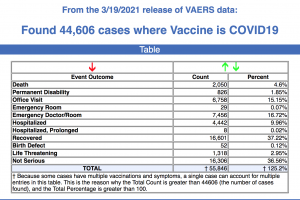
VAERS is the primary mechanism for reporting adverse vaccine reactions in the U.S. Reports submitted to VAERS require further investigation before a causal relationship can be confirmed. Every Friday, the CDC makes public all VAERS vaccine injury reports received as of the previous week.
This week’s VAERS data included 2,306 reports of anaphylaxis. Fifty-five percent of anaphylaxis reports were attributed to the Pfizer-BioNTech vaccine, 45% to Moderna and 1% to the Johnson & Johnson (J&J) vaccine, which was rolled out in the U.S. on March 2.
As The Defender reported earlier this month, the J&J vaccine contains polysorbate 80, known to trigger allergic reactions. The Moderna and Pfizer vaccines contain polyethylene glycol (PEG), also known to trigger anaphylactic reactions.
The latest news report of an anaphylactic reaction to a COVID vaccine was of a 68-year-old Kansas woman who died a day after receiving the vaccine. According to EMS dispatch records, the woman had an allergic reaction at a vaccine clinic site around 4 p.m. on Tuesday, KMBC reported. She had difficulty breathing and speaking and was injected with an EpiPen.
Kansas Department of Health and Environment spokesperson Kristi Zears told The Wichita Eagle that Evans had an anaphylactic reaction during a waiting period after receiving the shot. She was transported to the hospital and pronounced dead a day later. It is not clear whether Evans had underlying health conditions and the Kansas health agency did not indicate which COVID vaccine was administered.
According to the CDC’s website, “the CDC follows up on any report of death to request additional information and learn more about what occurred and to determine whether the death was a result of the vaccine or unrelated.”
To date, the only information the CDC has published related to the investigation of COVID vaccine-related deaths and how those investigations were conducted is a COVID-19 Vaccine Safety Update via the Advisory Committee on Immunization Practices (ACIP), published on Jan. 27.
On March 8, The Defender contacted the CDC with questions about reported deaths and injuries related to COVID vaccines. We provided a written list of questions about how the CDC conducts investigations into reported deaths, the status of investigations on deaths reported in the media, if autopsies are being done and the standard for determining whether an injury is causally connected to a vaccine.
We also inquired about whether healthcare providers are reporting all injuries and deaths that might be connected to the COVID vaccine, and what education initiatives are in place to encourage and facilitate proper and accurate reporting.
As of today, 18 days later, the CDC has not responded or followed up with our calls or emails. We have contacted them numerous times and are either told “they received the email,” “they will escalate it and it is in the system” or their press officers are still reviewing it. After our most recent follow up call this Wednesday and giving them an updated deadline of 48 hours, we still have not heard back.
A look at the numbers
Overall, the data released today reflects trends that have been emerging since The Defender first began tracking VAERS reports related to COVID vaccines.
This week’s VAERS data show:
- As of March 19, 321 pregnant women had reported adverse events related to COVID vaccines, including 97 reports of miscarriage or premature birth. None of the COVID vaccines approved for Emergency Use Authorization has been confirmed safe or effective for pregnant women, although J&J said earlier this month it would begin testing on pregnant women, infants and the immunocompromised.
- 535 cases of Bell’s Palsy. Of those, 64% of cases were reported after Pfizer-BioNTech vaccinations — almost twice as many as reported (36%) following vaccination with the Moderna vaccine. Three cases of Bell’s Palsy were reported with J&J’s vaccine (about 1%).
Physicians sound alarm about need for pre-screening
Meanwhile, concerns about mass vaccination continued to make national and international headlines this week.
As The Defender reported Tuesday, Dr. Hooman Noorchashm, cardiothoracic surgeon and patient safety advocate, said we’re taking the COVID pandemic problem — where a half-percent of the population is susceptible to dying — and compounding it by vaccinating people who are already infected. In an interview with Fox News host and political commentator, Tucker Carlson, Noorchasm said public health officials are making a “dramatic error” by promoting a “one-size-fits-all” COVID vaccination program:
“… the signal is deafening, the people who are having complications or adverse events are the people who have recently or are currently or previously infected [with COVID]. I don’t think we can ignore this.”
Noorchashm believes that a #ScreenB4Vaccine campaign could save millions from vaccine injuries. He is promoting a screening campaign that consists of “PCR or Rapid Antigen test to determine if there is an active infection and an IgG antibody test that would allow determination of a past infection. If either of these tests are positive, vaccination ought to be delayed for a minimum of 3 – 6 months,” Noorchasm told The Defender. “If at that time IgG levels are waning, it is reasonable to consider getting a vaccine shot. But even then, blood IgG levels should guide whether or not a person gets vaccinated.”
Noorchasm sent a third communication to the U.S. Food and Drug Administration this week, warning that deaths like that of 32-year-old Benjamin G. Goodman, who died after receiving the Johnson & Johnson vaccine, could have been prevented, and that there will be more deaths unless people are screened before being vaccinated.
An article in The Hill this week, by several physicians, also suggested that people be prescreened for COVID before being vaccinated.
The physicians wrote:
“A closer look at the level of protection obtained by a single shot vaccine regimen for those who are ‘COVID-primed’ is needed. Rigorous, effective and efficient antibody prescreening tools to identify these individuals would be required as well.”
AstraZeneca under fire in U.S. and Europe
As far as individual vaccines, AstraZeneca garnered the most headlines this week, in Europe and the U.S.
On March 22, The Defender reported that two independent research teams in Norway and Germany identified antibodies that provoke immune reactions leading to the type of blood clots experienced by some people who received AstraZeneca’s COVID vaccine.
Although many countries resumed their vaccination program with AstraZeneca’s vaccine after the EMA’s preliminary findings, some countries, including France, Denmark, Norway, Sweden and Finland, did not lift their restrictions on its use.
According to Reuters, Finland announced Wednesday it was still looking into two cases of blood clots but would resume using the AstraZeneca vaccine against COVID for people aged 65 and over. Finland plans to complete its investigation by April 6 at the earliest.
On March 23, U.S. health officials accused AstraZeneca of misrepresenting efficacy data when it included “outdated information” in its clinical trial results, which may have led to the vaccine maker providing the public with an incomplete view of its efficacy data, The Defender reported.
The statement by the National Institute of Allergy and Infectious Diseases came less than a day after the pharmaceutical company said its vaccine was 79% effective against COVID and 100% effective against severe or critical disease and hospitalization.
AstraZeneca released updated information on its COVID-19 clinical trial Wednesday which showed an efficacy rate of 76% against symptomatic COVID infection instead of the 79% figure released Monday. The estimated efficacy in people over 65 rose slightly, from 80% to 85%. The vaccine maker identified no safety concerns related to the vaccine.
On March 24, the Ukrainian government urged the public not to jump to conclusions after a servicewoman died two days after getting the AstraZeneca COVID vaccine, reported Fox News. Although the woman reportedly had chronic cardiovascular disease and other comorbidities, she experienced no side effects from the vaccine before she suddenly lost consciousness.
According to Reuters, nine other people were given the vaccine from the same batch on the same day and had no ill effects.
Children’s Health Defense asks anyone who has experienced an adverse reaction, to any vaccine, to file a report following these three steps.
The post 68-Year-Old Dies After Anaphylactic Reaction to COVID Vaccine as CDC Continues to Ignore Inquiry Into Increasing Number of Deaths appeared first on Children’s Health Defense.
Former CDC Director: COVID-19 Escaped From Wuhan Virology Lab
Former Centers for Disease Control and Prevention (CDC) Director Robert Redfield said he believes the CCP virus, the novel coronavirus that causes COVID-19, originated from a Chinese laboratory. “It’s not unusual for respiratory pathogens that are being worked on in a laboratory to infect a laboratory worker,” Redfield said in an interview with CNN on […]
The post Former CDC Director: COVID-19 Escaped From Wuhan Virology Lab appeared first on NTD.
Japan rejects China’s offer to provide COVID vaccines for athletes in upcoming Olympic games
Japan will not allow their athletes to take the Chinese offered vaccine, but the International Olympic Committee has accepted the offer from China.
China’s deception over COVID-19’s origins gets more outrageous every day
The former leader of the State Department’s task force investigating the origins of COVID-19 not only believes the virus escaped from the Wuhan Institute of Virology, but also that it was the result of bioweapons research. “The Wuhan Institute of Virology is not the National Institute of Health,” says David Asher. “It was operating a…
Pope, citing pandemic effect, cuts pay for cardinals, others
VATICAN CITY — Trying to save jobs as the pandemic pummels Vatican revenues, Pope Francis has ordered pay cuts for cardinals and other clerics, including priests and nuns, who work at the Holy See.
In a decree published online Wednesday by the Vatican’s official newspaper L’Osservatore Romano, Francis said that starting in April cardinals’ salaries will be reduced 10%. Superiors of the Holy See’s various departments, who, with few exceptions, are clerics, will be hit by 8% cuts while lower-ranking priests and nuns will see 3% vanish from their paychecks.
In the decree he signed on Tuesday, the pope noted that the Holy See’s finances have been marked by several years of deficit. Worsening those financial woes, the pope wrote, was the COVID-19 pandemic, “which has impacted negatively on all the sources of revenue of the Holy See and Vatican City State.”
The belt-tightening “has the aim of saving current job positions,” Francis wrote.
Lower-ranking lay-workers at the Vatican aren’t affected by the salary reductions, but their pay raises, due every two years, are being temporarily frozen under the austerity measures. The lowest-paid lay workers will still get raise, though.
Bans on tourism by many countries and other pandemic restrictions have severely reduced revenues at the Vatican Museums, which, with its Sistine Chapel, is a perennial money-maker for the Vatican,
The Museums opened for some weeks during the pandemic when the situation in Italy improved. But with tourists from the United States and some other countries banned from entering Italy, the museums’ cavernous rooms were eerily uncrowded in the pandemic.
The Museums are currently closed and will stay closed at least through the upcoming Holy Week, which normally is one of Rome’s heaviest periods for tourism.
Earlier this month, the Vatican said it has nearly used up its financial reserves from past donations to cover budget deficits over recent years. It has predicted a 50-million-euro ($60 million) deficit for this year.
Pandemic safety measures have seen many churches shuttered or limiting the number of faithful — many of whom leave monetary donations during services — who can enter.
The Vatican’s economy minister has said that the dwindled Museums revenue, as well as a drop in what Catholics donate, would contribute to a projected 30% reduction in revenue this year.
The pay cuts also apply to several Vatican basilicas in Rome as well as to the Vicariate, or diocese of Rome, which is under the pope’s direction.
Cardinals, other clerics and well as nuns in Rome generally don’t have expenses most lay people have, like market-value rents or mortgages, utility and heating bills, since many reside in housing owned by the Vatican or religious orders.
Some cardinals have spacious, well-appointed apartments in historic palazzi in Rome. A cardinal on the Vatican staff could earn close to 5,000 euros (($6,000) monthly, according to those familiar with Holy See hierarchy.
In any case, Francis noted, the salary reductions won’t apply to anyone who can document that the cuts will make it “impossible to meet fixed expenses related to their health conditions or those of their relatives.”
Commentary: The Nature of Chinese Communist Party’s Contempt for Us
by Victor Davis Hanson
Last week in Anchorage, Alaska, Chinese diplomats dressed down Biden Administration Secretary of State Antony Blinken and National Security Advisor Jake Sullivan. Both seem stunned by the Chinese broadsides.
Apparently, as elite Americans readily confess to inherent white supremacy and racism—highlighting the complaints of BLM and Antifa—the Chinese are happy to agree that such admittedly toxic Americans should not dare to criticize China’s racist policies.
Not since newly elected President John Kennedy was humiliated at the Cold War Vienna summit in June 1961 by USSR strongman Nikita Khrushchev have American diplomats been so roughly manhandled by a Communist government.
China’s defiant provocations are not just verbal. Nor are they aimed only at our high officials.
New York University students, at an overseas satellite Shanghai China campus, were manhandled and jailed by Chinese authorities. Not long ago U.S. diplomats in China were subject to Chinese COVID-19 anal swab testing—supposedly “in error.”
These examples of continued humiliation and harassment could be multiplied. Yet they are simply the current public face of China’s insidious and systematic theft of U.S. patents and copyrights. It brazenly violates trade agreements, as well as manipulates its currency, dumps products below cost on world markets, cyber-assaults, expropriates Western technology, and stonewalls accurate information on the origins of COVID-19.
If China gives out money, it logically believes it owns the recipient. New York University in the last five years has received some $47 million in Communist Chinese-affiliated gifts. So Beijing apparently believes that it now “owns” NYU, and can send any message it likes to its clients.
Stanford University recently was cited by the U.S. Department of Education for failing to report over $64 million from Chinese sources since 2010. No surprise that China, in a demonstration of their contempt, recently sent a visiting researcher to Stanford, who turned out to be connected with the Chinese military.
Hollywood claims that it is woke. But recently it was disclosed that some directors had selected their actors on the basis of skin color. They were obeying China’s requirements for American films to enter the lucrative Chinese film market, slated to become the world’s largest in 2021.
The NBA—both players and coaches—loudly condemns their supposedly racist American homeland. Yet they self-censor any criticism of massive human rights violations by the Chinese communists—given a $5 billion NBA Chinese market.
Lots of countries in Africa, Asia, Latin America, and Europe have signed up with the Chinese “Belt and Road” initiative to develop ports, harbors, rail, and freeways. They are now rereading the contractual fine print. Chinese multibillion dollar investments do not come without strings. The price of borrowing from China is tough terms of repayment and political subservience.
China is also the world’s greatest and most effective propagandist. Its intelligence services and disinformation efforts make the Cold War effort of the communist Soviet Union seem amateurish in comparison. China’s third of a million students who attend American universities and annual 3 million tourists to the United States soak up and master American popular culture.
As dutiful communist subjects, many are attuned to the self-loathing apparent in American universities, corporations, entertainment, and the media. In reaction, some seek to master and manipulate that sentiment in various ways and to China’s benefit.
China may have destroyed the culture of Tibet, destroyed democracy in Hong Kong, put Muslim minorities in detention camps, and systematically discriminated against African visitors, but the victimizer nonetheless plays the “victim” of American “racism.”
At best, its failed containment of the COVID-19 pandemic was criminally negligent. At worst, it was a hostile act. Yet each time China hears prominent Americans damn the United States as racist, Chinese racists chime in “Amen!”
China welcomes U.S. self-loathing that it interprets as weakness and decadence to be exploited—not as self-reflection to be admired, much less emulated.
In Chinese zero-sum thinking, if elite Americans themselves admit to systemic racism, sexism, and nativism, then they have already done most of the work for Chinese propagandists. China merely recycles such domestic charges to prove that a pathological America has no right to allege others to be racists—as it bullies neighbors with boasts that a dissolute and divided United States is in decline and cannot be counted as a reliable ally.
China is in a race to achieve global hegemony. For a while longer, it seeks sympathetic world opinion—at least until it has achieved unquestioned superior military and economic power.
So for now, China feigns victimhood. And it seeks solidarity with others inside the United States and abroad who claim to be fellow victims of American racism.
Such naked artifice and hypocrisy may seem crazy, given China’s atrocious human rights record. But China views our own exploding budget deficits, staggering national debt, open borders, disingenuous “1619 Project,” the violence of the summer riots, and the epidemic of race-based reeducation workshops as all far crazier—and most welcome supplements to their efforts.
– – –
Victor Davis Hanson is a distinguished fellow of the Center for American Greatness and the Martin and Illie Anderson Senior Fellow at Stanford University’s Hoover Institution. He is an American military historian, columnist, a former classics professor, and scholar of ancient warfare. He has been a visiting professor at Hillsdale College since 2004. Hanson was awarded the National Humanities Medal in 2007 by President George W. Bush. Hanson is also a farmer (growing raisin grapes on a family farm in Selma, California) and a critic of social trends related to farming and agrarianism. He is the author most recently of The Second World Wars: How the First Global Conflict Was Fought and Won and The Case for Trump.
Photo “Xi Jinping” by Narendra Modi. CC BY 2.0.
The post Commentary: The Nature of Chinese Communist Party’s Contempt for Us appeared first on The Georgia Star News.
Sinopharm Chairman Claims He Received COVID-19 Vaccine One Year Ago, Has Antibodies
Yu Qingming, party chief and chairman of Sinopharm, told Chinese state media on March 4 that he and others at the firm’s management received CCP (Chinese Communist Party) virus vaccines a year ago and still have a high level of antibodies. His claim ignited a heated discussion over the origins of the virus strains and the timeline of China’s vaccine development. Sinopharm is also known as China National Pharmaceutical Group Corporation, a Beijing-based Chinese state-owned enterprise. Yu, who is also a deputy to China’s National People’s Congress, told the People’s Daily during the Two Sessions—the CCP’s most important annual political conference from March 4 to 11—that in March 2020, Sinopharm management received COVID-19 vaccines and still have high levels of antibodies after one year of continuous monitoring. COVID-19 is the disease the CCP virus causes. He also touted his pharmaceutical group as the world’s largest manufacturer of COVID-19 vaccines so …
Happiness Report: World shows resilience in face of COVID19

The editors of the 2021 World Happiness Report found that while emotions changed as the pandemic set in, longer-term satisfaction with life was less affected.
STOCKHOLM — The coronavirus brought a year of fear and anxiety, loneliness and lockdown, and illness and death, but an annual report on happiness around the world released Friday suggests the pandemic has not crushed people’s spirits.
The editors of the 2021 World Happiness Report found that while emotions changed as the pandemic set in, longer-term satisfaction with life was less affected.
“What we have found is that when people take the long view, they’ve shown a lot of resilience in this past year,” Columbia University economist Jeffrey Sachs, one of the report’s co-author, said from New York.
The annual report, produced by the U.N Sustainable Development Solutions Network, ranks 149 countries based on gross domestic product per person, healthy life expectancy and the opinions of residents. Surveys ask respondents to indicate on a 1-10 scale how much social support they feel they have if something goes wrong, their freedom to make their own life choices, their sense of how corrupt their society is and how generous they are.
Due to the pandemic, the surveys were done in slightly fewer than 100 countries for this year’s World Happiness Report, the ninth one compiled since the project started. Index rankings for the other nations were based on estimates from past data.
The results from both methods had European countries occupying nine of the top 10 spots on the list of the word’s happiest places, with New Zealand rounding out the group. The top 10 countries are Finland, Denmark, Switzerland, Iceland, the Netherlands, Norway, Sweden, Luxembourg, New Zealand and Austria.
It was the fourth consecutive year that Finland came out on top. The United States, which was at No. 13 five years ago, slipped from 18th to 19th place. On a shortened list ranking only those countries surveyed, the U.S. placed 14th.
“We find year after year that life satisfaction is reported to be happiest in the social democracies of northern Europe,” Sachs said. “People feel secure in those countries, so trust is high. The government is seen to be credible and honest, and trust in each other is high.”
Finland’s comparative success in curbing COVID-19 may have contributed to the enduring trust the country’s people have in their government. The country took rapid and extensive measures to stop the spread of the virus and has one of Europe’s lowest COVID-19 mortality rates.
“In Finland as well, of course, people have been suffering,” Anu Partanen, author of “The Nordic Theory of Everything” said on Friday in Helsinki. “But again in Finland and the Nordic countries, people are really lucky because society still supports a system buffering these sorts of shocks.”
Overall, the index showed little change in happiness levels compared to last year’s report, which was based on information from before the pandemic.
“We asked two kinds of questions. One is about the life in general, life evaluation, we call it. How is your life going? The other is about mood, emotions, stress, anxiety,” Sachs said. “Of course, we’re still in the middle of a deep crisis. But the responses about long-term life evaluation did not change decisively, though the disruption in our lives was so profound.”
Issues that affect the well-being of people living in the United States include racial tensions and growing income inequality between the richest and poorest residents, happiness experts say.
“As for why the U.S. ranks much lower than other similarly or even less wealthy countries, the answer is straightforward,” said Carol Graham, an expert at The Brookings Institution who was not involved in the report. “The U.S. has larger gaps in happiness rankings between the rich and the poor than do most other wealthy countries.”
Report co-author Sonja Lyubormirsky, a professor of psychology at the University of California, Riverside, noted that American culture prizes signs of wealth such as big houses and multiple cars more so than other countries, “and material things don’t make us as happy.”
Conversely, people’s perception that their country was handling the pandemic well contributed to an overall rise in well-being, Columbia’s Sachs said. Several Asian countries fared better than they had in last year’s rankings; China moved to 84th place from 94th last year.
“This has been a difficult period. People are looking past it when they look for the long term. But there are also many people that are suffering in the short run,” he said.
Finnish philosopher Esa Saarinen, who was not involved in the report, thinks the Finnish character itself might help explain why the country keeps leading the index.
“I think Finns are pretty kind of content on some level at being just what we are,” he said. “We don’t really have to be more.”
____
Seth Borenstein in Washington D.C. contributed to this report.
Judicial Watch Sues for NIH Funding and Other Records Tied to China’s Wuhan Institute of Virology
(Washington, DC) – Judicial Watch announced today that it filed a Freedom of Information Act (FOIA) lawsuit against the U.S. Department of Health and Human Services (HHS) for National Institutes of Health (NIH) records of communications, contracts and agreements with the Wuhan Institute of Virology in China (Judicial Watch, Inc. v. U.S. Department of Health and Human Services (No. 1:21-cv-00696)). The lawsuit specifically seeks records about NIH grants that benefitted the Wuhan Institute of Virology.
The lawsuit was filed against Health and Human Services after the NIH denied an April 22, 2020, FOIA request, for:
- All internal NIAID communications regarding the Wuhan Institute of Virology in Wuhan, China;
- All agreements, contracts and related documents between NIAID and the Wuhan Institute of Virology; and
- All records, including agreements, funds disbursement records and related NIAID communications regarding a reported $3.7 million in grants provided by NIH to the Wuhan Institute of Virology.
In April 2020, the Daily Mail reported that documents “show the Wuhan Institute of Virology undertook coronavirus experiments on mammals captured more than 1,000 miles away in Yunnan – funded by a $3.7 million grant from the US government.”
The NIH in April 2020 suspended funding a grant to the non-profit EcoHealth Alliance that “had previously established a partnership with a virology laboratory in Wuhan, China” but in August gave the EcoHealth Alliance a grant of $7.5 million. The grant will reportedly “focus on Southeast Asia and the emergence of coronaviruses; filoviruses, the family responsible for Ebola; and paramyxoviruses, a family of viruses that includes measles and mumps.”
“For almost a year now, Dr. Fauci’s agency has stonewalled Judicial Watch’s lawful request for information about the agency’s connections to the controversial Wuhan lab,” said Judicial Watch President Tom Fitton. “The American people have a right to know about Dr. Fauci’s National Institute of Allergy and Infectious Diseases’ involvement with the infamous Wuhan Institute of Virology.”
In March 2021, Judicial Watch uncovered HHS/NIH records that show NIH officials tailored confidentiality forms to China’s terms and that the World Health Organization conducted an unreleased, “strictly confidential” COVID-19 epidemiological analysis in January 2020. Additionally, the records reveal an independent journalist in China pointing out the inconsistent COVID numbers in China to NIH’s National Institute of Allergy and Infectious Diseases’ Deputy Director for Clinical Research and Special Projects Cliff Lane.
In October 2020, Judicial Watch received records from the HHS that show Dr. Anthony Fauci, Director of the National Institute of Allergy and Infectious Diseases, approved a press release supportive of China’s response to the 2019 novel coronavirus.
###
The post Judicial Watch Sues for NIH Funding and Other Records Tied to China’s Wuhan Institute of Virology appeared first on Judicial Watch.
1 report, 4 theories: Scientists mull clues on origin of COVID-19
GENEVA — A team of international and Chinese scientists is poised to report on its joint search for the origins of the coronavirus that sparked a pandemic after it was first detected in China over a year ago — with four theories being considered and one the clear frontrunner, according to experts. The lengthy report…
China’s COVID-19 Timeline Questioned After Official Claims to Be Vaccinated in March 2020
The timeline of the COVID-19 outbreak published by the Chinese Communist Party (CCP) has been questioned by experts after an official claimed on March 5 that many executives in his company took an experimental CCP virus vaccine in March 2020. Yu Qingming, party secretary and CEO of Sinopharm Group Co., Ltd. (Sinopharm) claimed that executives and senior leaders of China National Pharmaceutical Group (CNPG), the parent company of Sinopharm, had received the vaccines developed by the group as early as March 2020. Sinopharm is a Chinese state-owned pharmaceutical company. Yu also claimed that the antibody level remains high after one year. His statement is completely incompatible with the CCP’s previous propaganda about the source of the virus and the development of vaccines. According to the CCP’s official statements, the CCP virus was first discovered in December 2019 and the Wuhan epidemic broke out in early January 2020. The Chinese CDC first isolated …
Before COVID Outbreak, Gates Planned Social Media Censorship of Vaccine Safety Advocates With Pharma, CDC, Media, China and CIA
Over the last two weeks, Facebook and other social media sites have deplatformed me and many other critics of regulatory corruption and authoritarian public health policies. So, here is some fodder for those of you who have the eerie sense that the government/industry pandemic response feels like it was planned — even before there was a pandemic.
The attached document shows that a cabal of powerful individuals did indeed begin planning the mass eviction of vaccine skeptics from social media in October 2019, a week or two before COVID began circulating. That month, Microsoft founder Bill Gates organized an exercise of four “table-top” simulations of a worldwide coronavirus pandemic with other high-ranking “Deep State” panjandrums. The exercise was referred to as Event 201.
Gates’ co-conspirators included representatives from the World Bank, the World Economic Forum (Great Reset), Bloomberg/Johns Hopkins University Populations Center, the Centers for Disease Control and Prevention, various media powerhouses, the Chinese government, a former Central Intelligence Agency/National Security Agency director (there is no such thing as a former CIA officer), vaccine maker Johnson & Johnson, the finance and biosecurity industries and Edelman, the world’s leading corporate PR firm.
At Gates’ direction, these eminences role-played members of a Pandemic Control Council, wargaming government strategies for controlling the pandemic, the narrative and the population. Needless to say, there was little talk of building immune systems, off-the-shelf remedies or off-patent therapeutic drugs and vitamins, but lots of chatter about promoting uptake of new patentable antiviral drugs and vaccines.
But the participants primarily focused on planning industry-centric, fear-mongering, police-state strategies for managing an imaginary global coronavirus contagion culminating in mass censorship of social media.
Oddly, Gates now claims that the simulation didn’t occur. On April 12, 2020, Gates told BBC, “Now here we are. We didn’t simulate this, we didn’t practice, so both the health policies and economic policies, we find ourselves in uncharted territory.”
Unfortunately for that whopper, the videos of the event are still available across the internet. They show that Gates and team did indeed simulate health and economic policies. It’s hard to swallow that Gates has forgotten.
Gates’s Event 201 simulated COVID epidemic caused 65 million deaths at the 18-month endpoint and global economic collapse lasting up to a decade. Compared to the Gates simulation, therefore, the actual COVID-19 crisis is a bit of a dud, having imposed a mere 2.5 million deaths “attributed to COVID” over the past 13 months. . . .
Segment four of the script — on manipulation and control of public opinion — is most revealing. It uncannily predicted democracy’s current crisis:
- The participants discussed mechanisms for controlling “disinformation” and “misinformation,” by “flooding” the media with propaganda (“good information”), imposing penalties for spreading falsehoods and discrediting the anti-vaccination movement.
- Jane Halton, of Australia’s ANZ Bank, one of the authors of Australia’s oppressive “no jab, no pay” policy, assured the participants that Gates Foundation is creating algorithms “to sift through information on these social media platforms” to protect the public from dangerous thoughts and information.
- George Gao, the prescient director of the Chinese Center for Disease Control, worries about how to suppress “rumors” that the virus is laboratory generated: “People believe, ‘This is a manmade’… [and that] some pharmaceutical company made the virus.”
- Chen Huang, an Apple research scientist, Google scholar and the world’s leading expert on tracking and tracing and facial recognition technology, role-plays the newscaster reporting on government countermeasures. He blames riots on anti-vaccine activists and predicts that Twitter and Facebook will cooperate in “identify[ing] and delete[ing] a disturbing number of accounts dedicated to spreading misinformation about the outbreak” and to implement “internet shutdowns … to quell panic.”
- Dr. Tara Kirk Sell, a senior scholar at Bloomberg School of Health’s Johns Hopkins Center for Health Security, worries that pharmaceutical companies are being accused of introducing the virus so they can make money on drugs and vaccines: “[We] have seen public faith in their products plummet.” She notes with alarm that “Unrest, due to false rumors and divisive messaging, is rising and is exacerbating spread of the disease as levels of trust fall and people stop cooperating with response efforts. This is a massive problem, one that threatens governments and trusted institutions.”
The post Before COVID Outbreak, Gates Planned Social Media Censorship of Vaccine Safety Advocates With Pharma, CDC, Media, China and CIA appeared first on Children’s Health Defense.
WHO Delays Report On COVID’s Origins As China ‘Fights Tooth & Nail Over Each Sentence,’ WHO Advisor Says
WHO investigators ‘won’t be able to publish findings without official Chinese concurrence’.
- China has delayed the release of a World Health Organization report on the origins of the coronavirus pandemic as it reviews the document, according to a WHO advisor.
- The Chinese are fighting “tooth & nail over each sentence,” a WHO advisory committee member said.
- Several groups have called for a separate, more independent investigation of COVID’s origins.
China Bans UK MPs Over Uyghur Sanctions
Beijing has imposed sanctions on nine UK citizens, including five Members of Parliament. It comes in retaliation to the UK announcing sanctions for alleged human rights abuses against Uyghur Muslims.
The post China Bans UK MPs Over Uyghur Sanctions appeared first on NTD
Did the coronavirus leak from a lab? These scientists say we shouldn’t rule it out.
Nikolai Petrovsky was scrolling through social media after a day on the ski slopes when reports describing a mysterious cluster of pneumonia cases in Wuhan, China caught his eye. It was early January 2020, and Petrovsky, an immunologist, was at his vacation getaway in Keystone, Colorado, which is where he goes most years with his family to flee the searingly hot summers at home in South Australia. He was soon struck by an odd discrepancy in how the pneumonia cases were portrayed. Chinese authorities and the World Health Organization were saying there was nothing to worry about, but locals in the area, he says, were posting about “bodies being stretchered out of houses in Wuhan and police bolting apartment doors shut.”
Petrovksy is a professor at Flinders University, near Adelaide, and he is also founder and chairman of a company called Vaxine that develops immunizations for infectious diseases, among other projects. Since 2005, he’s received tens of millions of dollars in funding from the U.S. National Institutes of Health to support the development of vaccines and compounds called adjuvants that boost their effects. After Chinese scientists posted a draft genome of the novel coronavirus SARS-CoV-2, the disease culprit in Wuhan, Petrovksy — who by this time had put skiing on the backburner to work from his Colorado home office — directed his colleagues down under to run computer modeling studies of the viral sequence, a first step towards designing a vaccine.
This generated a startling result: The spike proteins studding SARS-CoV-2 bound more tightly to their human cell receptor, a protein called ACE2, than target receptors on any other species evaluated. In other words, SARS-CoV-2 was surprisingly well adapted to its human prey, which is unusual for a newly emerging pathogen. “Holy shit, that’s really weird,’” Petrovsky recalls thinking.
Biden Under Investigation For Breaking The Law Through Executive Orders
Like Donald Trump, Joe Biden has made a border wall promise he might not have the legal authority to keep.
On his first day in office, Biden hit pause on billions of dollars set to be spent on his predecessor’s long-touted barrier between the U.S. and Mexico while his administration figured out next steps for the money. Now the Government Accountability Office is launching a review to determine whether the new president broke the law by freezing the money in violation of budget rules designed to keep Congress in control of the cash flow, the federal watchdog confirmed this week. . .
Most Americans Are Thinking, “Of Course” | “Biden For President 2020” flag flies in Tijuana camp as migrants wait to cross US-Mexico border

A “Biden for President 2020” flag was seen flying in a tent encampment in Tijuana, Mexico, where hundreds of migrants are gathering until they can be processed and potentially released in the United States.
“It is every bit Biden’s migrant camp. They are flying the Biden flag. They are wearing the Biden T-shirts. There’s 500 to 1,000 individuals staying here that believe wholeheartedly that President Joe Biden wants them here and will help them get across,” Fox News’s Griff Jenkins said Monday during a visit to the encampment. […]
Continue reading Biden flag flies in Tijuana camp as migrants wait to cross US-Mexico border …
The article, Biden flag flies in Tijuana camp as migrants wait to cross US-Mexico border, was first published on BizPac Review.
Sex offenders and MS-13 members caught after illegally crossing the southern border
The following article, Sex offenders and MS-13 members caught after illegally crossing the southern border, was first published on BizPac Review.

Kaylee Greenlee, DCNF Illegal immigrants suspected of crimes ranging from rape and murder to gang affiliation have been arrested in the Rio Grande Valley sector of Texas, […]
Continue reading Sex offenders and MS-13 members caught after illegally crossing the southern border …
Biden, Not Trump, Driving Border Crisis
Commentary Secretary of Homeland Security Alejandro Mayorkas summed up our border crisis in a statement he released March 16: “We are on pace to encounter more individuals on the southwest border than we have in the last 20 years.” According to The Wall Street Journal, Border Patrol agents made about 75,000 arrests of migrants crossing illegally in January. And, the Journal reports, “the government is seeing more children arriving each day than ever before, with an average of 523 children taken into custody by Border Patrol agents each day over the last three weeks …” The basic factors driving those from the Northern Triangle of Central America—Honduras, Guatemala, and El Salvador—to want to come to the USA is no mystery. Per capita income in the United States, per the World Bank, is $65,298. In Honduras, it’s $2,575. It’s $4,620 in Guatemala and $4,187 in El Salvador. The already-horrendous economic conditions …
Former CBP Commissioner: Biden admin’s border policies are ‘against the nation’s best interest’
“I believe it’s for perceived political gain,” Mark Morgan said.
Lovers Of Falsehoods Must Be Head Over Heels With Jack Dorsey, Big Tech & Big Business | Twitter admits error by censoring photos of detention center at US-Mexico border
Twitter has admitted it made a mistake in censoring photos of migrants sleeping on the floor at a government detention center in Texas, according to a report. James O’Keefe, the founder of Project Veritas, posted a video on Twitter Monday showing pictures of the crowded facility but the photos were hidden behind a filter claiming…
Hundreds of migrant children detained at border have tested positive for COVID-19: report
Hundreds of migrant kids who have been detained at the U.S.-Mexico border have tested positive for COVID-19, an official for the Department of Health and Human Services told Ax…