
Cynthia Phillips was mesmerized when she saw the latest pictures of her favorite moon. Here at last was a fresh look at Europa, an icy satellite of Jupiter. The moon resembles a truffle drizzled haphazardly with strips of melted white chocolate, as if the universe had rushed to finish a baking-show challenge. The images gave us a new sense of Europa’s topography, its collection of ridges and troughs appearing more intricate than ever. The lighting was different this time, Phillips told me, and the shadows brought out dramatic shapes in the terrain.
The images were taken by a Jupiter-observing spacecraft as it swept past Europa last week, coming within just 222 miles (358 kilometers) of the frozen surface. Phillips, a planetary geologist at NASA’s Jet Propulsion Laboratory, immediately reached for the Europa globe on her desk and began comparing the real-world views with the topography stretched over the plastic orb. The last probe to come this close to Europa was disposed of in 2003, when NASA deliberately plunged it into Jupiter’s atmosphere after the mission started running low on fuel. “We haven’t seen Europa’s surface in this level of detail for 20 years,” Phillips said.
Europa might be the best place to search for life elsewhere in the solar system. Scientists are almost certain that beneath the Jovian moon’s frozen surface is a salty ocean with more water than all of Earth’s oceans combined. And such a watery subsurface environment could provide a comfortable home for small Europan life forms.
[Read: Jupiter’s frozen moon is studded with 50-foot blades of ice]
Two years from now, another NASA spacecraft will depart for the Jupiter system, specifically designed to study Europa. The probe will swing past the moon dozens of times, sometimes coasting just 16 miles (25 kilometers) above the surface. Each pass will bring scientists closer to understanding the workings of this celestial truffle and its mysterious interior. Beneath that frosty coating could be the answer to one of our biggest questions: Is there life anywhere else in the universe?
Europa is enveloped in a thick coat of water ice. (Some other moons in our solar system have ice made of methane and nitrogen—the cosmos is a weird place.) The criss-crossing lines visible in the new pictures are actually cracks and fissures in that frozen exterior. Scientists suspect that they’re caused by the stretching and squashing that Europa experiences as it orbits giant Jupiter. The moon’s terrain is sprinkled with chemical compounds such as sodium chloride and magnesium sulfate—more commonly known to Earthlings as table salt and Epsom salt—and they could indicate briny waters below.
A close-up view of Europa’s textured surface (NASA / JPL-Caltech / SWRI / MSSS
Scientists got their best evidence that a Europan ocean might exist two decades ago, when that earlier NASA spacecraft detected a magnetic connection between Europa and Jupiter that could easily be explained by the presence of a salty, global sea. This deep into the solar system, Europa’s underground ocean wouldn’t feel the warmth of the sun; it would stay liquid because of Jupiter’s gravitational tugging. In recent years, telescopes have detected signs of plumes of water vapor spewing out of the cracks and into space. Scientists believe that Europa’s ocean could be as old as the moon itself, about 4 billion years or so, which would give life plenty of time and a stable environment in which to evolve, Phillips said.
[Read: Europa’s mysterious glow]
The data suggest that Europa has a rocky mantle—the layer between the moon’s crust and core—and when rock and water come together, magical things can happen: Chemical interactions between them are known to produce hydrogen-rich materials for tiny creatures to metabolize. “On our own planet, hydrothermal systems at the seafloor provide energy for communities of microorganisms,” Samantha Trumbo, a planetary scientist at Cornell who studies icy ocean worlds like Europa, told me.
The upcoming NASA mission, named Clipper—a nod to the speedy, lightweight vessels favored by 19th-century merchants—will study nearly every bit of the Europan surface. If it gets lucky, the spacecraft could fly through some plume particles, take a sip, and analyze the contents. Alyssa Rhoden, a planetary geophysicist at the Southwest Research Institute who studies Europa, is most excited about a Clipper instrument designed to detect warmer-than-usual spots on the moon’s surface. “When you look at Europa’s surface, you can see a lot of pits where the surface seems to have dropped down a little bit, places where the surface has been disrupted,” Rhoden told me. “We think that that’s happening from heating coming from below.” That signature could simply indicate the presence of melted bits of ice near the frigid crust—or it could mean a roiling sea has floated toward the surface, perhaps bringing any tiny inhabitants with it.
[Read: Exploring the oceans of the outer solar system]
The Clipper mission is not meant to find definitive proof that life exists on Europa, only explore whether the moon has the right conditions and chemistry to make life possible. Evidence of life will require more missions, guided by Clipper’s data, that could land on the Europan surface and drill into the ice. NASA is also searching for life elsewhere in the solar system, notably on Mars, where a rover is collecting samples from a dried-up river delta. But Europa is a more tantalizing target, and so are the other ocean moons sprinkled across the solar system, such as Enceladus and Titan, which orbit Saturn, and Triton, around Neptune. The Mars mission is designed to search for signs of fossilized life that existed several billion years ago, when water once flowed on the planet. “It’s quite possible that Mars could have had life in the past, in a warmer-weather era, and it’s possible that there are subsurface pockets on Mars that could have remnants of this living biosphere,” Phillips said. “But on somewhere like Europa, life could exist there now.”
And what might humanity, by way of carefully engineered machines, find on Europa, once we’ve figured out which melty bits to inspect? “I would love for there to be Europan whales swimming around in that ocean,” Phillips said with a laugh. But alien life, if it exists, is likely to be small and simple. Energy sources are limited in the Europan depths, and scientists don’t think the environment can support the development of more complex organisms, Phillips said. Still, even the discovery of a single microbe would mark an explosive event in human history. It would mean that life had managed to spring up in two different places around the same star—in a universe absolutely brimming with stars. If it happened more than once here, in our own solar system, it’s likely happened elsewhere in the cosmos, around someone else’s sun. This is why scientists are so eager to catch a glimpse of Europa, and prepare as much as they can for the exploration to come. “We all want it to be water,” Rhoden said. “We all want it to be a cool plumbing system in the shell with lots of activity, and someday we’ll get down there and find little Europan sea urchins clinging to the bottom of the ice.”
Skip The Scoop | Seek Understanding
White House officials, Congress members to tour US border facility
White House officials along with members of Congress are traveling to the southern border Wednesday to visit a facility being used to house migrant children amid the current surge at the US-Mexico border. They are touring a facility in Carrizo Springs, Texas, as the Biden administration grapples with the massive influx of migrants at the…
Arizona Governor Says Kamala Harris Is ‘The Worst Possible Choice’ To Oversee Border Security
‘Flat-out just doesn’t care’.
Republican Arizona Gov. Doug Ducey said Wednesday that Vice President Kamala Harris is “the worst possible choice” to oversee security at the border.
“She’s about the worst possible choice that one could make,” Ducey said during a speech at the University of Arizona. “In no point in her career has she given any indication that she considers the border a problem or a serious threat.” . .
Biden taps VP Harris to lead response to border challenges
WASHINGTON — President Joe Biden has tapped Vice President Kamala Harris to lead the White House effort to tackle the migration challenge at the U.S. southern border and work with Central American nations to address root causes of the problem.
Biden made the announcement as he and Harris met at the White House on Wednesday with Health and Human Services Secretary Xavier Becerra, Homeland Security Secretary Alejandra Mayorkas and other immigration advisers to discuss the increase in migrants, including many unaccompanied minors, arriving at the border in recent weeks.
In delegating the matter to Harris, Biden is seeking to replicate a dynamic that played out when he served as President Barack Obama’s vice president. Obama turned to Biden in his first term to lead the White House effort to draw down U.S. troops in Iraq and oversee implementation of stimulus in response to the Great Recession.
“When she speaks, she speaks for me,” Biden said, noting her past work as California’s attorney general makes her specially equipped to lead the administration’s response.
Biden, who has faced stiff criticism from Republicans over the increased flow of migrants, is hoping to show Americans he’s taking the situation at the border seriously. He also wants to prevent the growing humanitarian and political challenge from overshadowing his administration’s ambitious legislative agenda.
But the high-profile assignment for Harris, who ran for the Democratic presidential nomination in 2020 and is expected to run for the White House again in the future, could be politically fraught.
“Needless to say, the work will not be easy,” Harris said. “But it is important work.”
Harris is tasked with overseeing diplomatic efforts to deal with issues spurring migration in the Northern Triangle countries of El Salvador, Guatemala and Honduras, as well as pressing them to strengthen enforcement on their own borders, administration officials said. She’s also tasked with developing and implementing a long-term strategy that gets at the root causes of migration from those countries.
Biden suggested President Donald Trump’s decision to cut $450 million funding in 2019 to the region was partly to blame for the situation.
Among the other reasons for the current increase: the thousands of Central American migrants already stuck at the border for months and the persistent scourge of gang violence afflicting the Northern Triangle countries.
Still, the numbers of both unaccompanied minors and families encountered at the border are lower than they were at various points during the Trump administration, including in spring 2019.
For Harris, the assignment gives her the first big opportunity to step to the front of the stage on a matter of enormous consequence for the administration. As the first Black woman elected vice president, Harris arrived on the job as a trailblazer. It has remained opaque how Biden would utilize her.
The move echoes not only Obama’s decision to deputize Biden but also Trump naming Vice President Mike Pence to lead his coronavirus task force and President Bill Clinton handing Vice President Al Gore environmental and technology portfolios early in his presidency.
It’s been a mixed bag for vice presidents in recent history who have been made the point person on delicate matters, said Joel Goldstein, the author of “The White House Vice Presidency: The Path to Significance, Mondale to Biden.”
Pence’s efforts on the coronavirus were stymied by Trump’s hijacking of the task force’s daily briefings early in the pandemic. Dick Cheney, who had been charged with leading George W. Bush’s search for a vice president only to take the spot himself, carved out what was seen by many critics as a shadow presidency in which he had an outsized influence on shaping Bush’s national security policies.
And Gore faced headwinds from Republicans in Congress who were reluctant to give him a win ahead of his unsuccessful 2000 run for the White House.
“Some of the risk versus reward depends to some extent on the vice president’s relationship with the president,” Goldstein said. “Whether or not the president had their back. Whether the president’s going to allow you to be in a position to accomplish things and be perceived to accomplish things.”
Biden made the announcement as a delegation of White House officials and members of Congress was traveled to the southern border on Wednesday to tour a facility in Carrizo Springs, Texas, where more than 750 migrant teenagers are being held.
The Biden administration has in recent weeks moved to open more than 10,000 new beds across the Southwest in convention centers and former oilfield camps. It notified Congress on Wednesday that it will open a new 3,000-person facility in San Antonio and a 1,400-person site at the San Diego convention center. HHS is also opening a second site in Carrizo Springs and received approval from the Defense Department Wednesday to begin housing teenagers at military bases in San Antonio and El Paso, Texas.
While acknowledging a “big problem” with the rising numbers of migrants, Rep. Norma Torres, D-Calif., one of five lawmakers to tour the facility Wednesday, credited the Biden administration with treating young migrants far more humanely than the Trump administration.
In an interview after the tour, Torres described children accommodated four to a room, and said she saw no signs of overcrowding. The young people attend school, have access to health care and are given weekly COVID-19 tests. Lawmakers were told 1 in 10 children are testing positive for the virus, but none at the facility had been hospitalized, she said.
“When I look at those kids, I see myself,” said Torres, an immigrant from Guatemala who arrived in the U.S. with her family as a child.
The White House faced criticism for limiting media access to Wednesday’s tour, keeping it to just one TV crew. It has still not allowed media to enter Border Patrol facilities where large numbers of children are detained or HHS sites that it rapidly opened under pressure. The Carrizo Springs facility was established in 2019 during the Trump administration and re-opened in February.
Republican Sen. Ted Cruz of Texas, who is leading a separate delegation of GOP senators to the border later this week, decried the lack of press access as a “muzzling” of the media by the Democratic administration.
“Joe Biden doesn’t want you to see,” Cruz told reporters at the Capitol.
Merchant reported from Houston and Lemire from New York. Associated Press writer Josh Boak in Washington contributed to this report.
Border Patrol holds migrant families for days under a south Texas bridge
Hundreds of migrant families, including babies and pregnant women, were detained under the Anzalduas International Bridge, sleeping in the dirt, without much food or medical care, people who were released said.
Border Agent Gives Inside Account of Overcrowded Facilities
The family-unit holding cells smell like urine and vomit. Fights break out in the unaccompanied-minor cells. Scabies, lice, the flu, and COVID-19 run rampant. Up to 80 individuals are squeezed into each 24- by 30-foot cell, and there aren’t enough mattresses for everyone. Sheets of plastic divide the rooms. “Any diseases that are in there, […]
The post Border Agent Gives Inside Account of Overcrowded Facilities appeared first on NTD.
Rep. Darrell Issa: Border crisis is being contrived, CBP and ICE told to ‘stand down’
The border crisis continues to get worse in California as even the San Diego Convention Center is being used to house illegal immigrants.
Biden Team Ignored Warnings from Career Immigration Officials That Their Actions Could Cause a Border Crisis
by Kaylee Greenlee
The Biden administration ignored career immigration officials’ warnings of an impending surge in the number of migrants arriving at the southern border, The Washington Post reported.
The administration has repeatedly refused to refer to the situation as a crisis, despite a seeming inability to curb the increasing flow of migrants, the Post reported. The administration’s mixed messaging, which often appeals to liberal activists, has hampered efforts to halt the influx of migrants at the southern border, according to the Post.
 Senior Customs and Border Protection (CBP) officials briefed the Biden transition team during the transition period on the potential risks of lifting former President Donald Trump’s policies and said it could lead to a surge in unaccompanied migrant minors, one current and two former Department of Homeland Security (DHS) officials told the Post.
The president’s transition team understood the potential risks and acknowledged multiple issues that could emerge as a result of repealing Trump-era policies, DHS officials told the Post.
Chad Wolf, former acting DHS secretary, said he talked to the Biden transition team about potential risks related to migrants and confirmed that career CBP officials warned of a looming crisis, the Post reported. However, Biden repealed several of Trump’s policies including border wall construction and paused deportations for 100 days within his first week of taking office.
A federal judge blocked President Joe Biden’s moratorium on deportations in January, according to the Associated Press.
“It’s one thing to hear it from political appointees, but career folks were telling them the same thing. They should have been better prepared,” Wolf said, the Post reported. “And I know they were briefed in detail by CBP.”
CBP encountered over 100,000 migrants at the southern border in February alone, including more than 9,000 unaccompanied minors, according to the agency. The Biden administration decided to allow unaccompanied minors to enter the country and remain in custody until they are matched with a sponsor in the U.S., according to the Post.
The Department of Health and Human Services currently has over 10,000 unaccompanied minors in its custody, according to the Post. An additional 5,000 unaccompanied minors are estimated to be in CBP facilities.
“When you create a system that incentivizes people to come across, and they are released, that immediately sends a message to Central America that if you come across you can stay,” Democratic Texas Rep. Vicente Gonzalez told the Post.
“It incentivizes droves of people to come, and the only way to slow it down is by changing policy at our doorstep. If they don’t change the policy, the flow of continued migration traffic isn’t going to stop or slow down,” Gonzalez added.
The Biden administration has continued expelling single migrant adults and some family units to Mexico under Trump’s Title 42 public health order. However, the Mexican government said in January it would stop accepting some families, forcing the U.S. to admit parents with children under 7 years old, according to the Post.
– – –
Kaylee Greenlee is a reporter at Daily Caller News Foundation.
The post Biden Team Ignored Warnings from Career Immigration Officials That Their Actions Could Cause a Border Crisis appeared first on The Georgia Star News.
Cruz, 17 Senators to Visit Donna Overflow Facility on Friday Amid Surge in Illegal Immigration
Sen. Ted Cruz (R-Texas) said that he and a delegation of 17 Republican senators will visit the temporary migrant overflow facility in Donna, Texas, as part of their upcoming tour of the U.S. southern border on Friday. Cruz had previously announced that he would lead the delegation of lawmakers to visit the U.S.-Mexico border amid an influx of illegal border crossing, particularly by unaccompanied minors. The overflow facility in Donna made headlines this week after photos of children at the facility sleeping in crowded conditions, either on floor mats or on the floor, were released to the media. “Tomorrow night, 18 senators are going to be traveling down to the Southern border, traveling down to Texas, to see first-hand the crisis that is unfolding, to see firsthand the over 100,000 illegal immigrants who were detained last month, to see the over 15,000 children that are in [the] custody of the Biden …
Journalists Start Demanding Substack Censor its Writers: to Bar Critiques of Journalists

On Wednesday, I wrote about how corporate journalists, realizing that the public’s increasing contempt for what they do is causing people to turn away in droves, are desperately inventing new tactics to maintain their stranglehold over the dissemination of information and generate captive audiences. That is why journalists have bizarrely transformed from their traditional role as leading free expression defenders into the the most vocal censorship advocates, using their platforms to demand that tech monopolies ban and silence others.
That same motive of self-preservation is driving them to equate any criticisms of their work with “harassment,” “abuse” and “violence” — so that it is not just culturally stigmatized but a banning offense, perhaps even literally criminal, to critique their journalism on the ground that any criticism of them places them “in danger.” Under this rubric they want to construct, they can malign anyone they want, ruin people’s reputations, and unite to generate hatred against their chosen targets, but nobody can even criticize them.
Any independent platform or venue that empowers other journalists or just ordinary citizens to do reporting or provide commentary outside of their repressive constraints is viewed by them as threats to be censored and destroyed. Every platform that enables any questioning of their pieties or any irreverent critiques of mainstream journalism — social media sites, YouTube, Patreon, Joe Rogan’s Spotify program — has already been systematically targeted by corporate journalists with censorship demands, often successfully.
Back in November, the media critic Stephen Miller warned: “It’s only a matter of time before the media tech hall monitors turn their attention to Substack.” And ever since, in every interview I have given about the success of Substack and every time I have written about journalist-led censorship campaigns, I have echoed that warning that they would soon turn their united guns on this platform. Miller’s prediction was prompted by a Columbia Journalism Review article entitled “The Substackerati” which claimed that Substack was structurally unfair because “most” of “the most successful people on Substack” are “white and male; several are conservative” and “have already been well-served by existing media power structures.”
All of that was false. The most-read and highest-earning writer on Substack is Heather Cox Richardson, a previously obscure Boston College History Professor who built her own massive readership without ever working at a corporate media outlet. And the writers that article identified in support of its claim — Matt Taibbi, Andrew Sullivan, Matt Yglesias and myself — do not remotely owe our large readerships to “existing media power structures.” The opposite is true, as The Washington Post’s Megan McCardle explained:
[These Substack writers] got so big by starting blogs that they could sell to traditional publications. They are not monetizing an audience they acquired through larger institutions, but reclaiming one they created themselves…. [O]bviously, one major characteristic of the successful one (wo)man show is the ability to swim against a crowd. Given that, it seems almost obvious that Substack would select people who are not in tune with the dominant views of the establishment media. And that the biggest audience numbers will come from folks who are not in tune with the establishment media….
That is precisely why they are so furious.
Facebook Looks To Compete In Market Dominated By Homeless Reporters
‘Many people in the journalism world saw how quickly their business fortunes can change’.
Biggest Casualty of COVID? Personal Freedoms.
Story at-a-glance:
- While the casualties of government-imposed COVID-19 countermeasures are manifold, the biggest and most tragic of them all is the loss of individual freedoms.
- We either choose freedom, or we choose to live under authoritarian rule. Even if restrictions are lifted, public attitude can place freedom on shaky ground, as public acceptance of overreach will allow for the same to occur again and again at a moment’s notice.
- The freedom to interact with other human beings is a crucial, most basic human need.
- The inevitabilities of life — which include uncertainty, moment-to-moment risk and the surety of death — demand that we not require people to cease living in order to “save” others from the ramifications of ill health.
- The answer, if we really want to protect the masses, is to educate and promote healthy living at all stages of life. Improving your health through a healthy lifestyle, sunshine, fresh air and real food, is the best way to protect the most people.
While the casualties of government-imposed COVID-19 countermeasures are manifold, the biggest and most tragic of them all is the loss of individual freedoms. As noted by Jonathan Sumption in his February 15, 2021, Telegraph commentary:
“What makes us a free society is that, although the state has vast powers, there are conventional limits on what it can do with them. The limits are conventional because they do not depend on our laws but on our attitudes.
“There are islands of human life which are our own, a personal space into which the state should not intrude without some altogether exceptional justification.
“Liberal democracy breaks down when frightened majorities demand mass coercion of their fellow citizens, and call for our personal spaces to be invaded. These demands are invariably based on what people conceive to be the public good. They all assert that despotism is in the public interest.”
A fragile freedom
As Sumption points out, “We cannot switch in and out of totalitarianism at will.” We either choose freedom, or we choose to live under authoritarian rule. Even if (and that’s a big if, at this point) restrictions are lifted, public attitude can place freedom on shaky ground, as public acceptance of overreach will allow for the same to occur again and again at a moment’s notice.
This is a serious problem, as there will always be other epidemics and pandemics. There is always the threat of terrorism and climate change. There will always be a public health calamity, be it obesity or diabetes, that can be used as justification for government intrusion into our private lives.
“A threshold has now been crossed,” Sumption writes. “A big taboo has gone. Other governments will say that the only question that matters is whether it works and whether they can ‘get away with it’ … We already have a striking example. The vaccine, which was supposed to make the lockdown unnecessary, has become a reason for keeping it in force …
“Infections, hospitalizations and deaths are plunging, but millions who are at virtually no risk are being kept in house imprisonment. This is being done mainly because a selective regime of controls would be too difficult for the state to enforce. Coercion quickly becomes an object in itself.”
Personal liberty is worth fighting for
Personal liberty, as Sumption points out, is critically important, and perhaps most important of all, for our mental and physical health, is the freedom to interact with other human beings. It is an absolutely crucial and most basic of human needs. Infants robbed of physical interaction fail to thrive and are at increased risk of death.
But children, adolescents, adults and the elderly have no lesser need for it. We may tolerate it for longer without marked ill effect, but over time, it takes its toll on health, emotional stability and longevity. The fact that we’re allowing government to ban human interaction is a dire sign of a society at the brink of self-destruction.
“I do not doubt that there are extreme situations in which oppressive controls over our daily lives may be necessary and justified,” Sumption writes.
An epidemic of Ebola, with a death rate of 50%, for example, might qualify. However, COVID-19 is nowhere near that serious a threat. As noted by Sumption, COVID-19 “is well within the range of perils which we have always had to live with, and always will.”
Data show the overall noninstitutionalized infection fatality ratio is 0.26%. People under the age of 40 have a mere 0.01% risk of dying from the infection. The vast majority that test positive for SARS-CoV-2 have no symptoms at all, and most do not get seriously ill.
We must relearn to accept the inevitabilities of life
What’s more, the average age of death from COVID-19 is somewhere between 76.9, according to one study, and 82, according to U.K. government data cited by Sumption.
Either way, this is right around the average age of death from any cause anyway, and therefore not an outrageous threat to public health. Yet, the public willingly relinquishes the freedom to live a normal life, somehow oddly convinced that by trading in their freedom, people at the end of their life will be spared the pain of death. They won’t. None of us will.
The inevitabilities of life — which include uncertainty, moment-to-moment risk and the surety of death — demand that we not require people to cease living in order to “save” others from the ramifications of ill health, regardless of their age. It’s as inhumane as it is illogical.
Rather, the answer, if we really want to protect the masses, is to educate and promote healthy living at all stages of life. Improving your health through a healthy lifestyle, sunshine, fresh air and real food, is the best way to protect the most people. Quarantining and shunning human interaction are probably the worst things you can do for yourself and society at large.
And let’s not go down the road of all the psychological devastation caused by teaching children to fear their own hands, other people, the air they breathe, and that their very presence poses a lethal threat to others.
The press has become an instrument of control
Historically, the press has been viewed as a crucial instrument for a well-informed public, and thus supportive of a free and democratically-run society. Indeed, this is why journalists and news outlets were known as “the Fourth Estate.” It was an acknowledgement of their societal influence. To be effective, the press had to develop a certain amount of public trust. Today, trust in mainstream media has dramatically eroded, and for good reason.
Time and again, reporters and entire news outlets have been caught peddling fake news, and when the press misleads rather than informs the public of the facts, they become tools for tyranny. Their viewers become more ignorant by the day rather than more informed, and thus more easily controlled and manipulated.
In a recent substack article, independent journalist Matt Taibbi addresses the attempt by UCLA professor and co-leader of the UCLA Center for Critical Internet Inquiry, Sarah Roberts, to shame readers away from substack. “Substack is a dangerous direct threat to traditional news media,” Roberts tweeted.
According to her half-baked reasoning, journalists who leave mainstream newsrooms for substack and other independent portals are taking unfair advantage of the trust they earned while gainfully employed within the Fourth Estate. Then, once on their own, they can print whatever they want without having to go through the onerous chore of fact checking and other standard checks and balances.
“To imply that trust is a thing that can only be conferred by a mainstream newsroom is beyond insulting, especially since mainstream news organizations already long ago started to become infamous for betraying exactly those hallowed ‘norms’ to which Roberts refers,” Taibbi writes.
“Why did a source like former NSA contractor Edward Snowden choose to come forward to Glenn Greenwald in particular? He surely wasn’t bothered by the fact that Glenn didn’t come up through the ranks of a paper like the New York Times or Washington Post.
“The answer connects to one of the primary reasons audiences are moving to places like Substack: the perception that traditional news outlets have become tools of the very corporate and political interests they’re supposed to be overseeing.
“Roberts complains about lines between opinion and reporting being blurred at Substack (an absurd comment on its own, but that’s a separate issue), but the ‘blurring’ problem at those other organizations is far more severe. Are newspapers like the New York Times checks on power, or agents of it?”
A century of controlled media
As detailed in “Reuters and BBC Caught Taking Money for Propaganda Campaign,” infiltration and manipulation of the media has been a routine occurrence since 1915, when J.P. Morgan interests, including the steel and shipbuilding industries, purchased editorial control of 25 of the most influential newspapers, thereby allowing them to control news about military preparedness, financial policies and other stories deemed crucial to their private and corporate interests.
Then, in 1948, the CIA launched Operation Mockingbird, a clandestine media infiltration campaign that allowed the agency to control and inject its own propaganda into the mainstream press. Today, several decades later, it’s clear that Operation Mockingbird never ceased. As noted by Taibbi:
“The major ‘traditional’ cable networks, as well as many of the bigger daily newspapers, have for years now been engaged in mad hiring sprees of ex-spooks, putting whole nests of known perjurers and Langley goons on their payrolls as contributors, where they regularly provide ‘commentary’ on news stories in which they themselves have involvement.”
The modern propaganda machine also includes Big Tech, which allows for previously unthinkable information control through automated censorship across a much broader spectrum of sources.
Literally overnight, an individual or company involved in the dissemination of truthful information that goes against the status quo can have their website shadow banned by search engines, their social media accounts eliminated, their web hosting and email services canceled and their online payment systems shut down. From one day to the next, you, your thoughts, opinions and all your hard work can be effectively erased.
Political power brokers call for massive censoring
We’re now even seeing politicians starting to throw their weight around, demanding censoring of political opponents and news outlets that fail to properly toe the political line.
U.S. House Democrats from California — Anna Eshoo and Jerry McNerney — went so far as to send a letter to a dozen cable, satellite and streaming TV companies, basically telling them to censor or remove Fox News, Newsmax and OANN. As noted by Glenn Greenwald in an article on the rapid escalation of government calls for censorship:
“Democrats’ justification for silencing their adversaries online and in media — ‘They are spreading fake news and inciting extremism’ — is what despots everywhere say … Since when is it the role of the U.S. Government to arbitrate and enforce precepts of ‘journalistic integrity?’
“Unless you believe in the right of the government to regulate and control what the press says — a power which the First Amendment explicitly prohibits — how can anyone be comfortable with members of Congress arrogating unto themselves the power to dictate what media outlets are permitted to report and control how they discuss and analyze the news of the day?”
FCC Commissioner Brendan Carr has strongly denounced the Democrats’ actions, calling it a “marked departure from First Amendment norms,” adding that the demands are “a chilling transgression of the free speech rights that every media outlet in this country enjoys … No government official has any business inquiring about the ‘moral principles’ that guide a private entity’s decision about what news to carry.”
To what aim control?
It’s important to realize that authoritarian dictators are not, in fact, trying to help you. They’re trying to change you. Censorship does not protect the public. It’s a control mechanism, as you are unlikely to rebel against an injustice that you don’t even know exists, or if you know about it, your understanding of the problem is diametrically opposed to the truth; hence, you’ll support a “solution” that will perpetuate or deepen the problem.
At an even deeper level, censorship and information suppression is an effort to alter your cognitive faculties, because how do you even define people and things that you are not allowed to criticize? As noted by Taibbi, Big Tech and media are tools for politicians, corporations and the intelligence industry, the interests of which are frequently diametrically opposed to that of the people.
Chemical companies cannot sell their toxic wares if an informed public shuns them. The fake food industry cannot flourish if the public understands the basics of health. Technocracy cannot be implemented if an informed public opposes the agenda, and so on.
What we see clearer than ever these days, is the schism in journalism where the old-school norms of gathering data and then delivering it to the audience and allowing them to make up their own minds as to whether it’s good or bad has been replaced by subjective interpretation of the data.
Essentially, most mainstream reporters now tell you how to think about a given topic. They even tell us how to think about people who refuse to think the way they’re instructed to think. That way, the public ends up doing the dirty work of censoring, canceling and dehumanizing the undesirables for them.
Rule through medicine
While the rise of dictatorships has historically involved the use of armed forces to subdue an unruly public, the budding dictatorship of today relies heavily on weaponized medicine and the control of information. If you’ve taken the time to familiarize yourself with the concept of technocracy, which has a distinct transhumanist component to it, you will see why this makes perfect sense and was, in fact, entirely predictable.
By tying the issue of health care into the digital surveillance apparatus, you end up with a very robust platform for automated mass control. The use of fear also works well in this scenario, since most are keen to stay alive and don’t want their loved ones to die. So, they fall for lies like “we have to shut down the world and sequester indoors for months on end or else we all die.”
A leading figure in this medical dictatorship scheme is Bill Gates, who now wields a dominating influence over not just Big Tech but also global health policy, agriculture and food policy (including biopiracy and fake food), weather modification and other climate technologies, surveillance, education and media. As reported by The GrayZone:
“Beyond the public relations bonanza about Gates lies a disturbing history that should raise concerns about whether his foundation’s plans for resolving the pandemic will benefit the global public as much as it expands and entrenches its power over international institutions.
“The Gates Foundation has already effectively privatized the international body charged with creating health policy, transforming it into a vehicle for corporate dominance. It has facilitated the dumping of toxic products onto the people of the Global South, and even used the world’s poor as guinea pigs for drug experiments.
“The Gates Foundation’s influence over public health policy is practically contingent on ensuring that safety regulations and other government functions are weak enough to be circumvented … Strong evidence suggests that the Gates Foundation functions as a Trojan horse for Western corporations, which of course have no goal greater than an increased bottom line.”
Indeed, as reviewed in “Bill Gates — Most Dangerous Philanthropist in Modern History?” Gates donates billions to private companies, and is invested in the very products and businesses he donates money to and otherwise promotes as solutions to the world’s problems, be they hunger, disease, pandemic viruses or climate change.
As suggested by The GrayZone, Gates’ global health empire is more about building an empire for himself and his technocrat cronies than promoting public health.
The Great Reset — a plan to capitalize on COVID-19 pandemic
For a time, there was so much uncertainty about SARS-CoV-2 and the infection it causes, you’re forgiven if you opted to err on the side of caution. Now, however, a full year later, it’s become obvious that this pandemic was never as serious as portrayed by the media, and that it is being used (whether preplanned or not) as a convenient vehicle for a radical overhaul of just about every aspect of life. And not for the better.
In a recent report, independent journalist Johnny Vedmore delved into the professional history and personal background Klaus Schwab, founder of the World Economic Forum, who wrote the books “The Fourth Industrial Revolution” (2016), “Shaping the Fourth Industrial Revolution” (2018) and “COVID-19: The Great Reset,” thereby cementing his role as a leading figurehead for the modern technocracy movement. Vedmore writes:
“As the driving force behind the World Economic Forum … Schwab has courted heads of state, leading business executives, and the elite of academic and scientific circles into the Davos fold for over 50 years.
“More recently, he has also courted the ire of many due to his more recent role as the frontman of the Great Reset, a sweeping effort to remake civilization globally for the express benefit of the elite of the World Economic Forum and their allies …
“Like many prominent frontmen for elite-sponsored agendas, the online record of Schwab has been well-sanitized, making it difficult to come across information on his early history as well as information on his family.
“Yet, having been born in Ravensburg, Germany in 1938, many have speculated in recent months that Schwab’s family may have had some tie to Axis war efforts, ties that, if exposed, could threaten the reputation of the World Economic Forum and bring unwanted scrutiny to its professed missions and motives …
“Digging even deeper into his activities, it becomes clear that Schwab’s real role has long been to ‘shape global, regional and industry agendas’ of the present in order to ensure the continuity of larger, much older agendas that came into disrepute after World War II, not just nuclear technology, but also eugenics-influenced population control policies …
“Is Klaus Schwab trying to create the Fourth Industrial Revolution, or is he trying to create the Fourth Reich?”
Is depopulation part of the agenda?
Gates’ family history is also heavy on eugenics, as is the Club of Rome’s agenda, another technocratic power center. The United Nation’s Agenda 21 also hints at the need for a dramatic reduction in population size in the coming decade.
The idea that eugenics might make a comeback may seem like a remote possibility, but considering the history of using vaccinations to secretly inhibit fertility in native populations, it would be naïve to dismiss the possibility out of hand. As reported in a 2014 paper written by researchers at the University of Louisiana and the University of British Columbia:
“Published research shows that by 1976 WHO researchers had conjugated tetanus toxoid (TT) with human chorionic gonadotropin (hCG) producing a ‘birth-control’ vaccine.
“Conjugating TT with hCG causes pregnancy hormones to be attacked by the immune system. Expected results are abortions in females already pregnant and/or infertility in recipients not yet impregnated. Repeated inoculations prolong infertility. Currently WHO researchers are working on more potent anti-fertility vaccines using recombinant DNA.
“WHO publications show a long-range purpose to reduce population growth in unstable ‘less developed countries.’ By November 1993 Catholic publications appeared saying an abortifacient vaccine was being used as a tetanus prophylactic.
“In November 2014, the Catholic Church asserted that such a program was underway in Kenya. Three independent Nairobi accredited biochemistry laboratories tested samples from vials of the WHO tetanus vaccine being used in March 2014 and found hCG where none should be present …
“Given that hCG was found in at least half the WHO vaccine samples known by the doctors involved in administering the vaccines to have been used in Kenya, our opinion is that the Kenya ‘anti-tetanus’ campaign was reasonably called into question by the Kenya Catholic Doctors Association as a front for population growth reduction.”
Certain vaccines have also been found to cause infertility as an unexpected side effect. For example, a 2018 study published in the Journal of Toxicology and Environmental Health found that women who received HPV vaccinations suffered higher rates of infertility.
According to this study, “if 100% of females in this study had received the HPV vaccine, data suggest the number of women having ever conceived would have fallen by 2 million.” After “skeptic” critics of scientific evidence that vaccines have significant health risks publicly attacked the study, the paper was withdrawn by the publisher.
What we lose is exponentially harder to get back
Safeguarding our Constitutional rights and civil liberties against unlawful government overreach is essential. Yet many are willingly giving up freedoms that, once gone, may be difficult, if not impossible, to get back. Vaccine passports are just one example.
By showing proof that you’ve received a COVID-19 vaccine, through a digital certificate or app on your phone, the hope is that you can once again board an airplane and travel freely, attend a concert or enjoy a meal in your favorite restaurant, just like you used to.
Except, being required to present your “papers” in order to live your life isn’t actually freedom at all — it’s a loss of personal liberty that you once had, one that disappeared right before your eyes and one that’s setting the stage for even more intrusive surveillance and privacy erosion.
While government has a duty to protect the health and welfare of its citizens, this duty must be balanced against the loss of individual rights and liberties. Right now we’re facing a battle of freedom versus tyranny. Long term lockdowns are clearly not in the public’s best interest. Rather, it’s tantamount to abuse.
Originally published by Mercola.
The post Biggest Casualty of COVID? Personal Freedoms. appeared first on Children’s Health Defense.
Glenn Greenwald criticizes ‘corporate journalists’ who seek to censor news they don’t like
Greenwald has shown his independence from the mainstream liberal orthodoxy, and he believes they want to silence him.
New cage facility for migrant children underway in Rio Grande Valley
A new holding center for unaccompanied kids and migrants is being built “as fast as they can” in the Rio Grande Valley as US Customs and Border Protection officials struggle to manage a flood of immigrants that’s left existing facilities well beyond capacity, The Post has learned.
Mexican Drug Cartels Use Children as Decoys to Smuggle Criminals Into US, Texas Sheriff Says
Mexican drug cartels are taking advantage of the Biden administration’s border policies to use children as decoys to smuggle their members into the United States, according to a sheriff from Texas. Hidalgo County Sheriff J.E. Guerra, who is on the front line of the ongoing surge in illegal crossings on the U.S.-Mexico border, told The New York Post that cartels are profiting more from trafficking humans than running drugs. Guerra described the cartels’ tactics to the NY Post, saying that they split up families seeking to illegally cross the border, and use the children as decoys so that criminal thugs, posing as their relatives, can come over with the children and get admitted into the United States. “Well, the cartels say, ‘You can cross with one child, we’re going to take two children. And we’re going to use those two children to smuggle two others and pretend that those are family units,'” …
Border Patrol Holding Thousands of Migrant Children Past The Legal Limit, Some Detained Longer Than 10 Days
Customs and Border Protection has held at least 800 unaccompanied migrant minors in custody for over 10 days, Axios reported
Customs and Border Protection (CBP) can legally hold unaccompanied minors for 72 hours, though over 3,300 were in custody over the limit as of Saturday, according to an internal Department of Homeland Security document obtained by Axios. Over 2,200 unaccompanied minors were held for more than five days and around 820 were in custody for over 10 days.
The number of unaccompanied minors in CBP custody for over 10 days has quadrupled in the last week, Axios reported. Only around 180 unaccompanied minors were in CBP custody for over 10 days as of last Monday.
Minors are required to be transferred from Border Patrol facilities within three days of arrival, however, the recent increase in encounters has overwhelmed processing capabilities.
NEW: Exclusive photos from inside a CBP temporary overflow facility taken over the weekend in Donna, Texas reveal the crowded, makeshift conditions at the border as the government’s longer term child shelters and family detention centers fill uphttps://t.co/uxdWO7cV7N
— Stef Kight (@StefWKight) March 22, 2021
CBP is legally required to hold unaccompanied minors until the Department of Health and Human Services is able to place them in a shelter.
The Biden administration’s immigration policy combined with natural disasters and other factors in Central America have contributed to an increase in migrants arriving at the southern border, Axios reported.
The Biden administration has reopened other temporary facilities including hotel rooms as temporary sites to hold unaccompanied migrant children and family units, Axios reported.
CBP did not respond to the Daily Caller News Foundation’s request for comment.
– – –
Kaylee Greenlee is a reporter at Daily Caller News Foundation.
The post Border Patrol Holding Thousands of Migrant Children Past The Legal Limit, Some Detained Longer Than 10 Days appeared first on The Georgia Star News.
New Border Photos Show Children Sleeping Shoulder-to-Shoulder in Transparent Pen
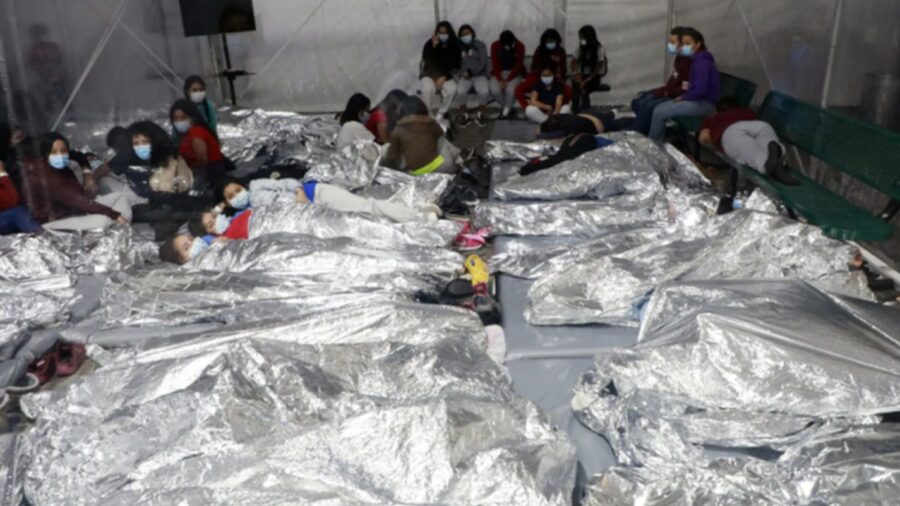
A temporary processing facility in Donna, Texas, as seen in a photo released by Customs and Border Protection, on March 23, 2021. (CBP)
Customs and Border Protection (CBP) officials released photos of crowded temporary facilities being used to process illegal immigrants who crossed the U.S.-Mexico border in the midst of a recent surge in migration.
The post New Border Photos Show Children Sleeping Shoulder-to-Shoulder in Transparent Pen appeared first on NTD.
“Shameful”: Amid Border Emergency, Immigrant Rights Advocates Urge Biden to Stop Detaining Children
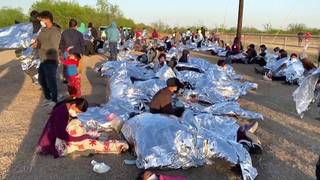
There are now over 15,000 unaccompanied migrant children in U.S. custody as the number of people seeking asylum at the southern border shows no sign of slowing down. The Biden administration has sharpened its rhetoric in recent weeks, insisting that the “border is closed” and pushing Mexico and Guatemala to stem the flow of migrants. The Biden administration has also maintained one of the most controversial Trump policies, which allows the U.S. to deny almost all asylum seekers on public health grounds. “What is happening at the southern border is shameful,” says Luz Lopez, a lawyer with the Southern Poverty Law Center focused on immigration. “We as a country should remain vigilant and hold any administration accountable, regardless of political party, with respect to our treatment of children seeking refuge, who are fleeing countries that are in turmoil, largely because of our geopolitical policies over the past several decades.”
Biden Administration to Use San Diego Convention Center as Immigration Shelter Amid Surge
The federal government is converting another convention center into a shelter for illegal immigrants amid a border surge that has shown no sign of slowing.
The post Biden Administration to Use San Diego Convention Center as Immigration Shelter Amid Surge appeared first on NTD.
3 Fully Vaccinated Hawaii Residents Test Positive for COVID-19
Three Hawaii residents who were fully vaccinated against the CCP virus have tested positive for COVID-19, the disease caused by the virus.
Senior Fox Business producer dies from coronavirus complications
“His excitement, positivity and energetic team spirit were one of a kind,” Fox executives said about employee Eric Spinato.
Project Veritas Obtains Photos of Biden’s Migrant Detention Centers

According to leftist media and their feckless followers on Twitter, Donald Trump put migrant children in cages. Never mind the policy was a carry over from President Obama. When a narrative is a foot, you’re not supposed to ask questions. Such was the hoopla, even AOC made a little hay with a dramatic photo op of crying in front of a “detention center.” The quotation marks there are not accidental. All this is relevant to the story Project Veritas has for us today. New alleged photos of migrant detention centers in Donna, Texas. Note who’s president and who’s not president for this one.
BREAKING: Project Veritas Obtains Never-Before-Seen Images Inside Texas Detention Facility
youtu.be
Biden’s detention centers don’t (ALLEGEDLY) seem all that different from a five letter word that rhymes with rages. I don’t know about you, but when I’m feeling a bit chilly, I don’t reach over and grab a sheet of aluminum foil. It just doesn’t have the feel of a faux fur throw or even low thread count duvet. Then again, I tend to sleep on places a little north of the floor. I guess that’s just my human privilege rearing its entitled head again.
Look it, migrants who came here illegally shouldn’t have the red carpet rolled before them. I’m not saying they should. But I didn’t burst the veins in my forehead for the past four years while feigning outrage about the conditions under which migrants were detained. I can’t say the same for some of our favorite Who’s Who idiots on the left. Who I can’t help but notice are as silent as the dead today. Seems problematic.
If keeping migrants, children or otherwise, detained in “cages” was wrong under Trump then it should also be wrong under Obama and the former Vice President Biden. Yet in Obama’s presidency 2.0, when we get images of migrants kept in cages wrapped like burritos from Chipotle we get nothing?
YouTube AGE-RESTRICTED Crowder?! War Against Big Tech Heats Up | Louder with Crowder
youtu.be
Need a quick laugh? Check out and subscribe to our CrowderBits YouTube channel for Louder with Crowder skits, opens, and parody videos!
Elections Aren’t The Only Thing The Power Structure Rigs | Monsanto & The World Wildlife Fund Sustainability Certificates
According to WDR research, the influential environmental organization WWF with its annual donations of around 500 million euros, around 4,000 employees and branches in more than 100 countries has become entangled in the interests of the industry – the report raises the question of whether the association’s work with the Slogan “For a living planet” (“For a living planet”) is compatible.
In the WDR documentary “Der Pakt mit dem Panda” (The Pact with the Panda), which the ARD broadcast last Wednesday at 11.30 pm, the multiple Grimme Prize winner Wilfried Huismann suggests that the gullibility of the donors is in some places properly strained for interests that barely preserve serve the planet.
Huismann documents that the WWF apparently helps dubious companies to obtain “sustainability certificates”. The association works at “round tables” with genetic engineering companies such as the agricultural giant Monsanto and the multinational Wilmar – and confirms to them that they produce soy and palm oil “sustainably”.
How It All Started To Crumble | Bayer Discovers “Black Ops” Division Run by Monsanto
For over a decade, Monsanto has been engaged in building and maintapining “hit lists” of journalists, lawmakers and regulators to be taken out if they opposed the evil agenda of GMOs and toxic glyphosate weed killer chemicals that now inundate the world food supply. Any influential person who opposed the Monsanto agenda was subjected to one or more of the following:
- Attempted bribery
- Death threats and intimidation
- Character assassination through well-funded “negative P.R.” campaigns
- Defamation via coordinated Wikipedia attacks, run by Monsanto operatives
- Career destruction, such as getting scientists blacklisted from science journals
- Being doxxed, having their home addresses publicized and their families and co-workers threatened
Revealed: Monsanto predicted crop system would damage US farms
The US agriculture giant Monsanto and the German chemical giant BASF were aware for years that their plan to introduce a new agricultural seed and chemical system would probably lead to damage on many US farms, internal documents seen by the Guardian show.
Risks were downplayed even while they planned how to profit off farmers who would buy Monsanto’s new seeds just to avoid damage, according to documents unearthed during a recent successful $265m lawsuit brought against both firms by a Missouri farmer.
The documents, some of which date back more than a decade, also reveal how Monsanto opposed some third-party product testing in order to curtail the generation of data that might have worried regulators.
And in some of the internal emails, employees appear to joke about sharing “voodoo science” and hoping to stay “out of jail”.
Bayer Won’t Ask U.S. Supreme Court to Reverse First Roundup Loss
Bayer AG won’t seek U.S. Supreme Court review of the first verdict finding its Roundup herbicide caused cancer.
Strawberries, Spinach, Kale Top EWG’s 2021 ‘Dirty Dozen’ List
Collard and mustard greens join kale among the most pesticide-contaminated fresh produce on the Environmental Working Group’s (EWG) 2021 Dirty Dozen list. For the first time, bell peppers and hot peppers have made the list.
The Dirty Dozen and the Clean Fifteen together make up EWG’s annual Shopper’s Guide to Pesticides in Produce, which analyzes Department of Agriculture test data to identify which fresh fruits and vegetables are most and least contaminated with pesticide residues.
“Whether organic or conventionally grown, fruits and vegetables are critical components of a healthy diet,” said EWG toxicologist Thomas Galligan, Ph.D. “We urge consumers who are concerned about their pesticide intake to consider, when possible, purchasing organically grown versions of the foods on EWG’s Dirty Dozen, or conventional produce from our Clean Fifteen.”
This year, the U.S. Department of Agriculture’s (USDA) tests found residues of potentially harmful chemical pesticides on nearly 70% of the non-organic fresh produce sold in the U.S. Before testing fruits and vegetables, the USDA washes, scrubs and peels them, as consumers would.
Leafy greens
Until this year, kale was alone in the number three spot on the Dirty Dozen. A total of 94 different pesticides were found on leafy greens, including neonicotinoids, or neonics. One sample of mustard greens had 20 different pesticides, and some kale and collard samples had as many as 17.
On all three types of greens, the pesticide most frequently detected by the USDA was DCPA, sold under the brand name Dacthal. The Environmental Protection Agency classifies DCPA as a possible human carcinogen, and the European Union banned it in 2009.
Neonics are the fastest-growing class of insecticides, despite a decade of research making it clear that they are highly toxic to honeybees and other pollinator species. Some studies on human health also suggest that exposure to neonics may be harmful to the developing fetus and to children.
Peppers
Bell peppers and hot peppers, tested for the first time since 2012 and 2011, respectively, are also included in this year’s list at number 10. The USDA found 115 pesticides on peppers — the most, by far, on any item.
Bell peppers and hot peppers contain concerning levels of acephate and chlorpyrifos, respectively – organophosphate insecticides that can harm children’s developing brains and are banned from use on some crops in the U.S. and from all uses in the EU. In 2017, the EPA, under the Trump administration, rejected a proposed chlorpyrifos ban, allowing it to remain on the market and subsequently in foods.
Citrus
Although no citrus fruits landed on the Dirty Dozen, this year’s Shopper’s Guide highlights the concerning levels of toxic pesticides found on these fruits, not only in USDA tests but also in independent laboratory tests commissioned by EWG.
Imazalil, a fungicide linked to cancer and hormone disruption, was detected on over 95% of tangerines tested by the USDA in 2019. In independent tests commissioned by EWG, nearly 90% of all the oranges, mandarins, grapefruit and lemons sampled contained either imazalil or thiabendazole, another endocrine-disrupting fungicide. More than half the samples had both. Almost all of the tests were conducted on conventionally grown fruit.
“The average concentration of imazalil in the citrus EWG had tested was an astonishing 20 times more than the limit we recommend to protect children from cancer,” said EWG toxicologist Alexis Temkin, Ph.D. “Yet this amount is perfectly legal. The EPA has abdicated its responsibility to adequately safeguard children from exposure to this pesticide.”
Legal does not mean safe
Most pesticide residues the USDA finds fall within government-mandated restrictions. But legal limits aren’t always safe.
The EPA’s safety levels, called tolerances, help agency regulators determine whether farmers are applying pesticides properly. If tolerance levels were set to protect all children eating produce, as EWG believes they should be, more fruits and vegetables would fail to meet them.
Pesticides are toxic by design. They are created expressly to kill living organisms — insects, plants and fungi that are considered pests. Many pesticides also pose health dangers to people, including hormone disruption, brain and nervous system toxicity, and cancer. These hazards have been confirmed by independent scientists and physicians, U.S. and international government agencies.
“EPA’s tolerances are often far higher than what many scientists believe is safe — particularly for pregnant women, babies and young children,” said EWG president Ken Cook. “EWG releases our Shopper’s Guide each year so consumers can make informed decisions that will let them reduce their family’s exposure to toxic pesticides while allowing them to eat plenty of healthy fruits and vegetables.”
Health benefits of reducing pesticide consumption
Organic standards prohibit the use of synthetic pesticides, among other things. Eating organic food reduces pesticide exposure and is linked to a variety of health benefits, according to an article published last year in the peer-reviewed journal Nutrients. In four separate clinical trials, people who switched from conventional to organic foods saw a rapid and dramatic reduction in their urinary pesticide concentrations, a marker of pesticide exposure.
Additional studies have linked higher consumption of organic foods to lower urinary pesticide levels, improved fertility and birth outcomes, reduced incidence of non-Hodgkin’s lymphoma, and lower BMI and reduced risk of Type 2 diabetes.
Babies and children are particularly vulnerable to many of the health effects associated with many pesticides, as the American Academy of Pediatrics recognized in a 2012 report on organic food.
“An all-organic diet is simply not affordable or accessible for many Americans,” said Dr. Philip Landrigan, a world-renowned pediatrician and epidemiologist. “EWG’s Shopper’s Guide provides useful, straightforward guidelines for choosing both organic and conventional produce to provide children with the healthy fruits and vegetables they need, but not the pesticide load they don’t.”
Landrigan is director of the Global Public Health Program and Global Observatory on Pollution and Health at the Schiller Institute for Integrated Science and Society at Boston College, a member of the National Academy of Medicine and one of the principal authors of the 1993 National Academy of Sciences study “Pesticides in the Diets of Infants and Children.” The study led to the enactment of the 1996 Food Quality Protection Act, which emphasized the importance of children’s health in the setting of safety standards for pesticides on foods.
How to use EWG’s shopper’s guide
The 2021 Shopper’s Guide to Pesticides in Produce ranks the pesticide contamination of 46 popular fruits and vegetables. It is based on results of USDA and Food and Drug Administration tests of more than 46,000 samples of produce.
Released every year since 2004, the Shopper’s Guide is designed to help consumers make the healthiest choices for their families, given budgetary and other constraints. EWG recommends that whenever possible, consumers purchase organic versions of produce on the Dirty Dozen list. When organic versions are unavailable or not affordable, EWG advises consumers to continue eating fresh produce, even if conventionally grown.
The USDA’s pesticide analyses are not comprehensive. The agency rotates which fruits and vegetables it tests each year, and it doesn’t test for all pesticides.
Originally published by Environmental Working Group.
The post Strawberries, Spinach, Kale Top EWG’s 2021 ‘Dirty Dozen’ List appeared first on Children’s Health Defense.
America’s Proxy Wars With Iran Ramp Up | Saudi Navy Starts Drills to Protect Oil Sites as Attacks Mount
Saudi Arabia started naval exercises in the Persian Gulf to improve its ability to foil “terrorist attacks” on oil facilities, underscoring the kingdom’s concern about a rise in drone and missile strikes claimed by Yemen’s Houthi rebels.
Upcoming Pentagon report will detail ‘difficult to explain’ UFO sightings
A forthcoming government report will detail a number of “difficult to explain” UFO sightings, former Director of National Intelligence John Ratcliffe said in a recent interview. Ratcliffe, the top intelligence official under former President Donald Trump, was asked about about incidents involving unidentified flying objects on Fox News Friday. “There are a lot more sightings…
Former Trump intel chief says some recorded UFO behaviors defy explanation
Some movements exceed current technology and were ‘traveling at speeds that exceed the sound barrier without a sonic boom,’ former DNI John Ratcliffe says.
US has secret evidence of UFOs breaking sound barrier without a sonic boom
The Pentagon and intelligence agencies were in December given a 180-day deadline to produce a report into UFO sightings, meaning it will be released by June 1.
Poll Shows Overwhelming Majority Support Voter ID Laws
by Eric Lendrum
The latest poll by Rasmussen Reports indicates that three-fourths of all Americans support stricter voter ID laws, such as requirements to present photo identification before voting, as reported by Breitbart.
The poll shows that 75 percent of likely American voters are in favor of laws that require presenting some form of photo ID, such as a driver’s license; only 21 percent opposed such a proposal. Among the 75 percent, 89 percent of Republican voters approved of such a suggestion, along with 77 percent of independents, and 60 percent of Democrats. In addition, an overwhelming majority of black voters support voter ID, at 69 percent to 25 percent.
Voter ID and other efforts to secure election integrity have come under fire in the months following the 2020 election, where there was widespread voter fraud and irregularities in multiple key swing states that most likely swung the election away from President Donald Trump and in favor of Joe Biden. In response, numerous Republican legislators across the country have introduced hundreds of bills to secure election integrity in some capacity, ranging from voter ID to restricting mail-in voting. Democrats have repeatedly and falsely claimed that such efforts are attempting to suppress minority voters.
Democrats in Congress are attempting to pass H.R. 1, a radical bill that would impose many of the election protocols that damaged a handful of key states at a nationwide level. The bill would legalize mail-in voting in all 50 states, and would also forbid states from implementing their own voter ID laws. It passed in the House of Representatives on a party-line vote, and now heads to the evenly-divided Senate. As many Democrats fear it will not pass the required threshold of 60 votes, some are calling for the abolition of the filibuster so that it can pass with a simple majority.
– – –
Eric Lendrum reports for American Greatness.
Photo “People Voting” by Wyofile Wyofile. CC BY 2.0.
The post Poll Shows Overwhelming Majority Support Voter ID Laws appeared first on The Georgia Star News.
Australian Politicians Push Resolution Condemning China’s Abuse of Uyghurs
Politicians from both sides of the Australian parliament have criticised China for “serious and systemic” breaches of human rights in Xinjiang. Liberal Kevin Andrews and Labor’s Chris Hayes are putting forward a resolution sharply critical of the Chinese regime’s treatment of Uyghur, or Uighur, people. The government has allowed debate on the bipartisan motion to condemn the Chinese government for its abuse of Uyghurs in Xinjiang. Andrews told the parliament on Monday, “There is overwhelming evidence of the cruel, inhumane, and brutal practises of the Chinese communist regime.” The United States, Canada, and The Netherlands have all officially recognised the situation in Xinjiang as a genocide, Andrews added. “This is a time when this parliament should speak with one voice. I cannot think of any member or senator who would vote against this motion,” he said of the resolution. Bahtiyar Bora from the Australian Uighur Association encouraged parliamentarians to show …
Suspect bashed Asian woman with pipe during NYC attack
A pipe-wielding man bashed an Asian woman in the face after yelling about her race in a suspected hate crime on the Lower East Side Sunday afternoon, police sources said. The victim, a 54-year-old woman, was walking near Grand and Ludlow streets when the maniac approached her with the weapon and yelled “f—king Asians!” at…
Asians Rarely, Though Increasingly Face Hate Crimes
Americans have been targeted for their Asian ancestry more often in recent years but the incidents remain rare. There were 158 anti-Asian hate crimes reported in 2019 by police agencies to the FBI, up from 148 the year before. The FBI won’t release its 2020 data until the fall but in 16 of the country’s […]
The post Asians Rarely, Though Increasingly Face Hate Crimes appeared first on NTD.
YouTube Removed Our Lockdown Anniversary Video, Here’s Our Response

On March 16, Louder with Crowder celebrated the one-year anniversary of “15 Days to Flatten the Curve.” It was a year since “experts” told us we needed to shut down for fifteen days. Steven and the gang felt the anniversary called for a party. Sadly, the entire episode has been removed from YouTube. “But why” you ask. Let’s skip down memory lane for that. Remember Dr. Erickson and Dr. Massihi? It’s okay, they’ve also been removed from YouTube. They were the two California doctors who spoke out against COVID restrictions all the way back in April of 2020. Since they also questioned the tactics surrounding COVID, while actually speaking about their actual experiences in the medical field, their video was labeled misinformation and YouTube removed any uploads of it. That now includes OUR show for showing a clip of the forbidden video. The Big Tech company claimed the Louder with Crowder episode “LOCKDOWN ANNIVERSARY! Reviewing ALL the Lies and the Liars Who Told Them!” violated its guidelines and was removed from the platform. Though the episode can be seen in its entirety if you’re a Mug Club subscriber.
YouTube claims our video broke its COVID-19 medical misinformation policy. This is going to be good, so grab a snack. Here’s the part relevant to this issue of our video’s banishment:
-
- Denial that COVID-19 exists
- Claims that people have not died or gotten sick from COVID-19
- Claims that the virus no longer exists or that the pandemic is over
- Claims that the symptoms, death rates, or contagiousness of COVID-19 are less severe or equally as severe as the common cold or seasonal flu
- Claims that the symptoms of COVID-19 are never severe
There is also an “Educational, documentary, scientific or artistic content (EDSA)” policy that states YouTube may allow “content that violates the misinformation policies noted on this page if that content includes context that gives equal or greater weight to countervailing views from local health authorities or to medical or scientific consensus. We may also make exceptions if the purpose of the content is to condemn or dispute misinformation that violates our policies. This context must appear in the images or audio of the video itself. Providing it in the title or description is insufficient.”
We added the bolded sentences for reasons which will become clear as we skip down the trail of insanity.
Let’s look at the offending clip in question, shall we? For those of you who are Mug Club members, we’re listing the time stamps so you can play along. Never say we don’t love our audience.
24:20 – We begin with Steven stating the WHO position that COVID’s death rate is 3.4% and exceeds that of the flu. This is what the screen capture looks like. We’d add video but… can’t.

24:24 – There is a clip showing a news broadcast reporting that the WHO considers the mortality rate of COVID to be 3.4%:

24:30 – There is a clip showing another news broadcast reporting that the WHO considers the mortality rate of COVID to be 3.4%:

24:39 – There is a clip showing a Bloomberg News report that the WHO considers the mortality rate of COVID to be 3.4% and “much more lethal” than the flu:
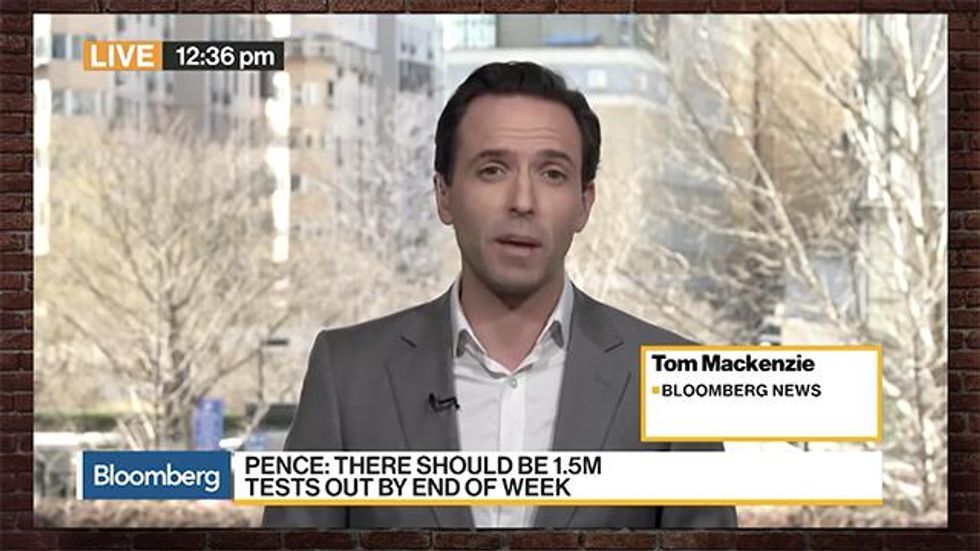
Are you sensing a pattern here? Good, but there’s more.
24:47 – There is a clip showing WHO Director General Dr. Ghebreyesus presenting at a WHO press conference stating that the mortality rate is 3.4% for COVID and alleging that the seasonal flu kills less than 1%:
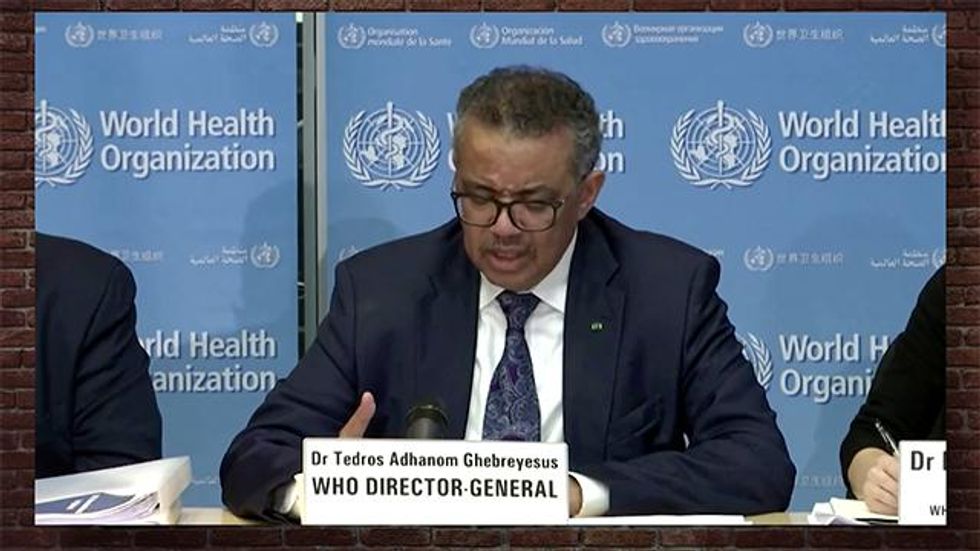
25:06 – There is a clip from Fox News, where the interviewing anchor states that the WHO has reported the COVID mortality rate as being 3.4%, then asking President Trump’s opinion on that, and the president disputes the figure:

That’s SIX “countervailing views.” Steven, the WHO, and four news agencies. It was only after that context was provided that the show went on to provide counter-evidence from COVID tracking data websites that use the CDC and Johns Hopkins as their data sources.
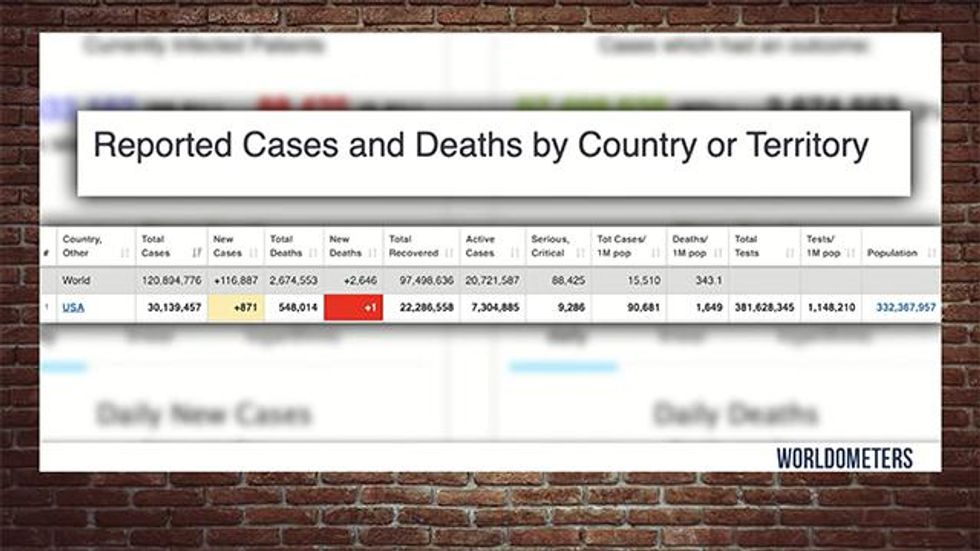
25:28 – We presented a Worldometers overlay showing a 1.8% COVID mortality rate, on screen for less than 3 seconds, which uses CDC and other governmental agency data regularly relied on by the New York Times and other news organizations.
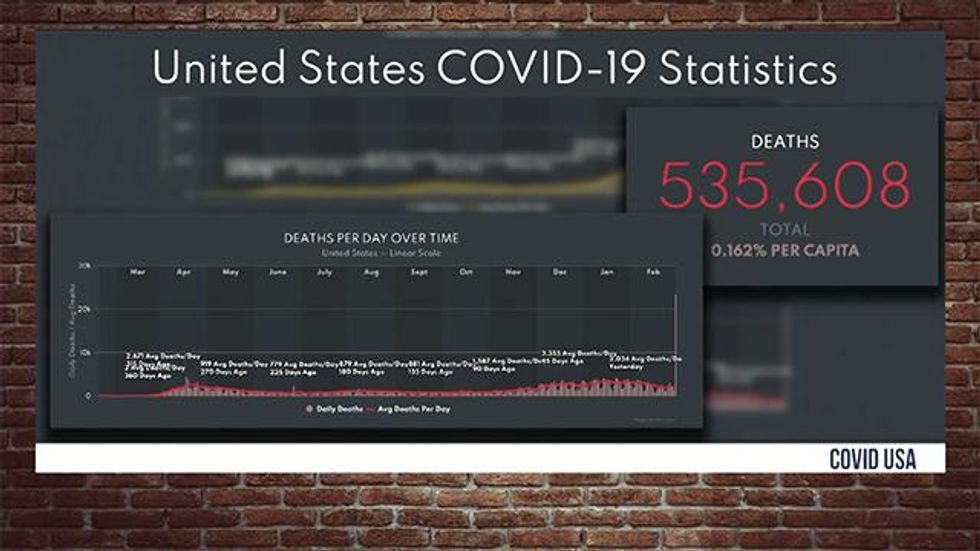
25:49 – Next, there was a COVIDUSA.net overlay showing a 0.162% COVID mortality rate, on screen for less than 1 second, which is sourced from the CDC/Johns Hopkins.
25:56 – Co-host Gerald Morgan says the WHO was correct that the COVID mortality rate was at or greater than the flu rate for those over 40, but disputes that COVID mortality rate is greater than the flu for those under 40, particularly infants. Here’s the face Gerald makes during the video.

26:39 – Steven introduced the Erickson/Massihi video as being banned from YouTube and Facebook for making statements counter to the WHO narrative:
27:36 – At the conclusion of the Erickson/Massihi clip (which only gives 1-2 sentences at all about mortality rates of COVID vs. the flu), Steven again reiterates that this video was banned in 2020 as being “misinformation” despite the statements then matching data seen today about those mortality rates.
Still with us? Great.
Attorney Bill Richmond sent YouTube a detailed email with all this information contending:
- Context was abundant,
- Countervailing views were thoroughly mentioned by Steven,
- The countervailing views handily satisfy the EDSA exception.
Did YouTube review the whole episode to see that Louder with Crowder had presented the information it presented? YouTube claims the show was reviewed in its entirety. Our contention is that doesn’t seem to be the case. This was YouTube’s response:
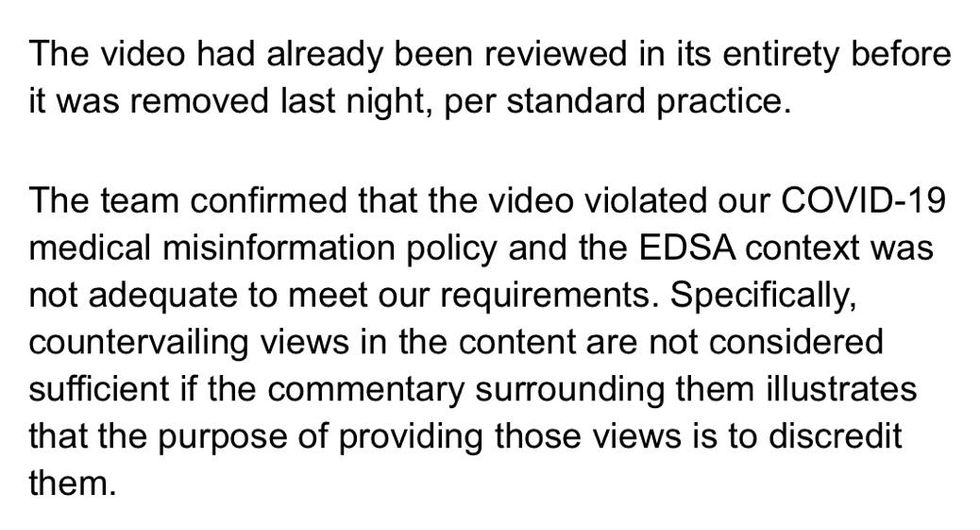
The video had already been reviewed in its entirety before it was removed last night, per standard practice.
The team confirmed that the video violated our COVID-19 medical misinformation policy and the EDSA context was not adequate to meet our requirements. Specifically, countervailing views in the content are not considered sufficient if the commentary surrounding them illustrates that the purpose of providing those views is to discredit them.
Basically, even though we proved that we were well within YouTube’s guidelines and backed up that assertion with links, timecodes, and verified data, YouTube insists that we broke its guidelines anyway. Why? Because the commentary “surrounding them” didn’t discredit them. It seems like for YouTube, there’s only one conclusion one is allowed to draw when it comes to COVID-19 policies. And any other conclusion drawn is to be stricken from existence.
Riddle me this: does the above response from YouTube look like a response from a publisher? Or a platform? Think about it.
The answer here is a simple one. YouTube should reinstate the video. Failure to do so violates YouTube’s own stated policies and YouTube’s enforcement actions in similar circumstances. If YouTube refuses to reinstate the video, other action will need to be taken.
Pfizer’s COVID Vaccine Could Become Most Lucrative Drug in the World
Pfizer’s COVID vaccine is already the second-highest revenue-generating drug in the world — but the company plans to turn the vaccine into an even bigger cash cow once the pandemic ends, according to news reports.
Citing comments made by Pfizer CFO Frank D’Amelio, Forbes and FiercePharma reported that the company “is going to get more on price” once the pandemic wanes and “we are no longer in a pandemic pricing environment,” D’Amelio said.
The vaccine maker expects 2021 sales of about $15 billion based on current contracts for its COVID vaccine, but that number could double as Pfizer says it can potentially deliver 2 billion doses this year, according to The Guardian.
One analyst speculated that Pfizer could be targeting a price 3 to 4 times higher than the $19.50 the company currently charges the U.S. government — or even up to $156 per dose.
Pfizer based the vaccines’ current price on the need for governments to secure doses and get the virus under control. The company splits the profits 50-50 with German partner, BioNTech.
Under Operation Warp Speed, Pfizer agreed to supply the U.S. government with 100 million doses of its vaccine for $1.95 billion, so Americans can receive the vaccine for free.
Pfizer’s initial contract included an option for the government to buy up to 500 million more doses at $19.50 per dose. That’s well below the $150 or $175 per dose the drugmaker typically pulls in for a vaccine, D’Amelio said during the February earnings call.
In comparison, the Moderna vaccine is priced at $15 per dose, Johnson & Johnson (J&J) is $10 and AstraZeneca’s COVID vaccine is $4 per dose, reported Fierce Pharma.
Pfizer executives unveiled the company’s $15 billion sales estimate as part of the company’s 2021 guidance, based on doses set to be delivered in 2021 under existing contracts.
To put $15 billion into perspective, Pfizer also markets the bestselling vaccine outside of COVID –– pneumococcal shot Prevnar 13. In 2020, Prevnar 13 revenues were $5.85 billion. Pfizer’s entire vaccine franchise pulled in $6.56 billion in 2020, reported Fierce Pharma.
As initial demand for its COVID vaccine subsides, the company could make significant profits by charging higher prices and implementing routine booster doses for new variants of the virus, Pfizer CEO Albert Bourla told analysts, big banks and investors during the February earnings call.
During the Barclays’ Global Health Conference, D’Amelio said the company doesn’t see this as a one-time event, but “as something that’s going to continue for the foreseeable future.”
Pfizer has already launched a study of a third vaccine dose to address variants, called for annual boosters and told investors to expect a revenue stream similar to flu vaccines.
“Every year, you need to go get your flu vaccine,” Bourla said. “It’s going to be the same with COVID. In a year, you will have to go and get your annual shot for COVID to be protected.”
That will mean even more sales — and more profits — from the vaccine, reported WRCBtv, a CBS subsidiary.
According to Forbes, some critics say the dramatic increase in the cost of the vaccine is a “bait and switch” operation that could result in Pfizer being called to Capitol Hill to justify the expense to the American public.
But the drugmaker isn’t alone in viewing vaccine pricing differently during the pandemic. J&J and AstraZeneca have each pledged to sell their vaccines at cost during the pandemic with the contractual right to deem the pandemic “over” in July 2021, paving the way for price increases, reported the Financial Times.
Moderna indicated it may raise prices after the pandemic turns into an endemic. During a House Committee on Energy and Commerce hearing last summer, manufacturers were asked whether they would sell the vaccine at cost.
Moderna said it would not sell its vaccine at cost, despite the fact that development and manufacturing of the vaccine was almost entirely funded by U.S. tax dollars. Moderna subsequently earned an award for the “worst example of profiteering and dysfunction in healthcare” by the Lown Institute in Boston.
Like Pfizer, rival Moderna is poised to make billions from its COVID vaccine. As of mid-January, Moderna had secured $11.7 billion in advance purchase orders from various governments and organizations, and the company was in the process of negotiating more deals, according to Fierce Pharma.
Moderna CEO Stephane Bancel said in an interview the company could join the ranks of the largest vaccine players by revenue this year.
Unlike Moderna, “Pfizer’s COVID-19 vaccine development and manufacturing costs have been entirely self-funded, with billions of dollars already invested at risk,” the company said in a Nov. 16, 2020 press release.
Dr. Reshma Ramachandran, a physician-fellow in the Yale National Clinicians Scholars Program testified last month before U.S. lawmakers about vaccine pricing and the refusal of the government and drug manufacturers to reveal information about the arrangements they’ve reached around their vaccines.
In an interview with YaleNews, Ramachandran explained that when Pfizer moves away from “pandemic pricing” and towards price points that are in line with other vaccines it has on the market, at $150 or $175 per dose, insurance companies will have to shoulder the cost and they’ll pass it down to the public through insurance premiums.
We’ve already seen this with flu vaccines –– “a publicly funded vaccine technology has continued to increase in price over the past two decades with significant impacts on our public health program budgets and our insurance premiums,” Ramachandran said. “It’s not the companies that have taken on the risk of developing and manufacturing vaccines. It’s the American people.”
The post Pfizer’s COVID Vaccine Could Become Most Lucrative Drug in the World appeared first on Children’s Health Defense.
China has detained my young children. I don’t know if I’ll ever see them again
When I left my children five years ago, I did it in a rush. I didn’t have time to grab any memento, any toys. All I took was a family photo.
At the time, my husband and I felt we had no choice. The Chinese authorities were harassing us constantly and demanding that we give up our passports. There would be “consequences” if we didn’t. There was also a strict birth control policy. They wanted to do a “body check” on me to see if I was pregnant, and I was.
We had managed to get visas to go to Italy, but we feared there would be questions at the border if we left with all our children at once. So we decided to take my then youngest son, who was still breastfeeding, and leave the four others with their grandparents until they could join us later on. They were aged between seven and 11 at the time.
If we hadn’t left China then, I don’t know if we ever could have. But still we did not imagine how much worse things would get in Xinjiang.
After we made it to Italy, the authorities started to target our family. My mother was taken to an internment camp, and my father was interrogated for several days before being taken to hospital. He was 80 years old.
Meanwhile, the children had no one. According to the Chinese government, they were the children of “betrayers”. Our other relatives could not take care of them because they were afraid that they would be sent to camps too.
The school soon noticed that no parents or guardians were present at meetings, so they asked the government to handle these “orphaned” children. They were sent to a prison-like school with 24-hour surveillance. They call these places “orphan camps”.
My children are called “orphans”, but I am still alive.
In November 2019, my father passed away. But that was also the month we received some good news, when the Italian government issued a permit to bring my children to Italy.
Informing our children was a risk due to the surveillance of their communications, but we managed to do it in March 2020 in a video call.
To obtain their visas they would need to travel to the Italian consulate in Shanghai, 5,000km away. They were too young to take such a journey alone, but we couldn’t find anyone to accompany them to Shanghai due to the risks.
One night in May 2020, the Chinese police interrogated my children for two hours. They asked why they kept in contact with their parents. They said this was dangerous, and threatened to take them to an internment camp at the end of the school term.
The children were scared. My son was calling us every day, pleading to be rescued. He said he was on a list of people going to an internment camp. With the Italian visa set to expire in August, we had to let the children go to Shanghai by themselves.
We gave them instructions and, with the help of strangers and contacts, they made it to Shanghai. But when they got there, they were refused entry to the Italian consulate. Two days later the police caught them, and they were sent back to the orphan camp.
Until then, I had never given up hope that we would see our children again. But now our situation is desperate. China has detained my children, and if they want to harm them, they can.
It is a risk for Uyghurs to speak out about the human rights violations we are suffering, but we told our story to Amnesty International in the hope that someone will help us.
In the five years since I left my children, I have not stopped thinking about them even for a minute. Nobody can truly understand what I feel unless they experience this.
I do not know what my children are doing now. I have seen footage of orphan camps posted online, so I know they watch Chinese “red” propaganda films and sing “red” songs in the school. Whenever I watch these videos, I think of my children and the way they’re educated. How they’re restricted in a small classroom, learning things they don’t want to, separated from their parents, and how they must miss us.
My baby was born in Italy, and we have another that was born here. Sometimes we hold them in our arms and tell them about their brothers and sisters in Xinjiang, and we cry. They ask when they will meet their siblings, and I do not know the answer. At night I wake from nightmares, and I pray to Allah to bring the children back to us. In those times, the only thing that comforts me is the photo of them I grabbed as I rushed out of the door five years ago.
The article was originally published by The Guardian
DR JOHN LEE: My darkest predictions have come true… the effects of lockdowns are catastrophic
One year on from the start of the first lockdown, the brutal price of this drastic policy is all too obvious DR JOHN LEE writes.
Trump’s net worth dropped by $700 million while he took no salary as President
The following article, Trump’s net worth dropped by $700 million while he took no salary as President, was first published on BizPac Review.

Former President Trump’s net worth plummeted $700 million while he was in office, falling from $3 billion to $2.3 billion according to an analysis done by Bloomberg News. Factors that contributed to the losses include an aging portfolio, the pandemic, and the harm done to Trump’s brand due to the Jan. 6 Capitol riot. Attacks […]
Continue reading Trump’s net worth dropped by $700 million while he took no salary as President …
With Biden In Office, ISIS Is Rising From The Ashes Worldwide | ISIS Claims Responsibility for Killing 33 Malian Soldiers
DAKAR—ISIS terrorist group’s West Africa affiliate claimed responsibility on Sunday for an ambush last week that killed 33 Malian soldiers, according to a statement published by the SITE Intelligence Group. Fourteen soldiers were also injured in Monday’s attack near the northern town of Tessit, near the border with Niger, according to Mali’s army. ISIS said in a statement that its members captured three vehicles as well as weapons and ammunition, according to SITE. The group has claimed responsibility for previous attacks on either side of the border that have killed dozens of Malian and Nigerien soldiers. It also carried out the 2017 ambush in the Nigerien village of Tongo Tongo that killed four American special forces troops and five Nigerien soldiers.