
Cynthia Phillips was mesmerized when she saw the latest pictures of her favorite moon. Here at last was a fresh look at Europa, an icy satellite of Jupiter. The moon resembles a truffle drizzled haphazardly with strips of melted white chocolate, as if the universe had rushed to finish a baking-show challenge. The images gave us a new sense of Europa’s topography, its collection of ridges and troughs appearing more intricate than ever. The lighting was different this time, Phillips told me, and the shadows brought out dramatic shapes in the terrain.
The images were taken by a Jupiter-observing spacecraft as it swept past Europa last week, coming within just 222 miles (358 kilometers) of the frozen surface. Phillips, a planetary geologist at NASA’s Jet Propulsion Laboratory, immediately reached for the Europa globe on her desk and began comparing the real-world views with the topography stretched over the plastic orb. The last probe to come this close to Europa was disposed of in 2003, when NASA deliberately plunged it into Jupiter’s atmosphere after the mission started running low on fuel. “We haven’t seen Europa’s surface in this level of detail for 20 years,” Phillips said.
Europa might be the best place to search for life elsewhere in the solar system. Scientists are almost certain that beneath the Jovian moon’s frozen surface is a salty ocean with more water than all of Earth’s oceans combined. And such a watery subsurface environment could provide a comfortable home for small Europan life forms.
[Read: Jupiter’s frozen moon is studded with 50-foot blades of ice]
Two years from now, another NASA spacecraft will depart for the Jupiter system, specifically designed to study Europa. The probe will swing past the moon dozens of times, sometimes coasting just 16 miles (25 kilometers) above the surface. Each pass will bring scientists closer to understanding the workings of this celestial truffle and its mysterious interior. Beneath that frosty coating could be the answer to one of our biggest questions: Is there life anywhere else in the universe?
Europa is enveloped in a thick coat of water ice. (Some other moons in our solar system have ice made of methane and nitrogen—the cosmos is a weird place.) The criss-crossing lines visible in the new pictures are actually cracks and fissures in that frozen exterior. Scientists suspect that they’re caused by the stretching and squashing that Europa experiences as it orbits giant Jupiter. The moon’s terrain is sprinkled with chemical compounds such as sodium chloride and magnesium sulfate—more commonly known to Earthlings as table salt and Epsom salt—and they could indicate briny waters below.
A close-up view of Europa’s textured surface (NASA / JPL-Caltech / SWRI / MSSS
Scientists got their best evidence that a Europan ocean might exist two decades ago, when that earlier NASA spacecraft detected a magnetic connection between Europa and Jupiter that could easily be explained by the presence of a salty, global sea. This deep into the solar system, Europa’s underground ocean wouldn’t feel the warmth of the sun; it would stay liquid because of Jupiter’s gravitational tugging. In recent years, telescopes have detected signs of plumes of water vapor spewing out of the cracks and into space. Scientists believe that Europa’s ocean could be as old as the moon itself, about 4 billion years or so, which would give life plenty of time and a stable environment in which to evolve, Phillips said.
[Read: Europa’s mysterious glow]
The data suggest that Europa has a rocky mantle—the layer between the moon’s crust and core—and when rock and water come together, magical things can happen: Chemical interactions between them are known to produce hydrogen-rich materials for tiny creatures to metabolize. “On our own planet, hydrothermal systems at the seafloor provide energy for communities of microorganisms,” Samantha Trumbo, a planetary scientist at Cornell who studies icy ocean worlds like Europa, told me.
The upcoming NASA mission, named Clipper—a nod to the speedy, lightweight vessels favored by 19th-century merchants—will study nearly every bit of the Europan surface. If it gets lucky, the spacecraft could fly through some plume particles, take a sip, and analyze the contents. Alyssa Rhoden, a planetary geophysicist at the Southwest Research Institute who studies Europa, is most excited about a Clipper instrument designed to detect warmer-than-usual spots on the moon’s surface. “When you look at Europa’s surface, you can see a lot of pits where the surface seems to have dropped down a little bit, places where the surface has been disrupted,” Rhoden told me. “We think that that’s happening from heating coming from below.” That signature could simply indicate the presence of melted bits of ice near the frigid crust—or it could mean a roiling sea has floated toward the surface, perhaps bringing any tiny inhabitants with it.
[Read: Exploring the oceans of the outer solar system]
The Clipper mission is not meant to find definitive proof that life exists on Europa, only explore whether the moon has the right conditions and chemistry to make life possible. Evidence of life will require more missions, guided by Clipper’s data, that could land on the Europan surface and drill into the ice. NASA is also searching for life elsewhere in the solar system, notably on Mars, where a rover is collecting samples from a dried-up river delta. But Europa is a more tantalizing target, and so are the other ocean moons sprinkled across the solar system, such as Enceladus and Titan, which orbit Saturn, and Triton, around Neptune. The Mars mission is designed to search for signs of fossilized life that existed several billion years ago, when water once flowed on the planet. “It’s quite possible that Mars could have had life in the past, in a warmer-weather era, and it’s possible that there are subsurface pockets on Mars that could have remnants of this living biosphere,” Phillips said. “But on somewhere like Europa, life could exist there now.”
And what might humanity, by way of carefully engineered machines, find on Europa, once we’ve figured out which melty bits to inspect? “I would love for there to be Europan whales swimming around in that ocean,” Phillips said with a laugh. But alien life, if it exists, is likely to be small and simple. Energy sources are limited in the Europan depths, and scientists don’t think the environment can support the development of more complex organisms, Phillips said. Still, even the discovery of a single microbe would mark an explosive event in human history. It would mean that life had managed to spring up in two different places around the same star—in a universe absolutely brimming with stars. If it happened more than once here, in our own solar system, it’s likely happened elsewhere in the cosmos, around someone else’s sun. This is why scientists are so eager to catch a glimpse of Europa, and prepare as much as they can for the exploration to come. “We all want it to be water,” Rhoden said. “We all want it to be a cool plumbing system in the shell with lots of activity, and someday we’ll get down there and find little Europan sea urchins clinging to the bottom of the ice.”
Skip The Scoop | Seek Understanding
Biden twiddles his thumbs as kidnapped journalist is tortured in Belarus
One thing is clear from Thursday’s broadcast of weeping dissident Belarusian journalist and opposition activist Raman Pratasevich declaring his respect for dictator Alexander Lukashenko: He was plainly tortured into doing it.
“They beat him — you can see the marks,” Pratasevich’s father, Dmitry, said. “All his words are the result of psychological and physical violence.”
On a state-TV program June 3, Pratasevich praised Lukashenko and said he “immediately confessed to organizing mass disorder.”
Back on May 23, Lukashenko’s goons faked a bomb threat and deployed a fighter plane to force down a jet owned by Irish-based Ryanair (en route from Greece to Lithuania) to kidnap Pratasevich in flagrant defiance of all international air conventions.
Pratasevich fled Belarus in 2019 out of fear that authorities would abduct him. He was plainly right. . . .
Soros Backed Sheriff Penzone and the Maricopa County Board Wouldn’t Turn Over Router Data to AZ Senate Audit – He’s Now Likely Facing Contempt Charges In Another Case

Soros backed Maricopa County Sheriff Paul Penzone begged the Arizona Senate to end their audit of the 2020 Election in Maricopa County. Now it looks like he will soon be charged with contempt in a different case where he has delayed providing data to the court.
We’ve recently reported on the Sheriff of Maricopa County who was backed by George Soros in the 2016 election. Sheriff Paul Penzone was with the Maricopa Board of Supervisors when they begged the Arizona Senate to stop the audit they were in the process of executing in the County.
Then at one point during the audit, it was uncovered that the Maricopa Board of Supervisors refused to provide information requested for review. This was unheard of in any audit. The Board claimed that providing router data posed a threat to the Sheriff’s office. The router information would have shown where items were sent and at what time and the size of the transfer of information.
Now in a different case Penzone is likely facing contept charges for committing similar inactions. A federal judge signalled on Thursday that he will find Sheriff Paul Penzone in contempt for taking too long to investigate charges of misconduct among officers.
In a pointed rebuke after the U.S. Department of Justice asked U.S. District Judge G. Murray Snow in March to order a contempt hearing, Snow said Penzone’s department is “clearly” out of compliance with his 2016 court order to overhaul the investigation process.
“Even if I believe everything in the brief is true, which I don’t, I would still find the sheriff in contempt,” Snow told the attorneys early in the hearing, referring to Penzone’s response to the Justice Department’s request for an order to show cause.
The Justice Department and the sheriff’s lawyers should focus on negotiating remedies, not the moot merits of a potential contempt case, Snow said.
Why does this surprise no one?
The post Soros Backed Sheriff Penzone and the Maricopa County Board Wouldn’t Turn Over Router Data to AZ Senate Audit – He’s Now Likely Facing Contempt Charges In Another Case appeared first on The Gateway Pundit.
Establishment Media Float Another Anti-Trump Conspiracy Theory: ‘Backwards’ Pants Means ‘Dementia’
Key players in the establishment media floated a conspiracy theory former President Donald Trump (R) wore his pants “backwards” Saturday and it was proof he has “dementia.”
New York Daily News columnist and “Obama guy” Brandon Friedman got the conspiracy theory revved up by posting on Twitter a poor quality video someone shot of a television screen of Trump standing near the podium in Greenville, North Carolina Saturday night:
Others are noting this, but it can’t be shared enough: Donald Trump gave his big speech today with his pants on backwards. Look close and tell me I’m wrong.pic.twitter.com/sRsoJVfyf8
— Brandon Friedman (@BFriedmanDC) June 6, 2021
Friedman said it “can’t be shared enough” and added definitively Trump “gave his big speech today with his pants on backwards.”
To date, Friedman’s video has over 6.2 million views.
Hypocrisy & Gaslighting 101 | “Twitter declares access to its platform a ‘human right’ despite banning Trump”
Twitter declares access to its platform a ‘human right’ despite banning Trump and conservatives for their views
- Twitter’s statement came as a response to Nigeria’s decision to ban the social media giant from the country
- Twitter had deleted a tweet from Nigerian President Muhammadu Buhari that was seen as threatening separatist movements
- President Buhari’s tweet reportedly referenced the bloody civil war in Nigeria’s Biafra region in the late 1960s, during which a million people were killed
- Some had considered Buhari’s tweet a veiled threat to modern day separatists
- Nigeria’s Federal Ministry of Information and Culture then tweeted on Friday that the social media account would be banned across the country
- Conservatives in the United States then ripped into Twitter, on Twitter, for its statement declaring the platform a human right
Nigeria Suspends Twitter Days After President’s Post Removed
ABUJA—Nigeria said on Friday it had indefinitely suspended Twitter’s activities, two days after the social media giant removed a post from President Muhammadu Buhari that threatened to punish regional secessionists.
Information Minister Lai Mohammed said the government had acted because of “the persistent use of the platform for activities that are capable of undermining Nigeria’s corporate existence”.
Mohammed did not spell out what form the suspension would take or give more details on the undermining activities. His ministry also announced Twitter’s suspension on Twitter. . . .
‘The Bigotry Of Low Expectations’: Horace Cooper Dismisses Biden’s Claim That Black People Can’t Hire Lawyers, Accountants
Project 21 Chairman Horace Cooper said Saturday that President Joe Biden is guilty of “the bigotry of low expectations” by claiming black people can’t hire lawyers or accountants and be successful entrepreneurs.
Biden made the remarks Tuesday during a speech to mark the centennial of the 1921 Tulsa Race Massacre.
New York Mayoral Candidate, Now Claiming to Be Pro-Trump, Bashed Him as ‘Arrogant’ and Praised Mass Amnesty

Supposed pro-Trump Republican New York Mayoral candidate Fernando Mateo in February bashed him as “arrogant” and praising mass amnesty, newly surfaced clips reveal.
Mateo, a community activist and business owner, is currently running in the New York Mayoral race, and is touting himself as the pro-Trump candidate. This week, he met with President Trump, and was endorsed by his former national security advisor Michael Flynn, who claimed that Mateo “supports and embraces President Trump’s America First agenda.” Mateo even suggested that President Trump may be soon to endorse him in the race too.
However, an appearance on Hot 97’s “Ebro in the Morning” from February this year has recently resurfaced that contradicts his apparent America First credentials. One clip, initially posted on Twitter by Gavin Wax, the current President of the New York Young Republican Club, shows Mateo bashing President Trump, saying that he “had issues” and was “arrogant” with no “humility:
“You know what? I knew that Donald Trump had issues… He had bad issues and he had good issues,” said Mateo. “The good issues were the economy, he kept us out of a war, you know he basically helped the brown and black people probably more than any other president that I know of, but you know what? He was arrogant. He didn’t have humility. He was not a president for all the people. But you know what, that’s that. New York City is my life man…” . . .
Governor Newsom Reneges on Promise to Surrender His Emergency COVID-19 Powers
California Governor Gavin Newsom promised to surrender his emergency powers to govern under a public health emergency by June 15. But yesterday during a vaccine lottery event, Newsom claimed it wasn’t the time to surrender any of his powers, claiming “uncertainty in the future” is reason enough for him to maintain his power to enforce mask mandates and business restrictions.
Hawaii to drop quarantine, COVID-19 testing once 70% of state is vaxxed
Once 70 percent of the state has been vaccinated, Hawaii will drop its quarantine and COVID-19 testing requirements, officials said.
Hawaii will also stop making people wear masks indoors once that level is reached, Hawaii Gov. David Ige told reporters Friday.
So far, 59 percent of Hawaii’s population has had at least one dose of a COVID-19 vaccine and 52 percent finished their dosing regimen, state health data shows.
Currently, travelers arriving from out of state must spend 10 days in quarantine or show proof of a negative COVID-19 test taken before their departure for the islands at the airport.
Once 60 percent of Hawaii’s population is vaccinated, the state will let travelers skip the quarantine if they can show they were vaccinated in the US.
Restrictions on travel between the islands will open up before that.
SARAH VINE: This war on mothers is feminism’s biggest fight for decades
SARAH VINE:
Mum, mother, mummy. I am proud to call myself all these things. In common with countless women throughout the ages, being a mother is a fundamental, undeniable and indelible part of my identity as a woman.
But the powerful and hugely influential gay rights organisation Stonewall thinks such a fundamental belief is wrong. Not only wrong, but also discriminatory and very possibly wicked.
It asserts I must not call myself mother, nor be called one. Instead, I must re-educate my brain to think of myself as ‘a parent who has given birth’. Not to do so is an affront to trans people, an attack on their right to gender self-identification.
And we can’t have that. No, far better to cancel a vast swathe of the population – that is to say mothers – so a small number of biological males who wish to define themselves as female (not something, by the way, that I have any issue with), can feel better about themselves.
Over 138,000 Americans Tune in to Watch President Trump’s NC Speech… Before He Even Takes the Stage — Joe Biden Is LUCKY to Get 1,000
President Donald Trump is set to speak tonight at 7:00 p.m. Eastern at the annual North Carolina Republican Party state convention.
President Trump will be the keynote speaker at the NCGOP dinner on Saturday night.
South Dakota Governor Kristi Noem is also scheduled to speak.
Even before President Trump took stage tonight 58,000 were watching the livefeed on Right Side Broadcasting Network.
At 7 PM when President Trump was scheduled to speak 93,000 Americans were tuned in to watch the President on RSBN.
And at 7:15 PM ET 138,000 people were watching the live-feed on RSBN.
Now compare President Trump’s numbers to Joe Biden’s numbers–
Joe Biden had 560 people watching him this week during a speech on Memorial Day on the White House YouTube page. . .
Dr. Nicole Saphier on Gain of Function Research in Wuhan Lab, Fauci’s Emails, and the Politicization of COVID-19
At the Wuhan Institute of Virology, “they have published data that they were actually introducing furin cleavage sites,” a mutation that would make a virus much more dangerous, said Dr. Nicole Saphier, Director of Breast Imaging at the Memorial Sloan Kettering Cancer Center. In this episode, we sit down with Dr. Saphier to discuss the Wuhan lab leak theory, Dr. Fauci’s newly released email trove, and her new book, “Panic Attack: Playing Politics With Science in the Fight Against COVID-19.” “When you have the CDC coming out saying young children still need to be wearing masks outdoors, even when they’re physically distancing, until they’re vaccinated—this makes no sense,” Dr. Saphier said. . . .
If You Think Intimidation Will Stop, Think Again. The ‘Left’ Doubles Down | “Cancel Culture Works. We Wouldn’t Have Marriage Equality Without It.”
Anyone looking to understand how same-sex marriage went from legal in one state to the law of the land a decade later should not overlook the small crowd that gathered outside San Diego’s Manchester Grand Hyatt hotel just past noon one Friday in July 2008, holding signs that said, “The Hyatt of hypocrisy.”
Those present had been rallied by a retired Republican political operative named Fred Karger. His aim was the defeat of Proposition 8, a ballot measure that if passed, would ban same-sex marriage in California. Instead of aiming to mobilize voters or move public opinion against the measure, however, he decided to target the money behind it.
Doug Manchester’s $125,000 donation was not the biggest to the pro-Proposition 8 cause, but he was the most substantial public-facing target Mr. Karger could find. He began picketing Mr. Manchester’s pre-eminent holdings, including the namesake downtown convention hotel, with a boycott that would endure for years. It was the first time gay-marriage activists adopted a strategy of scaring their most well-heeled opponents away from the fight.
Joe Biden Just Banned Investment In CCP Military Firms His Son Hunter Profited From.
President Joe Biden banned investment in nearly 60 firms due to close ties to the Chinese Communist Party military operations and human rights abuses. Among the companies included in the ban are entities that have enjoyed millions of dollars in investment from Hunter Biden and Bill Gates, The National Pulse can reveal.
U.S. Hits 300 Million Doses With Covid in Retreat: Virus Update
The U.S. passed the milestone of administering more than 300 million vaccine doses. New cases and deaths continue to plunge and are back to the levels just after U.S. states began imposing restrictions in March 2020.
The U.K. will accelerate its vaccination program in a bid to stay on its path out of lockdown, the Telegraph reported. Meanwhile, civil servants are drawing up contingency plans to delay the June 21 easing of virus restrictions, the Financial Times reported.
China authorized the emergency use of Sinovac Biotech Ltd.’s coronavirus vaccine for children, becoming the first major country to grant approval for those as young as three. Singapore canceled its Formula One race for a second year because of the pandemic.
Britain will lead the way on vaccine passports at the G7 summit
Britain will lead the way on vaccine passports at the G7 summit as Boris Johnson is urged to establish globally agreed way of checking who is jabbed and tested to save time for airlines
- Britain will use this week’s summit to develop Covid certification travel scheme
- Boris Johnson urged to set up a globally agreed way to see if people have had jab
- Industry figures warned travel will be ‘paralysed’ in the future without a scheme
- Proposals call for immediate alignment between countries on health certificates
Bannon’s War Room | Saturday Edition Hour 1 | Recorded June 5, 2021 | Video: 48 Minutes 38 Seconds
Episode 1,001 – We the Establishment … How the Scientific Elite Helped the CCP Create the Pandemic. “They are culpable,” he said. “They have been covering up the origins of the virus from the very beginning. Guests are: Natalie Winters, Col. Lawrence Sellin, Dr. Peter Navarro, Bernie Kerik, John Fredericks.
Bannon’s War Room | Saturday Edition Hour 2 | Recorded June 5, 2021 | Video: 48 Minutes 38 Seconds
Episode 1,002 – The Mostly Peaceful Protester of the Flying Saucer World. “Donald Trump is not in the White House today because of Brian Kemp,” Kerik said. “And governors and legislatures like him…that certified results that were fraudulent.” Guests are: Natalie Winters, Bernie Kerik, John Fredericks, Joe Allen.
Common Sense In A Senseless World | Thomas Sowell Full Documentary | Video: 56 Minutes 57 Seconds
Thomas Sowell: Common Sense in a Senseless World traces a life journey that started with an introduction to the Harlem Library and culminated at the esteemed Hoover Institution. The story of one of this era’s greatest authors on race, history, and economics is told by The Wall Street Journal’s Jason Riley.
Director: Kyle Clark, Starring: Jason Riley, Larry Elder, Walter E. Williams.
“You’re about to meet one of the greatest minds of the past half century.” ~ Jason Riley
BOOM! Mike Lindell Files Fed Lawsuit Against Dominion and Smartmatic For “Weaponizing the court system” To SILENCE Lindell And Others About Election Fraud
Mike Lindell is a patriot.

100 Percent Fed UP – The popular My Pillow CEO, whose incredible story of how Jesus Christ saved him from his addictions to gambling, alcohol, cocaine, and eventually crack cocaine, has been fighting to uncover and election fraud since November 5, 2020.

On the morning after the election, Americans were stunned to discover Trump’s incredible lead had evaporated in critical swing states where the counting of absentee ballots suddenly stopped, and then, in the wee hours of the morning, when the counting resumed, Joe Biden suddenly and inexplicably had taken the lead over Trump in multiple states.
Along with millions of other Americans, Lindell has refused to accept the results of the election and are not giving up on their fight to examine and expose what happened in the nation’s most hotly contested election. . . .
June 4, 2021 | Nightly News Rebroadcast | Video: 49 Minutes 53 Seconds
Fighting Extremism in U.S. Military: Analysis; Governor Encourages Utahns to Pray for Rain. Facebook opts to continue former President Trump’s account suspension, Utah’s extremely dry conditions are threatening crops, livestock, wildlife, and supply chains, and Scientists say that last year’s wildfires blazed at least 10% of the world’s Giant Sequoia trees.
Clean Elections Court Victory!
Judicial Watch Lawsuit for Access to Illinois Voter Roll Data Can Proceed
A federal court ruled our lawsuit can proceed against Illinois officials for denying public access to Illinois’ voter registration database.
We filed the lawsuit on behalf of the Illinois Conservative Union (ICU) and three of its officers, Carol Davis, Janet Shaw, and Loretta Savee, after Illinois state officials refused to allow them to obtain a copy of the state’s voter registration database despite their lawful request for it under federal law (Illinois Conservative Union et al v. Illinois et al. (No. 1:20-cv-05542)).
The National Voter Registration Act of 1993 (NVRA) provides that states “shall make available for public inspection and, where available, photocopying at a reasonable cost, all records concerning the implementation of programs and activities conducted for the purpose of ensuring the accuracy and currency of official lists of eligible voters.”
When members of the ICU sought access to Illinois’ voter list, however, they were outrageously told they must view the database one record at a time, on a single computer screen, during “normal business hours,” at the State Board of Elections office in Springfield, Illinois, which is 200 miles from where they live. There are over 8 million voter registrations in Illinois. We argued that Illinois’ arbitrary restrictions “make a mockery” of federal law, “as much as a requirement that Plaintiffs wear blindfolds.”
United States District Court Judge Sara L. Ellis ruled that “Plaintiffs have plausibly alleged that” Illinois law “conflicts with” and “and frustrates the NVRA’s purpose of providing voter information to the public to help ensure the accuracy and currency of voter registration rolls.” She also allowed a claim to proceed under the Equal Protection Clause of the Fourteenth Amendment, on the ground that political committees in Illinois can access copies of the voter registration database while ordinary citizens cannot.
The claims will proceed against Illinois’ chief state elections official, Bernadette Matthews, the Acting Executive Director of the Illinois State Board of Elections. The Court directed further briefing on whether NVRA claims can proceed against the Board itself and the State of Illinois under the doctrine of sovereign immunity.
Dirty voter rolls can mean dirty elections – which is one reason why federal law requires access to voting rolls. This court ruling further affirms that Illinois voters and citizens have a right to review election rolls under federal law. Illinois’ stubborn and unlawful refusal to make them available suggests the state knows the rolls are a mess.
Judicial Watch is a national leader for cleaner elections.
In 2020, we sued North Carolina, Pennsylvania, and Colorado for failing to clean their voter rolls.
In 2018, the Supreme Court upheld a voter-roll cleanup program that resulted from a Judicial Watch settlement of a federal lawsuit with Ohio. California settled a federal lawsuit with us and in 2019 began the process of removing up to 1.6 million inactive names from Los Angeles County’s voter rolls.
Kentucky also began a cleanup of hundreds of thousands of old registrations after it entered into a consent decree to end another Judicial Watch lawsuit. In September of last year, the U.S. District Court for the Eastern District of Kentucky agreed to extend the consent decree through 2025 after finding that that Kentucky’s former Democrat Secretary of State Alison Lundergan Grimes breached its terms by delaying sending out voter notices, which allowed the names of people who have died or moved away to remain on the Commonwealth’s voter rolls.
In October 2020, we released a study that found 353 counties nationwide that had more voter registrations than citizens old enough to vote, i.e., counties where registration rates exceed 100%. These counties combined had about 1.8 million registrations over the 100%-registered mark.
Judicial Watch Attorney Robert Popper is the director of Judicial Watch’s election integrity initiative. We are being assisted in Chicago by Stephen F. Boulton of Anthony J. Peraica & Associates, Ltd. . . .
COVID Origin ‘Worst Cover-Up in Human History’ + More
Rep. McCaul: COVID Origin ‘Worst Cover-Up in Human History’
Texas Rep. Mike McCaul on Sunday said it was “more likely than not” that the coronavirus originated from a lab accident, calling it the “worst cover-up in human history.”
Bipartisan support has grown for a congressional probe into whether the virus originated in a Chinese lab following a Wall Street Journal report that three scientists at the Wuhan Institute of Virology had been hospitalized in November 2019 with symptoms consistent with the virus. . . .
BOMBSHELL: Fauci Kept Funding Peter Daszak’s Wuhan ‘Gain of Function’ Experiments with $7.5 Million after Trump Canceled Grant
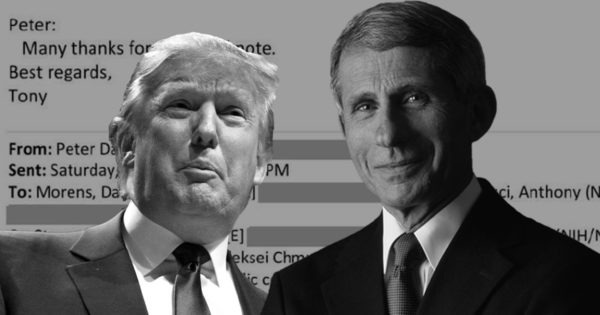
Peter Daszak, who studied controversial “gain of function” experiments on coronavirus elements in Wuhan, received $7.5 million from Anthony Fauci after Trump cancelled his grant.
Last April, reports emerged that the EcoHealth Alliance, an organization run by one Peter Daszak, was involved in funding and collaborating with the Wuhan Institute of Virology, where researchers were examining coronaviruses extremely similar to the one behind the COVID-19 outbreak, and allegedly engaging in “gain of function” research relating to them. In an April 17th press conference, President Trump confirmed that a grant worth around $3.7 million since 2015 given to Daszak’s group by the National Institute for Health would be ended “very quickly” following the reports.
Only one week later on April 24th, all future funding for the EHA was cut, and they were ordered to stop spending the $369,819 remaining from its 2020 grant. “At this time, NIH does not believe that the current project outcomes align with the program goals and agency priorities,” Michael Lauer, the agency’s deputy director for extramural research, wrote in a letter to EcoHealth Alliance officials.
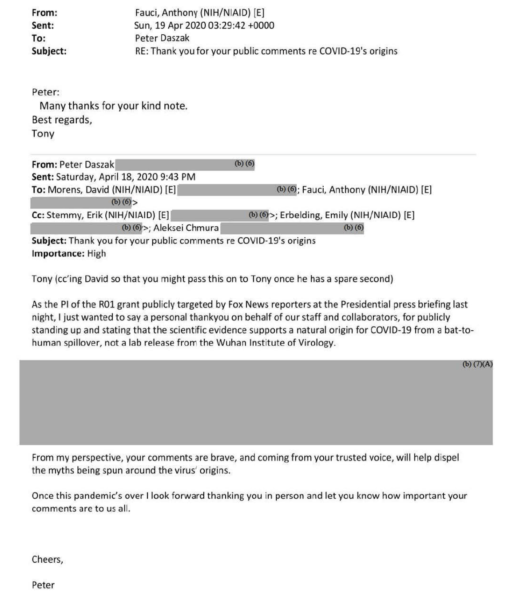
From within the treasure trove of 3,200 pages of emails obtained from Anthony Fauci, one email can be found from Daszak, who thanked Fauci for dismissing the lab leak theory as being simply conspiratorial the day after President Trump announced the funding would be cut.
“As the PI of the R01 grant publicly targeted by Fox News reporters at the Presidential press briefing last night, I just wanted to say a personal thankyou [sic] on behalf of our staff and collaborators, for publicly standing up and stating that the scientific evidence supports a natural origin for COVID-19 from a bat-to-human spillover, not a lab release from the Wuhan Institute of Virology,” Daszak said. “From my perspective, your comments are brave, and coming from your trusted voice, will help dispel the myths being spun around the virus’ origins,” he continued, expressing his wish to thank Fauci in person. (READ MORE: Tucker Carlson Says Fauci’s Emails Merit ‘Criminal Investigation’, He May Have Committed ‘Perjury’ In Confrontation With Rand Paul)
Only a few months later in August, Fauci, who along with being put in charge of America’s response to COVID-19, is the director of the National Institute of Allergies and Infectious Diseases, which is part of the NIH, helped confirm that Daszak’s organization would receive a new grant of $7.5 million to study coronaviruses as part of a new network.
The CREID network, which contains 11 institutions including the EHA, “coincidentally” will continue to study the emergence of coronaviruses in Southeast Asia. Fauci said that the network will help “enable early warnings of emerging diseases wherever they occur, which will be critical to rapid responses,” while Daszak boasted that they will be working in rural hospitals, according to a statement, “in remote parts of Malaysia and Thailand to get to the front line of where the next pandemic is going to start.”
Questions will be raised as to why Fauci and the NIH reauthorised the grant to Daszak and his organization despite President Trump’s clear opposition to the funding. In a statement on Thursday, President Trump said that he was astonished at the time to hear about the funding of the Wuhan Institute, and said Fauci had a “lot of questions” to answer, especially regarding the alleged “gain of function” research. . .
Iran’s Proxies in Iraq Threaten U.S. With More Sophisticated Weapons
BAGHDAD — The United States is grappling with a rapidly evolving threat from Iranian proxies in Iraq after militia forces specialized in operating more sophisticated weaponry, including armed drones, have hit some of the most sensitive American targets in attacks that evaded U.S. defenses.
At least three times in the past two months, those militias have used small, explosive-laden drones that divebomb and crash into their targets in late-night attacks on Iraqi bases — including those used by the C.I.A. and U.S. Special Operations units, according to American officials.
Gen. Kenneth F. McKenzie Jr., the top American commander in the Middle East, said last month that the drones pose a serious threat and that the military was rushing to devise ways to combat them.
Iran — weakened by years of harsh economic sanctions — is using its proxy militias in Iraq to step up pressure on the United States and other world powers to negotiate an easing of those sanctions as part of a revival of the 2015 nuclear deal. Iraqi and American officials say Iran has designed the drone attacks to minimize casualties that could prompt U.S. retaliation. . . .
The Great Thomas Sowell | John Stossel Retrospective
“If you have always believed that everyone should play by the same rules … that would have gotten you labeled a radical 50 years ago, a liberal 25 years ago and a racist today,” says Thomas Sowell.
[ Rumble ]
Bannon’s War Room | Morning Edition Hour 1 | Recorded June 4, 2021 | Video: 48 Minutes 28 Seconds
Episode 998 – Deplorables Descend on Jekyll Island … MAGA Movement Grows in GA. “This is a time for the people to stand up and get involved,” she said. “We’re seeing everyday people get into politics, they’re running for school board. Guests are: Raheem Kassam, John Fredericks, Kari Lake.
Bannon’s War Room | Morning Edition Hour 2 | Recorded June 4, 2021 | Video: 47 Minutes 49 Seconds
Episode 999 – Berlin Had Good Scientists in 1939, Too … NIH Director Shills for CCP. “They’re positioning this…to try edge their way out,” said Stephen K. Bannon, after Collins did a softball interview with Hugh Hewitt. “Morning Joe is grasping how they throw Fauci under the bus, but also how they get out of their own culpability there.” Guest is: Raheem Kassam.
Bannon’s War Room | Evening Edition | Recorded June 4, 2021 | Video: 47 Minutes 49 Seconds
Episode 1,000 – Just Like the Aztecs … Election Audits and the NIH’s Experiments in Child Sacrifice. Guest is: Ken Paxton, Phillip Patrick, Boris Epshteyn, Joe Allen.
June 3, 2021 | Nightly News Rebroadcast | Video: 54 Minutes 38 Seconds
Bill Gates, Warren Buffett to Launch Nuclear Power Plant; Texas County Reacts to Border Crisis. Experts and lawmakers are urging the White House to quickly counter the Chinese Communist Party’s use of vaccines as leverage, President Joe Biden signed an executive order banning U.S. investment in 59 Chinese companies, and a ransomware attack hits ferry services in Massachusetts.
Govt. violates law; stalls Freedom of Info requests for specific Covid-19 Fauci emails
The following is a news analysis. The Washington Post recently received a treasure trove of Dr. Anthony Fauci’s emails related to the Covid-19 pandemic and response. Read The Washington Post article here But the shame of it is… under federal law, the emails should have been made public over a year ago. According to Freedom […]
Of Course | “Google Diversity Chief Will Remain at Company in Wake of Anti-Semitic Remarks”
Google’s global lead for diversity strategy will stay with the company after an uproar over his anti-Semitic comments but will no longer work on diversity issues, according to a Google press statement on Thursday.
Kamau Bobb will now focus on science and technology education, the company said. Bobb was already a member of Google’s computer science education team, a media consultant for Google told the Washington Free Beacon on Wednesday.
The decision follows calls from Jewish groups, such as the Simon Wiesenthal Center and Stand With Us, for Google to fire Bobb. Google broke its silence days after the Free Beacon reported Tuesday on a 2007 blog post in which Bobb claimed that Jews have an “insatiable appetite for war.”
“We unequivocally condemn the past writings by a member of our diversity team that are causing deep offense and pain to members of our Jewish community and our LGBTQ+ community. These writings are unquestionably hurtful,” said Google in the statement. “The author acknowledges this and has apologized. He will no longer be part of our diversity team going forward and will focus on his STEM work.”
Bobb sent an email apology late Tuesday to a listserv of Jewish Google employees, known within the company as the “Jewglers,” saying his anti-Semitic tirade was “intended as a critique of particular military action.”
“[T]he world is leaving us all feeling unsafe and unsettled right now. i certainly don’t want to contribute to that,” he wrote. “[N]one of this changes or excuses the words i wrote – but i am deeply sorry for them.”
In Bobb’s blog 2007 post, titled “If I Were a Jew,” he offered his thoughts on how Jews should view the Israeli-Palestinian conflict.
“If I were a Jew I would be concerned about my insatiable appetite for war and killing in defense of myself,” he wrote in the Nov. 30, 2007, post on his personal blog, where he was still actively publishing as recently as April 2021. “Self defense is undoubtedly an instinct, but I would be afraid of my increasing insensitivity to the suffering [of] others.”
Bobb appears to have deleted the blog post Thursday. A copy is still available on Internet Archive.
The post Google Diversity Chief Will Remain at Company in Wake of Anti-Semitic Remarks appeared first on Washington Free Beacon.
Media Ignores Heinous Attack on Republican Lawmaker’s Home
Snopes, the left-leaning “fact-checking” website, sent Rep. Nancy Mace (R-SC) a note demanding to know if she was responsible for vandalizing her own home, the Republican lawmaker said on the Todd Starnes Radio Show.
Mace announced on social media earlier this week that her Charleston home had been vandalized with vile graffiti along with Antifa symbols.
“It’s a very, very jarring experience,” she told me on my radio program. “And no one should feel like they’ve got to look over their shoulder every day. It doesn’t matter what your political leanings are, Republican or Democrat or indifferent, everyone should feel safe in their own homes.”
Mace said she was especially troubled because she is a single mom with young children.
“People should be safe in their homes. Their families should be safe,” she said. “You should be able to have the ideas that you want without retribution in this country. That’s what freedom is all about.”
The attack was widely condemned by Republicans but garnered hardly any national news coverage or denouncements from congressional Democrats. . . . .
Justice Department investigating law firm linked to Hunter Biden’s Burisma work
The Justice Department is investigating the work of a consulting firm linked to President Biden’s son Hunter Biden for potential illegal lobbying.
In 2015, Blue Star Strategies, a Washington-D.C.-based lobbying and public affairs firm took on the Ukrainian energy company Burisma Holdings as a client while Hunter Biden served on its board, four people familiar with the investigation told Politico, Thursday. . . .
NASA aims for 2 new missions to Venus to learn about ‘lost habitable’ world
For the past few years, Mars has been having its moment.
The planet has captured the fascination of Hollywood, the US and China both landed rovers on its surface and Elon Musk, the head of SpaceX, recently announced that his company hopes to launch its next-generation rocket in 2022 from a platform in the Gulf of Mexico. His sights are set on Mars.
Other planets have become something of an afterthought. When was the last time you caught yourself thinking about Neptune? Pluto had the worst fate of all and in 2006 was downgraded to dwarf planet.
But NASA on Wednesday announced its intention to bring more attention to Venus, the second planet from the sun. The planet–which is one of the brightest objects in the night sky– is considered an “inferno-like world” but may have been “the first habitable world in the solar system, complete with an ocean and Earth-like climate.” . . .
A New York 7-Year-Old Was Accused of Rape. Is Arresting Him the Answer?
At the forested edge of the Canadian border this spring, state police arrested a person from the hamlet of Brasher Falls, N.Y., population about 1,000. He was charged with rape.
The pain of such crimes often tears small towns apart without rippling beyond their borders. But following the March 23 arrest, news of the arrest ricocheted far beyond the hamlet.
The resident charged with rape was a 7-year-old boy.
Little is known about the circumstances of the arrest, the specifics of the allegations or the case’s disposition. The records of cases involving children are kept private. But in New York, the arrest reignited a discussion about how the justice system deals with so-called juvenile delinquents — children between the ages of 7 and 18 whose cases are heard in family court.
Judges, juvenile justice experts and lawyers who have handled such cases from both sides of the courtroom say arrests traumatize children, ensnare them in the legal system and increase their chance of recidivism. Young children are almost never charged as adults. But arresting and charging them at all, those who study the issue say, ignores the science of brain development and in an attempt to seek justice often achieves the opposite result.
“What we know now is that the science doesn’t support prosecution of second graders,” said Dawne Mitchell, who leads the Legal Aid Society’s juvenile rights practice. Citing cognitive science that shows such young children lack true awareness of the consequences of their actions, and that emphasizes the psychological trauma of being cuffed and prosecuted, Ms. Mitchell is one of a growing number of experts across the country urging states to raise their age minimums.
Trump Admin Covertly Obtained Phone Records Of NYT Reporters
The administration told The New York Times that Trump officials seized the records of reporters Matt Apuzzo, Adam Goldman, Eric Lichtblau and Michael Schmidt from Jan. 14 to April 30, 2017. The DOJ also got a court order to seize their email logs, but told the Times that “no records were obtained.”
Last month, the Biden DOJ revealed that the Trump administration also seized the phone records of reporters at The Washington Post and the phone and email logs for a reporter at CNN.
Though the DOJ did not disclose what article was being investigated, the Times speculated it was related to former FBI director James Comey and his leadership in the investigation into Hillary Clinton’s emails in the run up to the 2016 presidential election.
The paper mentioned that its article contained a classified DOJ memo about then-Attorney General Loretta Lynch and her role in the investigation. The article ran on April 22, 2017.
Vet’s mic cut off as he spoke of role freed slaves played in Memorial Day origins
A US Army veteran’s microphone was cut off during a Memorial Day event in Ohio as he discussed the role freed black slaves played in the holiday’s origins, video shows.
Footage of Monday’s event shows retired Army Lt. Col. Barnard Kemter tapping the microphone midway into his 11-minute speech during a ceremony at Markillie Cemetery in Hudson, Ohio, where one of the organizers admitted they intentionally dropped the audio, the Akron Beacon Journal reported.
Cindy Suchan, president of the Hudson American Legion Auxiliary, declined to say who specifically turned down the volume, but said organizers wanted the portion cut out since it was “not relevant to our program for the day,” adding that the theme was to honor Hudson veterans.
Kemter, 77, who served in the Army from 1965 through 1995, said he was dismayed by the incident.
Rand Paul Doubles Down on #FauciEmails, Calls Fauci ‘Morally Culpable’ for Pandemic
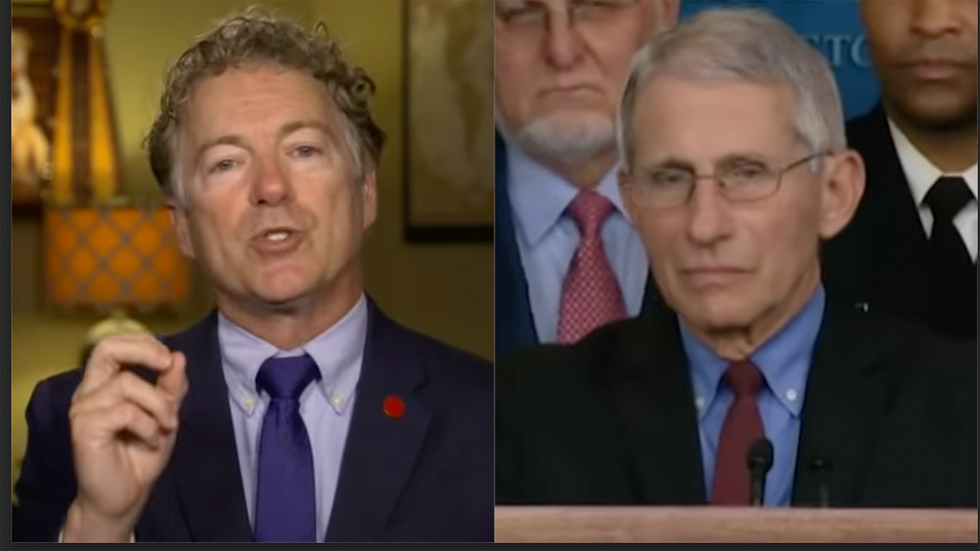
Wednesday was a great day to be Rand Paul. It’s rare that someone gets to wake up in the morning and discover that everything you’ve been saying has been right all along. For Sen. Paul, it’s the #FauciEmails showing everything he and my editor Courtney have said about Anthony Fauci was pretty accurate. At first, Paul only had two words for the media’s favorite bureaucrat. After some time to collect his thoughts, the senator laid out just how serious this is.
Rand Paul on whether there’s ‘criminal culpability’ regarding Dr. Fauci
youtu.be
At the very least, there’s moral culpability. In the research done by the bat scientist in Wuhan, she gives him credit. She lists the exact NIH grant with a ten-numeral disclaimer or ID number, listing the money and thanking the NIH for the money. It’s clearly “gain of function.” There are several scientists who are in this field, cellular biologists, they all say that taking a SARS virus and adding an S-protein to it to make it infect human cells, that is the very definition of gain of function. It’s very dangerous. We shouldn’t be doing it here or there. But Dr. Fauci has denied it to this day.
But the private e-mails show that he was acknowledging that it was gain of function. Nobody was questioning it. The scientific community needs to look at this, because he hides behind this veil of the lab coat that nobody can question him. … It absolutely was gain of function research. He was funding it. And to this day, he is still saying he would do it again.
If reading the words “gain of function” makes you glassy-eyed and confused … join the club. It ties into the “Wuhan Lab Theory” that Facebook says we’re allowed to talk about now. Best I can tell, think back to Jurassic Park and Jeff Goldblum lambasting the scientist so focused on whether he could, he never thought about whether he should. Only instead of killer dinosaurs, they created a virus that wreaked havoc on the entire planet. DISCLAIMER: I’m a blogger and not a scientist.
Whether or not American taxpayers helped fund this research and/or how much Pope Tony is responsible are excellent questions. Ones that should be investigated via hearings and bipartisan commissions. Two things that Rand Paul says there’s next to no chance of happening. Those would have to be called by the people in charge (Democrats).
In order to do so, they’d have to admit they were wrong this whole time. Also, they’d have to admit that the pandemic restrictions were based on questionable information that we now know was being questioned back then. Also, they’d have to admit that they lacked any curiosity in questioning that information that led to those restrictions. Things that, if it got out to the American people, the American people might be more than mildly annoyed at.
Being proven right is nice and all, but it only goes so far. Now we need answers.
Looking for a fashionable way to support Louder with Crowder? Get your swag at Crowdershop today!