
Cynthia Phillips was mesmerized when she saw the latest pictures of her favorite moon. Here at last was a fresh look at Europa, an icy satellite of Jupiter. The moon resembles a truffle drizzled haphazardly with strips of melted white chocolate, as if the universe had rushed to finish a baking-show challenge. The images gave us a new sense of Europa’s topography, its collection of ridges and troughs appearing more intricate than ever. The lighting was different this time, Phillips told me, and the shadows brought out dramatic shapes in the terrain.
The images were taken by a Jupiter-observing spacecraft as it swept past Europa last week, coming within just 222 miles (358 kilometers) of the frozen surface. Phillips, a planetary geologist at NASA’s Jet Propulsion Laboratory, immediately reached for the Europa globe on her desk and began comparing the real-world views with the topography stretched over the plastic orb. The last probe to come this close to Europa was disposed of in 2003, when NASA deliberately plunged it into Jupiter’s atmosphere after the mission started running low on fuel. “We haven’t seen Europa’s surface in this level of detail for 20 years,” Phillips said.
Europa might be the best place to search for life elsewhere in the solar system. Scientists are almost certain that beneath the Jovian moon’s frozen surface is a salty ocean with more water than all of Earth’s oceans combined. And such a watery subsurface environment could provide a comfortable home for small Europan life forms.
[Read: Jupiter’s frozen moon is studded with 50-foot blades of ice]
Two years from now, another NASA spacecraft will depart for the Jupiter system, specifically designed to study Europa. The probe will swing past the moon dozens of times, sometimes coasting just 16 miles (25 kilometers) above the surface. Each pass will bring scientists closer to understanding the workings of this celestial truffle and its mysterious interior. Beneath that frosty coating could be the answer to one of our biggest questions: Is there life anywhere else in the universe?
Europa is enveloped in a thick coat of water ice. (Some other moons in our solar system have ice made of methane and nitrogen—the cosmos is a weird place.) The criss-crossing lines visible in the new pictures are actually cracks and fissures in that frozen exterior. Scientists suspect that they’re caused by the stretching and squashing that Europa experiences as it orbits giant Jupiter. The moon’s terrain is sprinkled with chemical compounds such as sodium chloride and magnesium sulfate—more commonly known to Earthlings as table salt and Epsom salt—and they could indicate briny waters below.
A close-up view of Europa’s textured surface (NASA / JPL-Caltech / SWRI / MSSS
Scientists got their best evidence that a Europan ocean might exist two decades ago, when that earlier NASA spacecraft detected a magnetic connection between Europa and Jupiter that could easily be explained by the presence of a salty, global sea. This deep into the solar system, Europa’s underground ocean wouldn’t feel the warmth of the sun; it would stay liquid because of Jupiter’s gravitational tugging. In recent years, telescopes have detected signs of plumes of water vapor spewing out of the cracks and into space. Scientists believe that Europa’s ocean could be as old as the moon itself, about 4 billion years or so, which would give life plenty of time and a stable environment in which to evolve, Phillips said.
[Read: Europa’s mysterious glow]
The data suggest that Europa has a rocky mantle—the layer between the moon’s crust and core—and when rock and water come together, magical things can happen: Chemical interactions between them are known to produce hydrogen-rich materials for tiny creatures to metabolize. “On our own planet, hydrothermal systems at the seafloor provide energy for communities of microorganisms,” Samantha Trumbo, a planetary scientist at Cornell who studies icy ocean worlds like Europa, told me.
The upcoming NASA mission, named Clipper—a nod to the speedy, lightweight vessels favored by 19th-century merchants—will study nearly every bit of the Europan surface. If it gets lucky, the spacecraft could fly through some plume particles, take a sip, and analyze the contents. Alyssa Rhoden, a planetary geophysicist at the Southwest Research Institute who studies Europa, is most excited about a Clipper instrument designed to detect warmer-than-usual spots on the moon’s surface. “When you look at Europa’s surface, you can see a lot of pits where the surface seems to have dropped down a little bit, places where the surface has been disrupted,” Rhoden told me. “We think that that’s happening from heating coming from below.” That signature could simply indicate the presence of melted bits of ice near the frigid crust—or it could mean a roiling sea has floated toward the surface, perhaps bringing any tiny inhabitants with it.
[Read: Exploring the oceans of the outer solar system]
The Clipper mission is not meant to find definitive proof that life exists on Europa, only explore whether the moon has the right conditions and chemistry to make life possible. Evidence of life will require more missions, guided by Clipper’s data, that could land on the Europan surface and drill into the ice. NASA is also searching for life elsewhere in the solar system, notably on Mars, where a rover is collecting samples from a dried-up river delta. But Europa is a more tantalizing target, and so are the other ocean moons sprinkled across the solar system, such as Enceladus and Titan, which orbit Saturn, and Triton, around Neptune. The Mars mission is designed to search for signs of fossilized life that existed several billion years ago, when water once flowed on the planet. “It’s quite possible that Mars could have had life in the past, in a warmer-weather era, and it’s possible that there are subsurface pockets on Mars that could have remnants of this living biosphere,” Phillips said. “But on somewhere like Europa, life could exist there now.”
And what might humanity, by way of carefully engineered machines, find on Europa, once we’ve figured out which melty bits to inspect? “I would love for there to be Europan whales swimming around in that ocean,” Phillips said with a laugh. But alien life, if it exists, is likely to be small and simple. Energy sources are limited in the Europan depths, and scientists don’t think the environment can support the development of more complex organisms, Phillips said. Still, even the discovery of a single microbe would mark an explosive event in human history. It would mean that life had managed to spring up in two different places around the same star—in a universe absolutely brimming with stars. If it happened more than once here, in our own solar system, it’s likely happened elsewhere in the cosmos, around someone else’s sun. This is why scientists are so eager to catch a glimpse of Europa, and prepare as much as they can for the exploration to come. “We all want it to be water,” Rhoden said. “We all want it to be a cool plumbing system in the shell with lots of activity, and someday we’ll get down there and find little Europan sea urchins clinging to the bottom of the ice.”
Skip The Scoop | Seek Understanding
Suddenly, Democrats Are Offended by Nazi Analogies | Townhall

Damon Higgins/Palm Beach Post via AP
May 27, 2021
Republican Jewish-space-laser kook Marjorie Taylor Greene offered up a nonsensical Holocaust analogy the other day, comparing vaccine passports to yellow stars worn by Jews during the Holocaust. Though Greene has problems grasping historical context, she apparently possesses the ability to induce the entire left wing to pretend they are offended by dumb Nazi analogies.
It’s a quick turnaround. The media spent four years acting like the 2017 inauguration was akin to von Hindenburg handing power to Hitler. What am I saying? They’re still doing it. This very week you can read, for example, a Chris Cillizza piece headlined, “A majority of Republicans are living in a fantasy world built around the Big Lie.” The “Big Lie” — highly popular among Democrats (and Donald Trump) — is, of course, referring to a tactic the Nazis deployed against their political enemies. No one seemed upset when President-elect Joe Biden claimed Ted Cruz was a latter-day Goebbels spreading the “Big Lie.” If challenging the legitimacy of an election is tantamount to fascistic disinformation, Democrats have been running the Ministry of Public Enlightenment and Propaganda for the past five years.
Let’s face it: Taylor Greene is a rank amateur at playing the Nazi card. We have been drowning in reductio ad Hitlerum. “Donald Trump increasingly compared to Adolf Hitler,” explained a CBS News piece that treated Trump’s asking attendees at a rally to raise their hands and pledge to vote as if it were Nuremberg. “Is it wrong to compare Trump to Hitler?” asked a Philadelphia Inquirer columnist this past January. The answer? “No.” “Don’t compare Donald Trump to Adolf Hitler. It belittles Hitler,” noted a Washington Post op-ed. “Trump’s last days and the echo of one specific Hitler analogy,” wrote pundit Ishaan Tharoor. “I’m beginning to see what happened in Germany,” said four-time Godwin’s Law champion Jim Clyburn. Jerry Nadler is no slouch on the matter, either.
There are endless iterations of this theme. I could do this all day.
When Jamil Smith, a writer for Rolling Stone, tweeted, “First, they came for the undocumented,” he was conjuring up the famous poem by Martin Niemoller — “First they came for the socialists, and I did not speak out” — a Nazi who had a change of heart once he was sent to a concentration camp. “First they came…” is prevalent among the Trump-is-Hitler crowd. Russian collusion expert Benjamin Wittes had the temerity to plug his friend, former FBI director James Comey (found to have violated DOJ and FBI policies), former deputy director of the FBI Andy McCabe (found to have illegally leaked information to The Wall Street Journal and then lied about it), and Lisa Page and Peter Strzok (FBI agents who conspired to undermine an election) into Niemoller’s poem, as if these media darlings, who never had to seriously worry about their safety or comfort, should be compared to those forcibly taken from their homes and families to work, at best, as slave laborers.
Where was Chuck Schumer when Alexandria Ocasio-Cortez diminished the suffering of millions of dead Jews by comparing holding facilities on the Southern border to concentration camps? At the time, several media personalities attempted to defend the congresswomen by pointing out that the idea of a “concentration camp” predated the Holocaust — as if Ocasio-Cortez were conjuring up images of the Boers rather than Buchenwald. But it was the congresswoman who stressed that we should be “concerned enough with humanity to say that ‘Never Again’ means something and… that concentration camps are now an institutionalized practice in the Home of the Free.”
Suddenly, Democrats Are Offended by Nazi Analogies | Townhall
Commentary: Why Does the Left Hate Israel? | Georgia Star News
by Victor Davis Hanson
As over 3,000 rockets are fired into Israel by Hamas, the establishment of the Democratic Party seems paralyzed over how to respond to the latest Middle East war.
It is not just that they fear that the squad, Black Lives Matter, the shock troops of Antifa, and the woke institutions such as professional sports, academia, and the media are now unapologetically anti-Israel.
They are in terror also that anti-Israelism is becoming synonymous with rank anti-Semitism. And soon the Democratic Party will end up disdained as much as was the British Labour Party under Jeremy Corbyn.
The new core of the Democrats, as emblemized by Representatives Alexandria Ocasio-Cortez (D-N.Y.), Ilhan Omar (D-Minn.), and Rashida Tlaib (D-Mich.), has in the past questioned the patriotism of American Jews who support Israel, and often has had to apologize for puerile anti-Semitic rants.
The Left in general believes we should judge harshly even the distant past without exemptions. Why then, in venomous, knee-jerk fashion, does it fixate on a nation born from the Holocaust, while favoring Israel’s enemies, who were on the side of the Nazis in World War II?
It was not just that the Grand Mufti of Jerusalem, Amin al-Husseini, was a Nazi sympathizer. Egypt, for example, welcomed ex-Nazis for their hatred of Jews and their military expertise—whether the infamous death camp doctor Aribert Ferdinand Heim or Waffen-SS henchman Otto Skorzeny. The Hamas charter still reads like it is cribbed from Hitler’s Mein Kampf.
The Left claims it champions consensual government and believes the United States must use its soft power clout to isolate autocracies. But the Palestinian Authority and Hamas refuse to hold free and regularly scheduled elections. If an Israeli strong man ever suspended free elections and ruled through brutality, U.S. aid would be severed within days.
If history and democratic values cannot explain fully the hatred of Israel on the Left, perhaps human rights violations do. But here too there is another radical asymmetry. Arab Israeli citizens enjoy far greater constitutional protections than do Arabs living under either the Palestinian Authority or Hamas.
Is the Left bothered by the allies of Hamas? After all, most are autocracies such as Iran, North Korea, China, and Russia.
We return then to other reasons for the woke furor directed toward Israel.
In part, the Western Left despises the unapologetically successful—as if they are always beneficiaries of unfair privilege. Underdog Israel was not so hated from 1947-1967. Then it was poor, more socialist, and in danger of being extinguished by its many neighboring enemies.
But after the victories in the 1967 and 1973 wars, the Israeli military proved unconquerable, no matter how large the numbers, wealth, and armaments of its many enemies.
For the Left, Israel’s current strength, confidence, and success mean it cannot be seen as a victim, but only as a victimizer. The more its Iron Dome missile defenses knock down the flurry of Hamas rockets, the more its planes take out those who launched them, so all the more the Left bizarrely believes Israel wins too easily and acts “disproportionately.”
In the virtue-signaling world of the contemporary West, Israel has become caricatured as playing the role of the American white police, the Palestinians a foreign version of the oppressed Black Lives Matter movement. The Palestinians then are woke, the Israelis not so much.
The Left also has a strange idea of current “imperialism” and “colonialism.” The general rule is that Westerners cannot settle in numbers in the non-West. But the reversal is certainly not true. Millions of Middle Easterners are welcomed into Belgium, France, Germany, the U.K., and the United States.
Yet, Jews have been in what is modern-day Israel since nearly the dawn of civilization. And their 1947 borders only grew after they were attacked and threatened with extinction.
Again, the Left always claims that its anti-Israelism has had nothing to do with anti-Semitism.
But it is almost impossible now to make that distinction when woke criticism obsesses over democratic Israel and ignores far greater oppressors and oppressed elsewhere.
Why are there no demonstrations in major Western cities damning the Communist Chinese government that has put 1 million Muslim Uighurs in camps? Why are the world’s millions of former refugees—the Volga Germans, the East Prussians, the Cypriot Greeks—long ago forgotten, and yet the Palestinians alone deified as perpetually displaced by the Jews?
Our formal NATO ally, Turkey, received little global pushback for its treatment of the Kurds, or its frequent intolerance of religious minorities. Why then does the Jewish state alone always earn such venom?
Hating democratic Israel while it is under attack is not just a reflection of the new woke and ethically bankrupt Left. It is also a symptom of a deeper pathology in the West, one of moral equivalence, amoral relativism—and self-loathing.
Hating Israel, then, has become the surrogate Western way of hating oneself.
– – –
Victor Davis Hanson is a distinguished fellow of the Center for American Greatness and the Martin and Illie Anderson Senior Fellow at Stanford University’s Hoover Institution. He is an American military historian, columnist, a former classics professor, and scholar of ancient warfare. He has been a visiting professor at Hillsdale College since 2004. Hanson was awarded the National Humanities Medal in 2007 by President George W. Bush. Hanson is also a farmer (growing raisin grapes on a family farm in Selma, California) and a critic of social trends related to farming and agrarianism. He is the author most recently of The Second World Wars: How the First Global Conflict Was Fought and Won and The Case for Trump.
Photo “Free Palestine March” by Alisdare Hickson. CC BY-SA 2.0.
The post Commentary: Why Does the Left Hate Israel? appeared first on The Georgia Star News.
CNN Fires Contributor Who Praised Hitler | The Epoch Times
May 17, 2021
A CNN contributor who had a history of praising Nazi leader Adolf Hitler saw the broadcaster cut ties with him after his latest missives. Adeel Raja on Sunday posted on Twitter, “The world today needs a Hitler.” He later deleted the post. “Adeel Raja has never been a CNN employee. As a freelancer, his reporting contributed to some newsgathering efforts from Islamabad,” a CNN spokesperson told news outlets in a statement. “However, in light of these abhorrent statements, he will not be working with CNN again in any capacity.” The spokesperson initially said he had never heard of Raja, the Washington Examiner reported. A review of Raja’s Twitter history showed he has posted positively about Hitler, who oversaw the Holocaust, multiple times. In 2014, Raja wrote, “My support for Germany is due to what Hitler did with Jews!” “Hail Hitler!” he also said. Raja defended himself on Monday, responding to …
Never Forget | “The Rise of Utilitarian Extremism, and How to Recognize It” | Mercola
In an April 29, 2021, opinion piece published by Newsday,1 Arthur Caplan and Dorit Reiss, Ph.D., argue for the implementation of vaccine passports as a strategy to regain our freedom to travel and the “safe” reopening of schools and businesses.
Caplan is the director of medical ethics at NYU Grossman School of Medicine and Reiss is a law professor at UC Hastings College of the Law and a member2 of the Parent Advisory Board of Voices of Vaccines.
Caplan is also co-chair of the Vaccines Working Group on Ethics and Policy, a group formed specifically to address “key policy challenges associated with the testing and distribution of vaccines intended to prevent COVID-19 transmission in the United States,” and Reiss is a member of the board.3
Part of their argument is that vaccinations have “always” been “necessary for travel,” which is patently false. Proof of vaccination requirements are rare, and strictly limited to travel to certain destinations where the risk of contracting a disease and bringing it back to a population with nonexistent immunity against it is high. You’ve never had to show proof of vaccination when flying to Paris, France, for example.
Arguing for Unconstitutional Practices
Caplan and Reiss also argue that prohibiting businesses from requiring vaccine passports, which some state governors are now doing, is “unusual and irrational,” as private businesses have the right to make their business more attractive by increasing the safety for its staff and patrons.
The problem with that argument is that it is the government’s job to protect the Constitutional rights of all Americans. Allowing or encouraging businesses to create a two-tier society where unvaccinated people are barred from participating in civic society is unconstitutional on its face.
What’s more, proof of vaccination against COVID-19 will not ensure safety. It won’t even remotely promote it, as the so-called vaccines are designed to merely reduce symptoms of the infection. They don’t make you immune. You can still contract the virus and spread it to others. The only one who might benefit from the jab is the one getting it.
Of course, Caplan and Reiss make no mention of this crucial point, but since the vaccinated person is the only one getting any protection, no one needs to know your vaccination status, as it doesn’t affect them either way. A COVID-19 vaccinated individual poses the same risk to the community as an unvaccinated one.
So, the only reason for a vaccine passport is a control-related one, and Reiss and Caplan are keeping busy, trying to convince you otherwise. In a February 2021 Barron’s article,4 they argued for letting employers mandate vaccines for their employees, using the same lame arguments.
What’s happening here is that the U.S. federal government recognizes that it cannot legally mandate vaccine passports. It would be unconstitutional, as it would create a two-tier society built on medical discrimination. So, government is depending on private businesses to push through this measure. Reiss and Caplan’s efforts are part of this strategic subversion of Constitutional rights.
Caplan and Reiss also paired up for an opinion piece published April 27, 2021, by The Hour,5 in which they sank to typical propagandist lows, bashing parents of vaccine damaged children who fought against the removal of religious exemption to vaccination in Connecticut.6
The Threat of Utilitarianism
Caplan’s and Reiss’ one-sided obsession with utilitarianism, where risks to the individual are ignored and the idea of self-determination and personal choice is ridiculed, is clearly spelled out in an article published in the January/June 2020 issue of the Journal of Law and the Biosciences:7
“There is a large literature about school mandates, and a somewhat more limited literature on adult mandates, but there is less principled discussion of when is it appropriate to mandate a specific vaccine. Field and Caplan suggested an ethical framework to consider when school mandates ought to apply …
Their framework explains that autonomy, beneficence, utilitarianism, justice, and non-maleficence are the values affected by immunization mandates. Applying the framework here provides important insights on the suitability of a COVID-19 vaccine mandate …
[U]tilitarianism — acting for the benefit of the greatest number for society as a whole — supports a COVID-19 mandate, as it supports other vaccine mandates … The current pandemic is causing harms in lives and suffering, and also economic harms as preventing loss of more life requires measures like sheltering at home, closing businesses, and the closing of public spaces. Preventing these staggering costs is a huge social benefit.
Once a vaccine is available, the justification for measures like shelter at home will decrease, but preventing harms will depend on vaccine use. A mandate will increase use, boost herd immunity and reduce costs. The only caveat is that the balance of costs and benefits depends on the safety of the vaccine.”
Utilitarianism is a discredited pseudo-ethic that has repeatedly been used to justify horrific human rights abuses. By now, we can accurately predict what the outcome will be if we allow it to be used to justify vaccine passports and mandatory COVID vaccinations.
In short, utilitarianism is based on a mathematical equation that some individuals can be sacrificed for the greater good of the majority. In other words, if some people are harmed by vaccines, it’s an acceptable loss because society as a whole may or will reap gains.
Caplan and Reiss express this as “acting for the benefit of the greatest number.” The flip-side is that a smaller number — it could be 49 out of 100 — may be harmed and that’s acceptable, because the people harmed is still a smaller number than the majority.
More Than 11,000 COVID Vaccine Deaths Logged
The latest data on COVID-19 vaccine side effects suggest governments are already operating under this horrific utilitarian ideology.
How else do you explain the fact that the European Union’s vaccine injury reporting system had logged 330,218 adverse event reports, including 7,766 deaths, as of April 17, 2021,8 and the U.S. reporting system had logged 118,902 adverse event reports as of April 23, including 3,544 deaths and 12,618 serious injuries,9 yet all of these injuries and deaths are simply ignored and the call for everyone to get their jab continues unabated — all while bashing vaccine hesitancy as a mental illness, intellectual deficit or act of domestic terrorism?!
In a utilitarian system, you cease to be an individual with rights to autonomous decision-making and become a tool of the government, and that’s exactly what we’re seeing here. Government has apparently decided that some people — quite a few people, apparently — are expendable, which is the exact converse of what they’re telling us publicly.
They say we all must get vaccinated to save lives, especially the elderly. Yet lives are being taken, and these are not people who already have one foot in the grave. While COVID-19 kills the elderly and the seriously ill, these gene therapy injections are stealing the lives of younger, healthy individuals who are in the prime of their lives. How can you even compare those two scenarios and come to the conclusion that mass vaccination is the greater good?
While utilitarianism was a popular ideology in the late 19th and early 20th centuries, it went out of fashion in the mid-20th century, after the Third Reich employed the utilitarian rationale as an excuse to demonize and eliminate minorities judged to be a threat to the health, security and well-being of the State.10 Its abhorrent and unethical nature was clearly recognized and clarified during the Nuremberg trials.
Although we may disagree about the quality and quantity of the scientific evidence used by doctors and governments to declare COVID-19 “vaccines” safe, at our peril do we fail to agree that, while government may have the power, it does not have the moral authority to dictate that individuals born with certain genes and biological susceptibilities give up their lives without their consent for what the ruling majority deems is the greater good.
Having everyone conform to a normal weight and not having insulin resistance issues would be for the greater good of society. Does that mean government should have the power to send everyone above a certain BMI to a forced internment camp where they are exercised and underfed until they no longer pose an increased health care cost risk?
We really ought to think long and hard before we jump on the utilitarian wagon and start pumping our fists in the air in endorsement of the “greater good” narrative.
Most people in the U.S. are engaging in lifestyle practices that put them at a seriously increased risk of being a financial burden on society and the health care system, so don’t fall for the baseless idea that unvaccinated people, specifically, will end up costing more because they’ll end up with more serious cases of COVID-19. There’s no data at all to back that up.
Conspiracies Blamed for Growing Sensibility
As more and more people are starting to realize the perilous road we’re on and where it’s taking us, the mainstream propagandists are turning up the heat, blaming vaccine hesitancy on one “conspiracy theory” after another. They simply refuse to admit that people can, and most want, to make their own decisions.
Rising anti-vaccination sentiment is being blamed on everything from Russian bots and trolls spreading misinformation online and making a tiny minority appear larger than what it actually is,11 to rebranding “harmful anti-vaccine views” as a civil liberties issue or a part of some other conspiracy theory involving the drug industry or Bill Gates.12
The fact is, the vaccine mandate pushers have nothing but foul language and mockery at their disposal. They have no facts with which to prove that COVID-19 vaccines are safe and effective, or that mass vaccination will save lives. They cannot disprove the financial incentives and ties that exist between Gates, the World Health Organization, vaccine makers and government.
Gates is one of the largest funders of the WHO, which has been responsible for the global response to the pandemic, while simultaneously being heavily invested in COVID-19 vaccines and funding censorship of vaccine information.13
The WHO is also promoting global censorship of vaccine information, in part through its “Stop the Spread” campaign14 aimed at stopping the spread of COVID-19 “misinformation,” and a coalition of groups is calling on the Biden Administration to put together a disinformation task force.15
Showing just how ludicrous this suggestion is, the task force would “explore ways to crack down on deliberate disinformation campaigns in ways that don’t unduly limit free expression.” In other words, they’re to figure out how to censor people without making it a clear breach of the First Amendment.
Well, we already know one way in which they’re doing that, and that is by calling on private companies like Twitter and Facebook to censor for them. It’s still a violation of the First Amendment, though; it’s just harder to see.
Vaccine mandate pushers also cannot disprove that the pandemic is being used to roll out the Great Reset and global “build back better” plans that will decimate the U.S. Constitution and rob the working class of its wealth and autonomy. In short, they have no counter-arguments. All they can do is paint people who question their flimsy utilitarian narrative as crackpots of one sort or another.
If the vaccines were truly fantastic, word of their miraculous nature would spread like wildfire, just as reports of horrendous vaccine side effects now are, and people would flock to get them even in the absence of advertising and celebrity promotion.
The fact that name-calling and smear tactics are employed en masse to paint dissenters as crackpots and terrorists rather than presenting actual data and evidence that supports their pro-vaccine stance is proof positive that there’s something strange afoot.
Utilitarian Extremism Is on the Rise
I’ve previously written about the sudden influence wielded by a group called Center for Countering Digital Hate (CCDH) — a progressive cancel-culture leader with extensive ties to government and global think tanks that recently labeled people questioning the COVID-19 vaccine as a national security threat.
The CCDH has published two reports16,17 naming me as one of the top 12 individuals responsible for 65% of vaccine “disinformation” on social media, and in true utilitarian fashion, CCDH founder Imran Ahmed is calling on all platforms to silence me for the public good.
Ahmed has also published an article18 in the journal Nature Medicine, calling for the “dismantling” of the entire “anti-vaccine industry.” In it, he repeats the lie that he “attended and recorded a private, three-day meeting of the world’s most prominent anti-vaxxers,” when, in fact, what he’s referring to was a public online conference open to an international audience.
All attendants have access to the recordings as part of their attendance fee, so unless he illegally hacked his way into the conference, he didn’t have to record a thing. We gave it to him. When you lie about something that stupid, it really puts your credibility about larger issues in question.
The CCDH is partnered with Anti-Vax Watch, which held a demonstration outside the halls of Congress in this bizarre getup. While the CCDH claims to be fighting the good fight against dangerous crackpots and extremists, they work with people who look like they epitomize those terms.19
This is hardly the look of people standing on higher moral and ethical ground. This is pure theatre, which makes sense, seeing how they don’t have facts and data with which to make their point.

Gates-Funded Doctor Demands Terrorist Experts Attack Me
Dr. Peter Hotez, president of the Sabin Vaccine Institute,20 recently cited the CCDH in a Nature article in which he goes so far as to call for cyberwarfare experts to be enlisted in the war against vaccine safety advocates and people who are “vaccine hesitant.”
“Accurate, targeted counter-messaging from the global health community is important but insufficient, as is public pressure on social-media companies,” Hotez writes.21
“The United Nations and the highest levels of government must take direct, even confrontational, approaches with Russia, and move to dismantle anti-vaccine groups in the United States.
Efforts must expand into the realm of cyber security, law enforcement, public education and international relations. A high-level inter-agency task force reporting to the UN secretary-general could assess the full impact of anti-vaccine aggression, and propose tough, balanced measures.
The task force should include experts who have tackled complex global threats such as terrorism, cyber attacks and nuclear armament, because anti-science is now approaching similar levels of peril. It is becoming increasingly clear that advancing immunization requires a counteroffensive.”
This appears to be part of the campaign to pressure the White House administration into creating an information warfare task force, as mentioned earlier. Not surprisingly, the Sabin Vaccine Institute has received tens of millions of dollars from the Bill & Melinda Gates Foundation.22,23,24,25 Most recently, funds from the Gates foundation were used to create a report called “Meeting the Challenge of Vaccine Hesitancy.”26,27
A Well-Informed Humanity United Is the Answer
Even while censorship and utilitarian-driven extremism heats up, we must never stop seeking out and sharing information that impacts our health and freedom. Informed consent demands transparency of the bad along with the good. Right now, all people are given free access to is the supposed benefit, while all potential harms are whitewashed and scrubbed from the internet.
Nothing good can come of this. As noted in Kennedy’s October 24, 2020, online speech,28 “International Message of Hope for Humanity” — which kicked off a day of protest against the coup d’état by the technocratic elite — we must shed our imaginary fears, reject media fearmongering, insist on freedom of speech and engage in the democratic process.
“The only way we can win it is with democracy,” he said. “We need to fight to get our democracy back, to reclaim our democracy from these villains who are stealing it from us. Notice the people who are getting richest from this quarantine are the same people who are censoring criticism of the quarantine.”
The same is true for vaccines and vaccine passports. Kennedy also stressed another crucial point, namely the need to unify. We must put aside our quibbles over nonessential things like race, religion and political affiliations, and stay laser-focused on the real enemy.
“What the Big Tech villains … want us to do is fight with each other. They want Blacks fighting against Whites. They want republicans fighting against democrats. They want everybody polarized. They want everybody fragmented because they know that if we all get together, we’re going to start asking questions and those are questions they can’t answer …
Stop identifying yourself. The enemy is Big Tech, Big Data, Big Oil, Big Pharma, the medical cartel, the government totalitarian elements that are trying to oppress us, that are trying to rob us of our liberties, of our democracy, of our freedom of thought, of our freedom of expression, of our freedom of assembly and all of the freedoms that give dignity to humanity …
The free-flow of information, the cauldron of debate, is the only thing that allows governments to develop rational policies in which self-governance will actually work and triumph.
You are on the front lines of the most important battle in history — the battle to save democracy, freedom, human liberty and human dignity from this totalitarian cartel that is trying to rob us, simultaneously, in every nation in the world, of the rights that every human being is born with …
And I pledge to you: I will go down dying with my boots on, fighting side-by-side with all of you to make sure that we return these rights and preserve them for our children.”
I too will continue fighting for human rights, free speech and medical freedom. Without these, what are we? What is life reduced to? What’s the point of preventing a few COVID-19 cases and deaths if the entire global population — including the billions who are at no risk from this virus — must gamble their health in the process?
The Rise of Utilitarian Extremism, and How to Recognize It | Mercola
Commentary: Election Integrity and the Jim Crow Slur | Mackubin Thomas Owens
by Mackubin Owens
Not too long ago, a good friend of mine took umbrage at a Facebook post that compared a proposed “vaccination passport” to the requirement that Jews in Nazi Germany carry papers identifying them as such. As a Jew, my friend argued that such a comparison trivialized the horrors of the Nazi regime that culminated in the Holocaust.
My friend’s objection was justified. But this same individual has not hesitated to join the president of the United States in comparing the recent Georgia voting law to Jim Crow. Anyone who makes such a claim has no idea of what Jim Crow entailed. Second only to slavery, the Jim Crow era represents the darkest period in U.S. racial history, far darker than Reconstruction or the decade that followed.
Indeed, the racial oppression, segregation, and violence that prevailed throughout the South during the era of Jim Crow in many respects exceeded that of the period of slavery. At least during slavery, there were free blacks in the South who, while denied most civil rights, were protected by laws that left them free to go about their business unmolested and did not prevent commercial interactions between the races.
Jim Crow is usually lumped together with Reconstruction and the period that followed: the Compromise of 1877, during which the South was “redeemed” by the Democrats’ overthrow of the “carpetbagger” regime in the reconstructed South and the end of Republican governance. But even after federal protection of blacks in the South was withdrawn following the Compromise of 1877, blacks continued to vote and to hold political office. As C. Vann Woodward writes in The Strange Career of Jim Crow, for a decade, alternate approaches to race relations not involving disenfranchisement, segregation, and violence competed as attempts to address the race problem in the post-Civil War South. Indeed, during this post-Reconstruction period, blacks were making substantial economic, political, and social progress. This all came to an end with the Jim Crow era, which began in the late 1890s.
Jim Crow, especially in the decade after World War I, marked the high point of racism, not only in the South but also in the United States at large. Jim Crow was enabled by the triumph of progressivism and its corollary, “scientific” racism. Both shared the same intellectual roots and involved the explicit rejection of the principles of the Declaration of Independence.
The administration of Woodrow Wilson came down foursquare on the side of racism, dismissing most African Americans from the civil service and resegregating those few who remained. It sanctioned the rise of the “Second” Ku Klux Klan that far exceeded the power and influence of the short-lived Klan of Reconstruction. Segregation and repression of African Americans were enforced by the barrel of a rifle or the end of a rope.
To compare Georgia’s law, which seeks to achieve election integrity, to the dark period of Jim Crow is an abomination, pure and simple. It is a smear and a libel, not worthy of a reasonable person. But yet we have presumably respectable people, including the current occupant of the White House, making that claim.
The ludicrous claim that Republicans in Georgia want to reinstate Jim Crow is part of a broader false narrative. It acknowledges the racist past of the Democratic Party and its role in defending slavery and Jim Crow, even the racism of the Progressives like Woodrow Wilson. But, goes the argument, the parties subsequently changed places. The Republicans adopted a “Southern strategy,” which sought to appeal to the racism of white Southerners. Thus the Party of Lincoln and the Declaration of Independence became the party of racial bigotry.
The “Southern Strategy” narrative persists because it offers comfort to Democrats who wish to atone for their racist past. But it is false. According to this narrative, white Southerners decamped to the Republicans in response to the civil rights movement of the 1960s. The proof? Any political party that appeals to Southern white voters is racist because Southern whites are by definition irredeemably racist.
In addition to the blanket slur against white Southerners, many of whom worked within the limited political and social environment available to them, there are a number of other flaws with this argument. First, African-American voters began to shift to the Democratic Party during the era of the New Deal. They did so because they perceived it was in their economic interest to do so. Why didn’t the white Southern racists exit the Democratic Party then?
Second, many more Republicans than Democrats supported the civil rights legislation of the 1960s. Why would those motivated only by race shift their support to a party that did not share their racist outlook?
Third, many former Democrats left the party because of its feckless foreign policy and continuing government overreach. I was raised in a Southern Democratic household. From 1968 through 1976, I voted for Democrats. Jimmy Carter turned me into a Republican. Race had nothing to do with my odyssey from Democrat to Republican.
Fourth, white Southerners continued to this day to vote for Democrats. Indeed, since 1964, many Southern states have voted for Democrats in presidential elections, including Lyndon Johnson, Jimmy Carter, Bill Clinton, Al Gore, and Barack Obama.
Racism in the guise of both slavery and Jim Crow was at odds with America’s founding principles. If the principles of the Declaration are not universally true, then there is no logical reason not to pursue racist policies. The American tragedy represented by both slavery and Jim Crow is that we have often failed to live up to these principles. But there have always been Americans of good will—including many white Southerners—who have worked to bring American practice into line with American principles, no matter how imperfectly.
Which brings us back to elections. Elections are the lifeblood of a self-governing people. Accordingly, the integrity of the electoral process is of critical importance. People who persist in comparing Georgia’s efforts to ensure the integrity of the electoral process to Jim Crow—an evil, unconstitutional, and inhumane monstrosity—are engaged in slander, pure and simple.
– – –
Mackubin Thomas Owens is a retired Marine, professor, and editor who lives in Newport, RI.
Photo “Worker at polling counter” by Governor Tom Wolf CC 2.0.
The post Commentary: Election Integrity and the Jim Crow Slur appeared first on The Georgia Star News.
Bannon’s War Room | Episode 2230 | Saturday Edition Hour 2 | Recorded October 15, 2022 | Video: 48 Minutes 59 Seconds
Episode 2230: How we Need To Go On Offense Over The Next Three Weeks; Financial Markets, The Border, All Continue To Be Under Attack By The Regime.
If not a FOIA, how DID Politico get those sexual assault and service records on Jennifer-Ruth Green? | Hot Air
Oh, holy schamoly. There’s been some really interesting and potentially illegal developments in the case of the “released” Air Force service records of LtCol and congressional candidate Jennifer-Ruth Green. When last we heard, she was blasting her Democratic opponent and Politico for invading her privacy and using her “unauthorized, unlawfully released” – as she alleged – military personnel records for what was basically a political hit job. One in which she begged them not to run with the details of her personal trauma.
In the best spirit of the liberal #MeToo tradition – believing all women and respecting their right to privacy – they wrung them out, and published every last tidbit in them anyway. . .
Bannon’s War Room | Episode 2229 | Saturday Edition Hour 1 | Recorded October 15, 2022 | Video: 48 Minutes 58 Seconds
Episode 2229: Clean Elections For 2022: Dearborn Michigan Continues To Be The Battleground Against Child Indoctrination.
Never Forget | Glenn Greenwald Discusses Media’s Disgraceful Coverage of Julian Assange | Video: 12 Minutes 27 Seconds
Glenn Greenwald exposes the fact that Congress itself is under the surveillance of the U.S. intelligence agencies, which includes the very Congressmen and women that are supposed to have oversight over those same agencies. This is why Congress is afraid of them. Never Forget.
Never Forget | Greenwald Claims Trump Impeached to Stop Assange Pardon, CIA Declassification | Glenn Greenwald

In an interview at Mar-a-Logo, Candace Owens presses Donald Trump on why he did not pardon either Edward Snowden or Julian Assange, Dec. 29, 2021
As I’ve often said, Pompeo was a neocon who manipulated and deceived Trump by flattering him and staying in his good graces. So Pompeo was the one who was the one we knew we had to overcome in the transition. But there were enough people pushing Trump that we started to hear and believe based on very good, reliable information, that there was more than a 50 percent chance that Snowden was going to pardon Trump and less than 50 percent, but very far from zero, that he would pardon Assange.
Now, as we know, Trump left the White House and he pardoned neither of them. And I was angry about that because I knew it was a real possibility. And here’s the tweet I posted on January 20th, the day Trump left the White House and Joe Biden moved in, I tweeted quote “Trump left the White House about his week, cucked and submissive as it’s possible for a grown adult to scamper away.”
Now you can obviously see the anger and disgust in that tweet, because I knew that Trump wanted to pardon Edward Snowden and had strongly considered pardoning Julian Assange, but got scared into pardoning neither of them for reasons I’m about to explain to you.
Now, remember what happened after that Politico article on December 24th? After all of these indications were coming that Donald Trump was considering pardoning both Snowden and Assange, he was considering declassifying the JFK files. He was considering a whole variety of other acts that the establishment in Washington, meaning the establishment wings of all parties or petrified he was going to do.
What happened, they brought a second impeachment trial against him after January six. They brought in impeachment proceedings against the president, who they knew they had no time to impeach and remove from office. Why would they do that? It never made any sense from that perspective. Why would you try and impeach somebody who is obviously going to be leaving the White House before you have a chance to impeach them?
The reason is is because that gave them enormous leverage Republicans in particular over Trump being able to say to him, we know you want to do things like pardoning Edward Snowden and are considering Julian Assange and are considering declassifying CIA documents from 60 years ago about the JFK assassination and other matters that we don’t want you to do. And now we have leverage over you. If you do something like pardoning Julian Assange or Edward Snowden, we will vote to convict you in that impeachment trial that will render you potentially barred from seeking office in the future. You will have been the first president or the second president and the first president in over a century to be impeached and then convicted. It was a serious threat that Trump wanted to avoid. And the Republicans like Marco Rubio and Lindsey Graham, who were working with Liz Cheney to prevent these pardons, suddenly had a lot of leverage over Trump. . . .
Video Transcript: The Semi-Inside Story of Why Trump Refused to Pardon Snowden and Assange
Never Forget | “Journalists, lawyers claim CIA spied on them during Assange visit” | The Hill
Four journalists and attorneys who visited WikiLeaks founder Julian Assange in asylum filed a lawsuit against the CIA and its then-director Mike Pompeo on Monday for allegedly partnering with a private security firm that illegally recorded them and copied their data during the visits.
The lawsuit — which also names the private security firm, UC Global, and its founder, David Morales, as defendants — alleges the surveillance program violated their Fourth Amendment protections against illegal searches and seizures when they visited Assange in the Ecuadorian embassy in London.
British authorities later arrested Assange and have ordered his extradition to the U.S., where he faces 17 charges of espionage and one charge of computer misuse for helping steal and later publishing classified military documents. Assange appealed the extradition ruling last month.
For years, Assange took refuge in the Ecuadorian embassy to avoid trial and met with a number of visitors.
The suit states the two lawyers and two journalists named as plaintiffs were required to leave their devices with a security guard at the reception desk as a condition for visiting Assange, and that UC Global, which the embassy contracted to provide security for the facility and Assange, copied the data and later gave it to the CIA.
“While the named Plaintiffs initiate this action, the practices complained of violate the rights of well over 100 American citizens who visited Assange at the Ecuadorian Embassy in London, England,” the suit states, adding that the stolen data included confidential information from lawyers, journalists and doctors.
The suit alleges Pompeo personally approved the program, which also included hidden microphones inside the embassy. Pompeo later went on to serve as secretary of state in the Trump administration and is rumored to be considering a run for president in 2024.
Pompeo had called WikiLeaks a “non-state hostile intelligence service” in his first major public appearance as CIA director and described Assange as a “fraud” and “coward.” The agency under Pompeo also reportedly considered kidnapping or assassinating Assange.
The Hill has reached out to the CIA and Pompeo’s political action committee for comment.
“The conduct by the government was outrageous and inappropriate, which violated the most profound privacy rights of the plaintiffs and others who visited Assange in the embassy,” Richard Roth, the plaintiffs’ attorney, told The Hill.
“To make matters worse, many of the conversations were absolutely privileged and confidential in nature, in that the plaintiffs are journalists and attorneys who went there to visit their clients,” he said.
Many of the allegations were published in 2019 by El País. The newspaper reported Spain’s High Court was investigating UC Global, a Spanish company, and Morales after Assange himself filed a criminal complaint in the country alleging bribery and violations of client-attorney privilege and Assange’s privacy.
The lawsuit filed Monday alleges UC Global was connected with the CIA when it was providing security to the embassy after Morales attended a convention in Las Vegas, Nev.
Security personnel employed by Las Vegas Sands, which at the time owned the Venetian, the Palazzo and the nearby Sands Expo, recruited Morales to conduct surveillance on behalf of the CIA in early 2017, according to the lawsuit.
Court documents allege Las Vegas Sands, which was founded by GOP mega-donor Sheldon Adelson, had previously cooperated with the CIA on “similar matters.”
Las Vegas Sands declined to comment.
Journalists, lawyers claim CIA spied on them during Assange visit | The Hill
Never Forget | “Julian Assange supporters demanding his release will hold vigils across London today” | Daily Mail
Julian Assange supporters demanding his release will hold vigils across London today to mark two years since WikiLeaks founder was imprisoned after being dragged out of the Ecuadorian embassy
- Assange, 49, was dragged out of Ecuadorian embassy in London two years ago
- Supporters demanding his release will join events on Sunday outside embassy
- Assange lived there for seven years before being removed on April 11, 2019

Assange, 49, was dragged out of the Ecuadorian embassy in London after seeking refuge there for seven years
Vigils are set to be held this weekend to mark the second anniversary of WikiLeaks founder Julian Assange being detained in prison.
Assange, 49, was dragged out of the Ecuadorian embassy in London after seeking refuge there for seven years.
Supporters demanding his release will join events on Sunday outside the embassy, at Westminster Magistrates’ Court, and at Belmarsh prison in London where he is being held.
Assange lived inside the embassy for several years before being forcibly removed and arrested by police on April 11, 2019.
Julian Assange supporters demanding his release will hold vigils across London today | Daily Mail
Julian Assange | “WikiLeaks founder’s family brings campaign to Mexico” | The New York Post

Assange’s family hopes the Mexican government can put in a word to the United States to cancel the upcoming extradition of the WikiLeaks founder.
AP
MEXICO CITY (AP) — This week the objective was to insert mention of Julian Assange into a meeting between Mexico’s president and the United States’ top diplomat. Next week, it will be to have Australia’s prime minister bring it up with the U.S. president at Queen Elizabeth II’s funeral.
The efforts are part of the campaign by John Shipton, father of the WikiLeaks founder, to find allies and convince the U.S. to drop espionage charges against Assange, who remains in a British prison awaiting extradition to the U.S.
The journey by the septuagenarian Australian architect together with another son, Gabriel, brought them this week to Mexico. The country has become the family’s main ally in Latin America since President Andrés Manuel López Obrador offered Assange political asylum and called for the U.S. to allow him to seek refuge there.
“We call President López Obrador an ice-breaker,” because afterward the leaders of Chile, Colombia and Bolivia called for his release too, Gabriel Shipton said during the visit to Mexico. Among a packed scheduled of events, John Shipton received the key to the capital Wednesday on behalf of Assange, a ceremonial honor the city bestows on distinguished guests. The day before, he addressed Mexico’s Senate.
WikiLeaks founder’s family brings campaign to Mexico | The New York Post
Never Forget | “Graham Phillips: British Reporter Is Exiled and Has His Banking Accounts Frozen for Telling the Truth” | Niall McCrae
Guest post by Niall McCrae
An unremarkable Turkish café-takeaway in London, with its slowly turning rolls of doner lamb and chicken, was a strange setting for the meeting. Graham Phillips, a YouTube journalist, had organised a fund-raising event at a hall in Islington, seeking contributions for a drone and other equipment. He had briefly returned from the Donbas region of Ukraine, where the government was using military force to suppress an alleged separatist movement. This was an untold story in Western mainstream media, and Phillips wanted to do more than basic recordings with his mobile phone. He also wanted to encourage others to come out to Donetsk, where he was based, to see and share the reality.
However, Ukrainian nationalists heard about this, and the hall owner cancelled the booking. A sign on the door redirected people to a nearby pub, where Phillips was intending to use the function room. This too was stopped when the landlord received threats. And so those who remained gathered in the kebab shop. It was a mixed crowd: Eurosceptics, Stop the War activists, Russian emigrants – and possibly MI6. Phillips began his address, showing photographs of dead or injured civilians, but was heckled by a smartly-dressed man shouting: ‘those people are terrorists’. Phillips demanded that he leave, and the two adversaries almost came to fisticuffs until they were separated by my friend and others.
This was back in 2015, when Phillips was already a thorn in the side to the Russophobic establishment. He has spent years with the Donetsk people’s militia, men (and some women) who took up arms against their oppressors, having military experience from conscription in their youth, or defectors from the Ukrainian army.
Phillips earned respect from his hosts for his bravery in reportage, accompanying fighters as bullets whizzed past. He was on the frontline of the Battle of Debaltseve, a vital road and rail junction where government troops were forced to retreat after three weeks of street fighting, with heavy losses on both sides.
When the Kiev government broke the Minsk accords in 2014 and 2015, the West did nothing. It was not until this year that Putin’s patience finally ran out. By then, about fourteen thousand had died in the uneven conflict. Aware of a coming offensive by the heavily armed Ukrainian forces, the Russians moved into the Donbas, supported by the resistance in Luhansk and Donetsk oblasts.
Phillips, like his American counterpart Patrick Lancaster, filmed the scenes and interviewed citizens which Western media failed to cover. If you took the BBC for the truth, you wouldn’t know that Russian soldiers are treated as saviours by residents of cities such as Mariupol and Sevierodonetsk, Showing the trail of destruction after its retreat, Phillips accused the Ukrainian army of war crimes: civilians who tried to evacuate were beaten by the Azov Battalion who blocked all exit roads with destroyed cars (this video was deleted by YouTube).
Here is video of Graham Phillips in Ukraine discussing his persecution in the UK.
When British mercenary Aiden Aslin was captured and prosecuted by the self-declared Donetsk People’s Republic, British media cried foul. When Phillips interviewed the prisoner (with his consent) Tory ministers accused him of a war crime. The Geneva Convention, as they should know, does not apply to mercenaries, who are fair game for captors. In July the UK government included Phillips in its sanctions against Russia and perceived accomplices.
By contrast to other enemies of the state, Phillips has had it easy. Unlike Julian Assange and Tommy Robinson, also persecuted for speaking truth to power, he was abroad and untouchable. Instead, Liz Truss’ would-be war office at Westminster froze his assets and blocked his bank account. This is a radical and dangerous development in our political and social history, although it was given limited attention on mainstream media, apart from outspoken Mail on Sunday columnist Peter Hitchens.
‘Freedom for all means freedom for nasty people’ was the title of the article, although this would not have been of Hitchens’ choosing. Giving credit where it’s due, Hitchens explained the implications of being deprived of access to a bank account. Phillips cannot pay bills, utility supply to his London home will be cut, bailiffs will be buzzing around, and any damage to his property cannot be repaired. His insurance will be annulled. Phillips, if he wanted to challenge his plight in court, could not pay for the air fare – although that’s probably for the best. If he returned he would surely be arrested at Heathrow and thrown into prison without trial.
On YouTube, Phillips remarked on his extra-judicial punishment, and the bypassing of a system of justice built over centuries on the foundations of Magna Carta, as ‘Kafkaesque’.
As Hitchens noted, Phillips has committed no crime. The government’s justification was that he is ‘a video blogger who has produced and promoted content that supports and promotes actions and policies which destabilise Ukraine and undermine or throttle the territorial integrity, sovereignty, or independence of Ukraine.’ The last three years have woken many of us up to the sobering realisation that the law is an instrument of the state to use against inconvenient people. And if the law doesn’t work, another tool may be found, in this case sanctions against a foreign power. Expect more people to be denied access to their savings, because this is a slippery slope.
The post Graham Phillips: British Reporter Is Exiled and Has His Banking Accounts Frozen for Telling the Truth appeared first on The Gateway Pundit.
Never Forget | “Goldman Sachs Teams Up with Google’s ‘Director of Regime Change’ to Influence Global Politics” | Breitbart
Goldman Sachs has hired Jared Cohen, a former Google executive nicknamed the “director of regime change” by Wikileaks founder Julian Assange, for a new project that will use technology to advance the notoriously powerful investment bank’s policy goals around the world. Cohen was also a senior official in Hillary Clinton’s state department who will now manage “shifts in the geopolitical landscape” for the financial giant.
Never Forget | “FBI Raids DC Home of Oleg Deripaska, Chris Steele’s Former Employer and Central Player in Corrupt FBI Operation Against Donald Trump | Conservative Treehouse
irst things first. I feel the need to apologize to Mr. Deripaska. It is an unfortunate situation to see Oleg Deripaska receiving the Julian Assange treatment. Yes, that is exactly what is happening today as the institutionally corrupt FBI and DOJ attempt to throw a bag over Deripaska, in order to cover up their previous operations.
That said, Oleg Deripaska is not stupid, he knows these players and knows exactly what game the corrupt U.S. officials are playing. It was transparently obvious over the past few days that something was happening in the background. The Fourth Branch of Government, intelligence apparatus, Dept of Justice, FBI, and media enablers -writ large- began conducting an information warfare operation.

It is not coincidental: (1) the collective media apparatus brought Chris Steele out of hiding for an ABC interview with George Stephanopoulos, and a rehabilitation of his Dossier effort; then (2) the intelligence apparatus began scrubbing the Dossier from public downloads; then (3) the FBI apparatus notifies the media in advance and shows up to raid the home of a central participant in the Dossier story line. There are no coincidences of this connective scale.
This is a full-blown propaganda operation carried out by the DC-based Fourth Branch of Government. These moves indicate a likelihood that John Durham is almost finished with the spray paint operation. Remember, Lisa Monaco is Deputy AG, and John Carlin is back in the DOJ-NSD position. Both of them participated in the illegal weaponization and political surveillance operations against candidate Trump (that involved Deripaska), and both are now central to the ongoing clean-up and cover-up operation.
DC is a horrible and abusive vehicle; rusted to the core with metastatic corruption. Bill Barr was the bondo application and John Durham is the spray paint. The clear objective is to cover-up the corruption from public view and giving Oleg Deripaska the Julian Assange treatment is one part of that process. The FBI is to Washington DC what the FSB represents to Moscow.
Today, FBI agents from DC’s main office as well as Washington Field Office (WFO) raided the home of Russian Billionaire Oleg Deripaska. This move comes just 36 hours after CTH outlined the risk that Deripaska represents to all of the corrupt DC officials who participated in the Trump-Russia attack scheme. {Go Deep}
VIA NBC – FBI agents on Tuesday swarmed the home of Russian oligarch Oleg Deripaska in Washington, D.C., an agency spokesperson confirmed to NBC News.
The reason for their presence wasn’t immediately clear. The spokesperson said the agency is conducting “law enforcement activity at the home,” but wouldn’t elaborate.
The investigation is being led by federal investigators in New York City, according to two officials briefed on the matter. (read more)
The FBI told news outlets what they were doing in advance so the cameras could be present as part of the operation (similar to the Roger Stone raid). Unfortunately, most news consumers cannot see the script and performance that underpins the corrupt motive.
Never Forget | “Mitch McConnell Promises To Defend Biden Against Impeachment” | National File
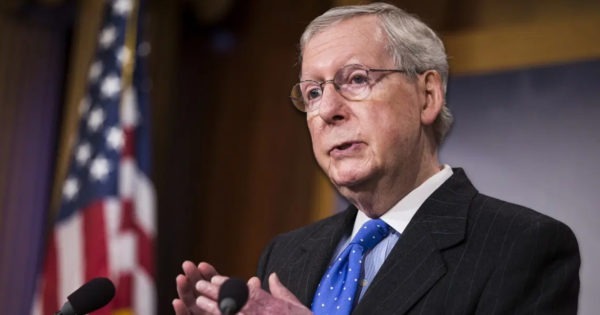
Senate Minority Leader Mitch McConnell yesterday promised to shield Joe Biden from a push for impeachment, telling reporters that the wildly unpopular Biden regime is here to stay despite a disastrous Afghanistan withdrawal that saw 13 American soldiers killed and the Taliban armed with billions of dollars in United States military equipment.
“Well, look, the president is not going to be removed from office,” said McConnell, who was asked if he would support a push for impeachment over the Afghanistan withdrawal. “There isn’t going to be an impeachment,” he added. McConnell then suggested Biden’s performance would result in establishment Republicans making big gains in the 2022 midterm elections, and described the soaring unpopularity of Biden as “buyer’s remorse.”
Despite being friendly with Democrats by advancing Joe Biden’s infrastructure bill that would see drivers taxed per mile, supporting anti-gun, pro-Antifa Attorney General Merrick Garland when he was appointed by Biden. and publicly accusing President Donald Trump of inciting violence on January 6 and suggesting a criminal investigation – even though he voted to acquit him – McConnell has gained few friends on the left.
As National File previously reported, some on the left believe McConnell stole his 2020 Senate reelection using the same type of fraud that many say resulted in Joe Biden winning the presidential election. McConnell also remains a bogeyman to leftists on Twitter, who blame him for the Supreme Court refusing to stop a Texas law that bans abortions after six weeks.
At the same time, McConnell has soured his relationship with the Republican base. As President Trump highlighted earlier this year, McConnell has extensive family ties to China that enriched him heavily. His wife, Elaine Chao, is the daughter of shipping magnets James and Ruth Chao, and the sister of businesswoman Angela Chao, who was appointed to a position on the Bank of China’s board of directors in 2016. He inherited $30 million after the death of Ruth, who owned a shipping titan that, while nominally based in the United States, worked almost exclusively with China and never flew the United States flag while sailing.
Following a lengthy public feud with President Donald Trump that began in the days following the 2020 election, with McConnell at one point allegedly blackmailing the 45th President, using the threat of impeachment to influence his pardons, McConnell was not invited to CPAC in 2021. President Trump has bashed McConnell repeatedly, blaming him for the narrow loss of the Senate in 2021, and referring to him as a “dour, sullen, and unsmiling political hack” who does not deserve the respect he receives in Washington, D.C. McConnell became so unpopular after betraying President Trump that one county in Kentucky demanded his resignation.
At one point this year, the relationship became so sour that Sen. Lindsey Graham (R-SC) went to Florida to visit with President Trump and urge him to end his feud with the establishment Republican leader. Graham is widely seen as McConnell’s logical replacement by the establishment, and McConnell is reportedly working on an exit strategy with the Kentucky Republican Party that would allow him to retire before the end of his term.
Mitch McConnell Promises To Defend Biden Against Impeachment | National File
Never Forget | “How Journalists Helped Promote the Steele Dossier” | Truth Over News
One of the primary promoters of the Steele dossier recently came out with yet another Trump–Russia collusion story. This time, Luke Harding claimed that Russian President Vladimir Putin personally ordered a secret operation to support a “mentally unstable” Donald Trump in the 2016 U.S. presidential election. Harding has a long history of promoting baseless Russia collusion theories. Harding broke the story that Trump’s National Security Adviser Gen. Michael Flynn had had an affair with a Russian spy. He also claimed that Trump’s campaign manager Paul Manafort had visited Julian Assange multiple times. And Harding alleged that the Kremlin had a Russian intelligence officer at the heart of Trump’s campaign. Welcome to Truth over News with Jeff Carlson and Hans Mahncke. . . .
How Journalists Helped Promote the Steele Dossier | Truth Over News
Bannon’s War Room | Episode 2228 | Evening Edition | Recorded October 14, 2022 | Video: 48 Minutes 58 Seconds
Episode 2228: The Attack On Children: From The Medical Board To The School Board.
Nightly News Rebroadcast | October 14, 2022 | Video: 28 Minutes 53 Seconds
The Justice Department on Oct. 14 officially appealed the appointment of the special master who is overseeing the review of documents seized at Mar-a-Lago. Parents at a crowded school board meeting in Michigan voiced their opinion on whether sexually explicit books should be available to children in school libraries and classrooms.
Never Forget | “FBI Drops Thousands of Pages of Documents on Murdered DNC Operative Seth Rich — This is After They Said They Had Nothing” | The Gateway Pundit

Seth Rich LinkedIn
The Stasi FBI released thousands of pages of documents today on murdered DNC operative Seth Rich.
This was after they denied for years they had nothing on the case.
It later was revealed that not only did they have thousands of pages of documents
** The documents were posted today on the FBI Vault —
Have at it…
https://vault.fbi.gov/seth-rich/seth-rich-part-01-of-01/view
For years Attorney Ty Clevenger requested this information on the case from the FBI.
This week the FBI released the information without notifying Clevenger.
Background:
For years we reported on the murder of Seth Rich in Washington DC before the 2016 presidential election.
For four years the FBI lied and said they had nothing on Seth Rich, but then in December 2020 the deep state FBI admitted they have 20,000 pages and a laptop all related to Seth Rich. The Deep State FBI liars finally brought the Seth Rich case out of the closet.
This story started with the release of emails by WikiLeaks related to the DNC and Hillary’s Campaign Manager creepy John Podesta. Within days, in June 2016, Ellen Nakashima, a Deep State favorite from the Washington Post, released a report that the Democrat National Committee (DNC) had been hacked by Russia. The firm that validated this was Crowdstrike and its President Shawn Henry confirmed the claims.
In December 2016, Ms. Nakashima followed up her reporting with the outlandish claim that the CIA had determined that Russia hacked the DNC because Russia wanted Trump to win the election. Nakashima also reported that the Intel Community had determined that Russia also sent the emails to WikiLeaks. This position was reinforced by the Mueller gang in their efforts to have President Trump removed from office.
WikiLeaks released DNC emails related to John Podesta, Hillary Clinton’s Campaign Manager, in the months before the 2016 Presidential election which showed massive corruption combined with an elitist attitude from members of the Hillary Clinton team – all willing to do whatever it took to win an election.
On March 8, 2020 and before on June 16, 2019, we presented arguments against the Mueller gang’s assertion that the DNC was hacked by Russians.
Cyber expert Yaacov Apelbaum posted an incredible report with information basically proving that the DNC was not hacked by the Russians.
Then, after years of being hidden by corrupt-lying Representative Adam Schiff in Congress, a number of testimonies related to the Russia collusion sham were unveiled after Schiff received pressure from Richard Grenell, the Acting Director of National Intelligence (ADNI) to release the transcripts. One transcript was from Crowdstrike’s Shawn Henry who stated under oath that Crowdstrike had no evidence that Russia even “exfiltrated” the emails from the DNC. The whole ‘Russia stole the DNC emails and sent them to WikiLeaks’ story was a fraud.
Many people suspected that in 2016 a young man working for the DNC by the name of Seth Rich, copied emails from the DNC and shared them with WikiLeaks. Mr. Rich was murdered in Washington D.C. in July 2016 and it was labeled a robbery, but his wallet, phone and watch were found on his person when the police arrived at the scene. We reported numerous oddities surrounding his death.
The Mueller gang never looked into the Seth Rich matter and never interviewed Julian Assange from WikiLeaks to determine who provided Assange the DNC emails which were reportedly the cause of the Russia collusion sham. We know this based on his thousand pages of reports where this is never mentioned.
We reported in mid-February 2020 how Attorney Ty Clevenger, who represents a client who is being sued for his comments about Seth Rich, reported to the courts that despite numerous assurances from the FBI that they had no information related to Seth Rich, emails related to Seth Rich were identified and provided to Judicial Watch. It looked like the FBI was lying to Clevenger all along.
In December the FBI admitted they had thousands of pages of information on Seth Rich. The documents were highly redacted when they were turned over to Attorney Ty Clevenger.
The post FBI Drops Thousands of Pages of Documents on Murdered DNC Operative Seth Rich — This is After They Said They Had Nothing appeared first on The Gateway Pundit.
Never Forget | “‘F*ck You’: Pink Floyd Co-Founder Rejects Pricey Facebook Deal” | The Daily Caller

[Twitter:Screenshot:La Jornada]
While speaking at a pro-Julian Assange event, Waters claimed that Facebook asked if the company could use the band’s “Another Brick in the Wall, Part 2” for an upcoming Instagram advertisement.
“It arrived this morning, with an offer of a huge, huge amount of money,” Waters said. “And the answer is, ‘F*ck you. No f*ckin’ way.”
Never Forget | “‘F*ck You’: Pink Floyd Co-Founder Rejects Pricey Facebook Deal” | The Daily Caller
Never Forget | “Snowden slams Harris, Blinken for celebrating World Press Freedom Day” | The New York Post
Edward Snowden slammed Vice President Kamala Harris and Secretary of State Tony Blinken for celebrating World Press Freedom Day as the United States continues its prosecution of Julian Assange.
In a post on Twitter Monday afternoon, Snowden responded to a tweet by the nation’s top diplomat celebrating the rights of journalists as the US maintains its extradition efforts on “espionage” charges against Assange.
“This would be more persuasive if the White House weren’t aggressively seeking an 175-year sentence for the publisher of award-winning journalism of global importance,” Snowden tweeted. “Despite pleas from every significant press freedom and human rights organization.”
In another tweet, this one responding to Harris, Snowden wrote essentially the same message.
Blinken’s tweet said that “the United States continues to advocate for press freedom, the safety of journalists worldwide, and access to information on and offline.
“A free and independent press ensures the public has access to information. Knowledge is power,” he continued.
Never Forget | FBI Releases Documents on Investigation Into Death of Democrat National Committee Worker Seth Rich | The Epoch Times
The FBI has produced 68 pages relating to a Democrat National Committee (DNC) worker who was shot dead in 2016 in Washington, including an investigative summary that appears to say someone may have paid for his death. Seth Rich, the worker, was shot dead in the early morning hours on July 16, 2020, near his home in the nation’s capitol. The murder, which is unsolved to this day, fueled widespread media coverage, especially after WikiLeaks founder Julian Assange suggested that Rich was the person who provided internal DNC emails to WikiLeaks. Rich’s family has called the theory that Rich leaked documents to WikiLeaks a conspiracy theory. Newly released files show top Department of Justice officials met in 2018 and discussed Rich’s murder. They reviewed Rich’s financial records and did not identify any unusual deposits or withdrawals. Additionally, none of the witnesses interviewed during the investigation reported to authorities anything unusual about …
Bannon’s War Room | Episode 2227 | Morning Edition Hour 2 | Recorded October 14, 2022 | Video: 48 Minutes 58 Seconds
Episode 2227: Parents Fight Back In Michigan Against Gender Ideology Being Pushed On Their Children; The Push For True Medical Freedom.
Bannon’s War Room | Episode 2226 | Morning Edition Hour 1 | Recorded October 14, 2022 | Video: 48 Minutes 57 Seconds
Episode 2226: Shapiro Has Failed Pennsylvania And Mastriano Stands Up For Pennsylvania; Democrats Are Bleeding Funding Leading Into Midterms.
Nightly News Rebroadcast | October 13, 2022 | Video: 28 Minutes 53 Seconds
The January 6 Committee voted unanimously on Oct. 13 to subpoena former President Donald Trump to testify before the panel. The Supreme Court denied Trump’s request to intervene in the dispute over classified documents seized at Mar-a-Lago.
Bannon’s War Room | Episode 2225 | Evening Edition | Recorded October 13, 2022 | Video: 48 Minutes 58 Seconds
Episode 2225: We Are Going To Experience Years Of Entrenched Inflation.
Ukraine’s Kyiv Area Hit By Iranian-Made Kamikaze Drones | The Associated Press

A man reacts near the body of his cousin, killed in a Russian rocket attack in Mykolaiv, Ukraine, Thursday, Oct. 13, 2022. (AP Photo/LIBKOS)
KYIV, Ukraine (AP) — Russian forces attacked Ukraine’s Kyiv and Odesa regions with Iranian-made drones and used missiles to strike other areas Thursday, Ukrainian officials said as Moscow punished the country for a fourth day after a truck bomb damaged a bridge to the annexed Crimean Peninsula.
A strike carried out near Makariv, a small city located 50 kilometers (31 miles) west of Kyiv, destroyed critical infrastructure. Throughout the capital region, residents whose lives had resumed some normalcy when the war moved east months ago again awoke to air raid sirens.
Russia intensified its bombardment of civilian areas in recent weeks as its military lost ground in multiple occupied regions of Ukraine that President Vladimir Putin illegally claimed as Russian territory. Putin’s supporters urged him to escalate the campaign further after the Crimea bridge attack.
It wasn’t clear if the explosive-packed drones caused any casualties. Ukrainian officials said dozens of people died this week after the Russian military ramped up the scope of its attacks, including at least two killed Thursday in a missile strike that destroyed an apartment building in southern Ukraine.
Ukrainian officials said Thursday that Iranians in Russian-occupied territories of Ukraine were training Russians how to use the Shahed-136 systems, which can conduct air-to-surface attacks, electronic warfare and targeting. Their deployment may indicate the Russian military is running out of its own drones. . . .
Ukraine’s Kyiv Area Hit By Iranian-Made Kamikaze Drones | AP News
Larry Elder: Protests in Iran — the silence of the ‘feminists’ and ‘progressives’ | BizPac Review
Where are the American feminists and “progressives” when we need them? You know, the men-versus-women, pro-abortion types who say things like the reversal of Roe v. Wade represents “men wanting to tell women what to do with their bodies”?
Last month, on Sept. 16, Mahsa Amini, a 22-year-old woman living in Iran, died in a hospital three days after being arrested in Tehran by the state’s morality police known as “Guidance Patrols.” Her “crime”? She showed too much hair underneath her hijab, or headscarf.
The New York Times reported: “The police did not offer an explanation for why Ms. Amini was detained, other than that it involved the hijab rule. Her mother said in an interview with Iranian news media that her daughter was observing the rules and wearing a long, loose robe. She said Ms. Amini was arrested as she exited the subway with her brother, and that his pleas that they were visitors to the city were ignored.”
According to the BBC: “Eyewitnesses said Mahsa Amini was beaten while inside a police van when she was picked up in Tehran on Tuesday. Police have denied the allegations, saying Ms Amini had ‘suddenly suffered a heart problem.’” However, at least one Iranian judicial official, according to state media, said the woman suffered “multiple fractures … in the pelvis, head, upper and lower limbs, arms and legs, which indicate that the person was thrown from a height.”
In protest, women in Iran are cutting their hair, with some taking to social media and burning their hijabs. Two weeks ago, CNN reported: “Protests have swept through more than 40 Iranian cities, including the capital Tehran. Iranian security forces have been cracking down on protesters, with hundreds arrested and at least 41 killed, according to state media. Some human rights organizations say the death toll is as high as 76.” As for Iran, Human Right Watch states: “Since March 21, 2022, at the beginning of Iranian New Year, Human Rights Activists News Agency (HRANA) has documented 306 executions, 130 of them for drug-related charges and 151 of them based on the Islamic principle of qisas, or ‘retribution in kind’ punishments. Between May 21 and June 21 alone, the group documented 99 executions.”
Rep. Alexandria Ocasio-Cortez, D-N.Y., tweeted: “Solidarity with the courageous women and allies in Iran protesting for their freedom. Mahsa Amini was senselessly murdered by the same patriarchal and autocratic forces repressing women the world over. The right to choose belongs to us all, from hijabs to reproductive care.” And Rep. Ilhan Omar, D-Minn., put out a statement: “Those responsible for her death should be held accountable and the world should be united in fighting against the policing of what women wear and how they show up in society. Banning the hijab is not much different than forcing one on women. Religious beliefs are personal and should never be imposed on anyone. (May God have mercy upon her soul).”
Rashida Tlaib, D-Mich., who once said about President Donald Trump, “We’re going to impeach this mother-f—-er,” and after the reversal of Roe v. Wade, tweeted, “Reproductive rights are human rights that remain under threat across the country,” tweeted mildly, “I stand in solidarity with the Iran protests as they fight for a woman’s right to bodily autonomy and against police brutality in the wake of the horrifying murder of Mahsa Amini.”
As for the rest of The Squad, silence.
No call by American feminists and progressives for the collapse of the totalitarian government of Iran. No wholesale condemnation of this police state’s mandate that women wear the hijab and face imprisonment for failing to do so, or for failing to wear it “correctly.” No plea that the Biden administration, at the very least, publicly support the Iranian protesters demonstrating the same kind of courage as have the Ukrainians following the Russian invasion.
Talk about “men telling women what to do with their bodies”! All the elements to make this an Iranian George Floyd moment are present. But the relative silence by The Squad has been deafening.
Larry Elder is a best-selling author and nationally syndicated radio talk-show host. To find out more about Larry Elder, or become an “Elderado,” visit www.LarryElder.com. Follow Larry on Twitter @larryelder.
Larry Elder: Protests in Iran — the silence of the ‘feminists’ and ‘progressives’ | BizPac Review
Pro-Life Protesters Speak Out on FBI Arrest; Alex Jones to Pay Nearly $1 billion for Hoax Claims | NTD Good Morning
The Justice Department has charged 11 pro-life activists for blocking access to an abortion clinic. Find out what supporters had to say in their defense at a press conference on Oct 12.
A Connecticut jury orders Info-wars host Alex Jones to pay close to $1 billion. Meanwhile, Jones continues to frame the trial as a free speech case.
Former Congresswoman Tulsi Gabbard has another surprise. It comes just a day after she announced leaving the Democratic party.
Topics in this episode include:
1. DOJ Charges 11 Pro-Life Activists
2. Jury Orders Alex Jones to Pay Nearly $1B
3. Gabbard to Stump for GOP U.S. Senate Nominee
4. Biden to Saudis – ‘1 More Month’
5. New Plan to Expel Venezuelan Migrants at Border
6. UN Demands Russia Reverse Annexations in Ukraine
7. Largest Fentanyl Seizure in NYC’s History
8. Homeless Surge After End of Covid Help
9. Virgin Orbit Plans First UK Rocket Air-Launch
10. Chinese Firm Tests Electric Flying Taxi in Dubai
11. Together Anything is Pawsible
12. Large Herd of Sheep Cause Traffic Jam in Utah
13. ‘Fat Bear Week’ Winner…
Pro-Life Protesters Speak Out on FBI Arrest; Alex Jones to Pay Nearly $1 billion for Hoax Claims | NTD Good Morning
Bannon’s War Room | Episode 2224 | Morning Edition Hour 2 | Recorded October 13, 2022 | Video: 48 Minutes 58 Seconds
Episode 2224: We Are Plummeting Due To The Regimes Zero Percent Interest Rate Policy; The Doors To Transhumanism Are Open.
Macron urges Putin to ‘return to the table’ on Ukraine | Infowars
French President Emmanuel Macron has urged Moscow to return to peace negotiations, while at the same time pledging additional military support for Kiev amid the ongoing escalation in the Russia-Ukraine conflict.
Speaking to the France 2 broadcaster on Wednesday, Macron condemned the large-scale missile attack launched by Russia against Ukraine’s critical infrastructure in the aftermath of the terrorist attack on the Crimea bridge. The missile strikes have shown that the conflict has entered “an unprecedented stage,”Macron asserted, claiming that “for the first time all over Ukraine civilians have been killed … and electricity and heating facilities have been destroyed.”
“We’re going to deliver … radars, systems and missiles to protect them from these attacks,” Macron said, adding that France is also negotiating delivery of six additional Caesar self-propelled howitzers to Ukraine. The artillery pieces were originally built for Denmark. . . .
Macron urges Putin to ‘return to the table’ on Ukraine | Infowars
Rep. Gosar: ‘The Anti-Christian Biden Regime Will be Defeated’ | National File
Last Updated on October 12, 2022
Arizona Rep. Paul Gosar let loose on the “anti-Christian Biden regime,” kicking off a series of tweets he’s put out over the course of this week blasting the “Biden crime family” and championing the America First movement. The American people, Gosar tweeted, are sick and tired of being “looted blind by warmongers and illegal aliens.”
“I wear Biden’s attacks on me as a badge of honor,” Gosar, perhaps the most pro-Trump, America First-aligned Congressman on Capitol Hill, said in a quote he attached to a Sunday tweet. “The anti-Christian Biden Regime will be defeated by the America First movement.”
America First. pic.twitter.com/hawy8uLYEi
— Rep. Paul Gosar, DDS (@RepGosar) October 9, 2022
The next day, Gosar followed up with another scathing review of the anti-American Biden agenda.
“Our country is being looted blind by warmongers and illegal aliens,” Gosar said in the tweet. “The American people are sick of it.”
America must be put FIRST again. pic.twitter.com/dji48Nx6b0
— Rep. Paul Gosar, DDS (@RepGosar) October 10, 2022
“Let’s put Americans first for a change,” Gosar wrote the following day, including another graphic directed at Joe Biden, his “crime family,” and corrupt Ukrainian President Zelensky.
“Biden and his crime family may owe Zelensky, but America doesn’t owe him a damn thing,” the Congressman says in the tweet, which comes on the heels of the Biden Administration announcing that even more American tax dollars will be sent to Ukraine.
Let’s put Americans first for a change. pic.twitter.com/ciPsJRm1tx
— Rep. Paul Gosar, DDS (@RepGosar) October 11, 2022
Currently, Americans are learning of multi-billion dollar aid packages to the deeply corrupt nation of Ukraine on a near-weekly basis.
Though corporate media reports have encouraged hysteria and claim that Kiev is on the verge of destruction should America not send more money, in real-life, the Ukrainian ruling class is partying on Americans’ dime, while Ukraine’s working class dies for a Sorosian cause.
Rep. Gosar’s Twitter statements come as the Arizona Congressman continues to be a leader in the America First movement, already securing re-election as no Democrat can even qualify for the ballot to take him on.
In a series of posts made to Gab last month, Gosar took on the racist affirmative action programs that deny White and Asian Americans opportunities they’ve actually earned by putting less qualified individuals in their place.
Rep. Gosar: ‘The Anti-Christian Biden Regime Will be Defeated’ | National File
BREAKING: Saudi Arabia Foreign Ministry Confirms Joe Biden Attempted to Coerce Kingdom to Cut Oil Prices Until After Midterm Election | The Gateway Pundit
On Tuesday Joe Biden threatened US ally Saudi Arabia during his CNN interview. Biden told Jake Tapper Saudi Arabia will face “consequences” for its oil production cuts announced this past week.
BREAKING: Here is Joe Biden threatening Saudi Arabia if they do not ramp up oil production 1 month before Congressional elections where his party is expected to lose
This is what Trump was impeached for in 2019
Jake Tapper does not follow up on this in any way pic.twitter.com/DvPzozmvBh
— Jack Posobiec (@JackPosobiec) October 12, 2022
Less than 24 hours later on Wednesday night the Kingdom of Saudi Arabia’s Foreign Ministry released a public statement on social media.
The Kingdom confirmed that Joe Biden attempted to coerce them to cut oil prices until AFTER the election.
A statement from the Ministry of Foreign Affairs regarding the statements issued about the Kingdom following the OPEC+ decision. pic.twitter.com/Bo7JVPDzFo
— Foreign Ministry (@KSAmofaEN) October 12, 2022
In the Foreign Ministry’s statement, the kingdom confirms that Joe Biden pressured the Saudi royalty to delay cuts in output and lower oil costs for another month until after the midterm election.
Here is the transcript:
An official at the Foreign Ministry in the Kingdom of Saudi Arabia stated that the government of the Kingdom of Saudi Arabia has viewed the statements issued about the Kingdom following the OPEC+ decision announced on October 5, 2022, which have described the decision as the Kingdom taking sides in international conflicts and that it was politically motived against the United States of America.
The Government of the Kingdom of Saudi Arabia would first like to express its total rejection of these statements that are not based on facts, and which are based on portraying the OPEC+ decision out of its purely economic context. This decision was taken unanimously by all member states of the OPEC+ group.
The Kingdom affirms that the outcomes of the OPEC+ meetings are adopted through consensus among member states, and that they are not based on the unilateral decision by a single country.
These outcomes are based purely on economic considerations that take into account maintaining balance of supply and demand in the oil markets, as well as aim to limit volatility that does not serve the interests of consumers and producers, as has been always the case within OPEC +.
The OPEC+ group makes its decisions independently in accordance with established independent practices followed by the international organizations. The Government of the Kingdom of Saudi Arabia would also like to clarify that based on its belief in the importance of dialogue and exchange of views with its allies and partners outside the OPEC + group regarding the situation in the oil markets, the Government of the Kingdom clarified through its continuous consultation with the US Administration that all economic analyses indicate that postponing the OPEC+ decision for a month, according to what has been suggested, would have had negative economic consequences.
The Government of the Kingdom of Saudi Arabia affirms that any attempts to distort the facts about the Kingdom’s position regarding the crisis in Ukraine are unfortunate, and will not change the Kingdom’s principled position, including its vote to support UN resolutions regarding the Russian-Ukrainian crisis, based on the Kingdom’s position on the importance for all countries to adhere to the United Nations Charter, principles of international law, and the Kingdom’s rejection of any infringement on the sovereignty of countries over their territories.
The Kingdom stresses that while it strives to preserve the strength of its relations with all friendly countries, it affirms its rejection of any dictates, actions, or efforts to distort its noble objectives to protect the global economy from oil market volatility. Resolving economic challenges requires the establishment of a non-politicized constructive dialogue, and to wisely and rationally consider what serves the interests of all countries.
The Kingdom affirms that it view its relationship with the United States of America as a strategic one that serves the common interests of both countries. The Kingdom also stresses the importance of building on the solid pillars upon which the Saudi-US relationship had stood over the past eight decades.
These pillars include mutual respect, enhancing common interests, actively contributing to preserve regional and international peace and security, countering terrorism and extremism, and achieving prosperity for the peoples of the region.
This should lead to Congressional hearings.
Saudi Arabia Rejects White House Criticism of Oil Output Cuts, Says US Asked for Delay Until Midterms | Epoch Times
The Saudi Arabian government on Wednesday night rejected White House criticism over a decision by a cartel of key oil-producing countries to cut production of the much-needed resource and confirmed the Biden administration requested it delay until after the U.S. midterm elections.
Saudi Foreign Minister Prince Faisal bin Farhan Al Saud also accused the U.S. government of attempting to “distort” the facts about the kingdom’s position on the Russia-Ukraine war.
On Wednesday, White House national security adviser Ned Price denied reports that Biden administration officials had requested the Organization of the Petroleum Exporting Countries (OPEC+) delay its decision to cut oil production until after the midterms….
Tulsi rattles Joe Rogan with prediction that Biden regime policies will lead to ‘World War III and a nuclear holocaust’ | BizPacReview
Former congresswoman Tulsi Gabbard not only succeeded in drawing attention to the fanatical ideologues and warmongers who are in control of the Democratic party when she announced her departure on Tuesday, but is also raising awareness that the reckless foreign policy of the Biden regime has put America on the road to a nuclear apocalypse.
Gabbard appeared on the latest edition of Joe Rogan’s popular Spotify podcast hours after she announced her split with the party where she stunned the host with her assessment of the dire situation that currently exists with Washington D.C. feeding the fire in the increasingly dangerous conflict between Ukraine and Russia, one that she suggested could escalated into “World War III and a nuclear holocaust” and likened the American people to “sitting ducks” whose lives could be snuffed out due to the deadly games being played by our leaders.
“Are you going to run for any kind of office as an independent?” Rogan asked her of her plans for a future political career now that she is an independent.
“I’m not running for anything now,” Gabbard answered. “I am deeply, deeply concerned about this very real and imminent threat of nuclear war that no one is talking about. That no one is preparing the American people for.”
“That people are kind of sitting ducks because of the decisions that our leaders have made. If I felt that there was a way that I could stop that and make a difference and impact that and pull us back from the brink, then yeah, I’d seriously consider running again,” she said. “My concern though is like, we don’t know what’s gonna happen, and you know, we don’t know if it’s gonna be too late.”
A visibly stunned Rogan struggled to find words after her grim assessment.
“There’s no way to argue with that. That’s like — as you’re saying this, I’m like, yeah, yeah,” he said. “I mean, I wish I had a counterpoint. Is it possible that this? — Yeah, but I don’t — this does not look good. And I don’t know how many people are even really truly aware of how close we are.”
“Most people aren’t,” Gabbard said. “And part of it is because, again, the media hardly covers it. And if they do, they’re talking about it as though it’s like, you know, one missile system against the other. They’re talking about the waging of a nuclear war as though it can be won or as though there’s some kind of limitation to the destruction and devastation that it will cause,” pointing out that the thoroughly corrupt media will also have blood on its hands if Armageddon comes to pass as Biden recently suggested.
She later faulted the current leadership for failing to push for the two warring countries to get to the negotiating table to arrive at a peaceful resolution.
Rogan later asked her what she thought would happen if an unthinkable war erupted between the U.S. and Russia as a result of Biden’s brinksmanship.
“I’m gonna ask you a difficult question. What do you think is gonna happen?” Rogan asked.
“If we continue down this path that we have seen, where we have seen this war continue to escalate since the invasion happened? We will end up in World War III and a nuclear holocaust,” she said, not bothering to sugarcoat it. . .
Bannon’s War Room | Episode 2223 | Morning Edition Hour 1 | Recorded October 13, 2022 | Video: 48 Minutes 58 Seconds
Episode 2223: You’re About To Lose A Decade Of Your Financial Future; The Biden Regime Has Turned Our Country Has Become A Business Model That Does Not Work.
Bannon’s War Room | Episode 2222 | Evening Edition | Recorded October 12, 2022 | Video: 49 Minutes
Episode 2222: When You Have To Pay For Freedom Of Speech; Florida’s State Surgeon General Pushes Back Against The WAPO Accusations.
Nightly News Rebroadcast | October 12, 2022 | Video: 26 Minutes 4 Seconds
A jury on Oct. 12 ordered Alex Jones to pay $965 million to relatives of the victims of the Sandy Hook school shooting. Pro-life activist Paul Vaugn speaks out after the FBI raided his home in Tennessee last week.