
migration
Despite COVID, many hospitals had a banner year with federal coronavirus bailout cash

Some of the richest hospital systems had hundreds of millions in surpluses. But CommonSpirit Health, based in Chicago, lost money despite getting about $1B in grant money.
Last May, Baylor Scott & White Health, the largest nonprofit hospital system in Texas, laid off 1,200 employees and furloughed others as it braced for the then-novel coronavirus to spread.
The cancellation of lucrative elective procedures as the hospital pivoted to treat a new and less profitable infectious disease presaged financial distress, if not ruin. The federal government rushed $454 million in relief funds to help shore up its operations.
But Baylor not only weathered the crisis, it thrived. By the end of 2020, Baylor had accumulated an $815 million surplus — $20 million more than it had in 2019, creating a 7.5% operating margin that would be the envy of most hospitals in the flushest of eras, a KHN examination of financial statements shows.
Like Baylor, some of the nation’s richest hospitals and health systems recorded hundreds of millions of dollars in surpluses after getting the lion’s share of the federal health care bailout grants, their records show. Those included the Mayo Clinic, Pittsburgh’s UPMC and NYU Langone Health.
But poorer hospitals — many serving rural and minority populations — got a tinier slice of the pie and limped through the year with deficits, downgrades of their bond ratings and bleak fiscal futures.
/cdn.vox-cdn.com/uploads/chorus_asset/file/22421775/Grogan.jpg) University of Chicago
University of Chicago“A lot of the funding helped the wealthy hospitals at a time, especially in New York, when safety-net hospitals were hemorrhaging,” said Colleen Grogan, a health policy professor at the University of Chicago. “We could have tailored it to hospitals we knew were really suffering and taking on a disproportionate amount of the burden.”
Baylor, which runs Baylor University Medical Center in Dallas and 51 other hospitals, says it spent $257 million last year on pandemic-related costs, including protective clothing for employees and patients and creating isolation rooms. Baylor says it has $197 million in unspent federal relief funds to use this year to cover costs of battling the virus and refrigerating vaccines.
“Our COVID-19-related expenses and lost revenue continue to exceed the funding we have received,” Baylor said in a written statement.
Other well-off hospitals and health systems faced bigger problems. CommonSpirit Health — a 140-hospital Catholic system that’s based in Chicago and operates in 21 states — and NewYork-Presbyterian Hospital lost money despite federal grants in the vicinity of a billion dollars each.
A few systems, including the for-profit chain HCA Healthcare, returned federal funds when they saw they had skirted their worst-case scenarios.
But most spent the aid and held onto any leftover money and new grants to cover pandemic costs this year.
Much of the lopsided distribution was caused by how the federal Department of Health and Human Services based the allotment of the initial bailout money on hospitals’ past revenue. That favored institutions with well-off patients withprivate health insurance over those that rely on lower-paying government insurance that many poor people use.
HHS didn’t take into account which hospitals had enough assets to survive.
Baylor, for instance, began 2020 with $5.4 billion in cash and investments — enough to keep it running for 238 days, the financial disclosures show.
Hospitals that ended the year with profits were entitled to aid because of the extraordinary latitude Congress and HHS set for how hospitals could classify pandemic costs.
Last fall, when HHS tried to limit how much aid hospitals could keep based on their profits — so money could be redirected to struggling hospitals — the effort was beaten back by the industry and Congress.
HHS officials declined interview requests but, in a written statement, said Congress ordered it to revert to its “broader definition of permissible use of . . . funds.”
The bailouts were initiated last spring to help healthcare providers ride out a once-in-a-century public health calamity. The money for hospitals and other healthcare providers from the Coronavirus Aid, Relief, and Economic Security Act and subsequent legislation totaled $178 billion.
It was intended to offset all costs of treating infected patients, including buying ventilators, masks, gowns and other personal protective equipment. Congress also authorized hospitals to use the money to compensate for a drop in revenue when they shut down elective surgeries and non-emergency treatments to prepare for the anticipated deluge of coronavirus patients.
The money — the Provider Relief Fund — helped many poorer hospitals avert cash crunches, layoffs and bond-rating downgrades. A survey by the consulting firm Kaufman Hall found that the median hospital gain during 2020 would have been 0.3% without federal support. With it, half of hospitals posted gains of 2.7% or more, below the 2019 median of 3.1%, according to the firm, which also does work for the American Hospital Association.
In February, the association urged Congress to replenish the near-empty relief fund, saying, “Hospitals have never experienced such a widespread, national health crisis.”
Some hospitals’ finances deteriorated significantly during the pandemic. From the end of March through December, the rating agency Moody’s downgraded 28 hospitals, primarily because of weaknesses like higher debt or more competition, said Lisa Goldstein, associate managing director at Moody’s.
Others suffered worse fates, like Williamson Memorial Hospital, which closed last April. The hospital, in West Virginia’s coal country, had been trying to climb out of bankruptcy protection, but “the decline in volumes experienced from the current pandemic were to[o] sudden and severe for us,” its CEO wrote on Facebook.
Conversely, many prosperous health systems emerged unscathed, often due to the federal aid.
“It gave them an ability to not have to draw down on their reserves to make up for the loss in revenue,” said Suzie Desai, a senior director for S&P Global Ratings.
Systems saw patient visits return to near normal as the year wore on. In some cases, business in the latter half of 2020 was higher than the previous year because of demand for treatments postponed from the spring, records show.
“We saw volumes spring back” in every area except emergency visits, said Kevin Holloran, a senior director for Fitch Ratings.
Major hospital systems also reported that cases tended to be more complex than normal, leading to higher insurance payments.
UPMC accepted $460 million in bailout money while collecting $2.5 billion more in revenue in 2020 than in 2019. The nonprofit system ended the year with an $836 million operating surplus — a 3.6% margin that was triple the prior year’s — in part due to growth of the health insurance plan the system owns.
Other hospitals that sold insurance, including Baylor, persevered because the cause of their financial troubles — fewer surgeries and doctor visits — meant the health plans paid fewer claims.
UPMC’s strong finances went unmentioned in a recent fundraising pitch launching its “Health Care Heroes” campaign: “During the past year, health care workers have carried the weight of the world on their shoulders, risking their own health and safety to ensure ours as we navigated the COVID-19 pandemic. … By making a donation, you will help provide training, recognition and support for our staff initiatives.”
Donald Yealy, chief medical officer of UPMC Health Services, said the appeal was a way to let people in the community show their appreciation.
Hospitals can hold onto unspent relief money until the end of July to defray further pandemic-related costs. After that, any unspent money must be returned.
UPMC retains $80 million in unspent relief money, which it expects to use, said Edward Karlovich, its chief financial officer.
In April 2020, the Mayo Clinic in Rochester, Minnesota, forecast up to $3 billion in lost revenue from the pandemic. Instead, Mayo, which got $338 million in federal relief money, ended the year with revenue $202 million higher than in 2019. It saw a $728 million surplus — a 5.2% margin.
“It gave us a shot in the arm when we needed it,” said Dennis Dahlen, Mayo’s chief financial officer.
Later, when it seemed likely Mayo would run a surplus, executives debated what to do with the federal money and “landed in a middle-of-the-road decision,” returning $156 million.
“We considered it with what everyone else was doing … and we thought about what was good for society,” Dahlen said. “‘Nonprofit’ doesn’t really mean no profit. It means tax-exempt. We still have to create earnings so we can reinvest in ourselves.”
Mayo ended the year with $14 billion in investments — $3 billion over 2019, a 29% increase.
The federal money was a lifesaver for some health systems.
Marvin O’Quinn, president and chief operating officer of CommonSpirit Health, said, “There was never a thought of turning back the money.”
/cdn.vox-cdn.com/uploads/chorus_asset/file/20078355/Screen_Shot_2020_07_11_at_7.18.33_AM.png) Ashlee Rezin Garcia / Sun-Times file
Ashlee Rezin Garcia / Sun-Times fileDespite taking $1.3 billion in relief money, CommonSpirit, with headquarters at 444 W. Lake St., ended last year with a $75 million deficit — a 0.2% loss.
“All the things we wanted to do — to renovate, to build new facilities, to expand our service — we’ve had to slow up to get through the crisis,” O’Quinn said.
The first $50 billion in relief money “was sent out indiscriminately as a life support,” said Ge Bai, an associate professor at Johns Hopkins Bloomberg School of Public Health.
HHS tried to target later distributions. It sent $22 billion to 1,090 hospitals with large numbers of COVID patients. It sprinkled $16 billion among hospitals serving poor populations, Native American tribes, people in rural areas and children.
Still, recipients included well-endowed academic medical centers and major urban hospitals. Only $14 billion took profitability into consideration, HHS documents show. It restricted those payments to hospitals with 3% or lower profit margins.
Wealthy hospitals also benefited because of HHS’s broad definition of lost revenue. If a hospital made less than the year before or just had less revenue than budgeted, it could chalk that up to the pandemic and apply the relief money to it.
In September, HHS tried to tighten limits on how much the hospitals could keep by basing that on the difference from the previous year’s net income rather than overall revenue to “probit most providers from using [Provider Relief Fund] payments to become more profitable than they were pre-pandemic, to conserve resources to allocate to providers who were less profitable.”
The American Hospital Association, based in Chicago, complained that would punish hospitals that cut costs and would be an “administrative and accounting disaster.”
HHS backed down, citing “significant attention and opposition from many stakeholders and Members of Congress.” Congress cemented the rollback in a December law.
Some hospital executives attributed their surpluses to aggressive cost-cutting.
NYU Langone Health got $461 million in relief money, covering about a third of its pandemic losses, said Daniel Widawsky, chief financial officer. Another third of Langone’s losses was absorbed by the record financial performance in the months before the pandemic, he said, and cost control addressed the rest. Widawsky said that, in March 2020, Langone canceled travel, froze hiring, paused construction and stopped discretionary purchases. “If they wanted to buy a pencil, they had to call me,” he said.
Langone ended its fiscal year in August with $208 million in net income and a $136 million surplus in the final quarter of 2020, or 5.5%. Earlier this year, two credit agencies upgraded their outlook on Langone from “stable” to “positive.”
Despite taking $942 million in bailout money, NewYork-Presbyterian Hospital had a $457 million operating deficit, a 7% loss, at the end of September — a sharp turn from September 2019, when it recorded a $166 million surplus, a 2.5% gain.
The system, which declined to comment, hasn’t released its financial metrics for the final three months of 2020. Fitch projected it would stay in the red. Still, NewYork-Presbyterian remains fiscally solid: Its most recent disclosure reported $3.8 billion in cash and short-term investments, enough to keep operating for over a year.
KHN (Kaiser Health News) is a nonprofit newsroom that produces in-depth journalism on health issues.
AstraZeneca’s Covid vaccine ‘may not be suitable for young people’, Prof Lockdown says
The UK’s MHRA vaccine regulator could stop younger people from having AstraZeneca ‘s coronavirus jab as soon as tomorrow over concerns about rare cases of blood clots.
NYC COVID positivity rate remains steady even as vaccines ramp up
New York City’s coronavirus positivity rate has remained stubborn for weeks — while new cases are only slowly inching downward — even as the city continues to ramp up vaccinations, the latest data shows. The Big Apple has a COVID-19 positivity rate of 6.55 percent on a seven-day rolling average – and that figure…
Texas COVID Cases, Deaths Plummet After Gov. Abbott Repeals Mask Mandate
Texas’ coronavirus case and death totals have collapsed in the month since Republican Gov. Greg Abbott repealed the state’s mask mandate.
Since Abbot repealed Texas’ mask mandate on March 2, Texas’ COVID-19 cases have dropped by about 4,000 per day, while the state’s deaths have dropped by 137 per day, according to the New York Times’ COVID tracker.
Many Democratic politicians predicted that Texas’ cases and deaths would skyrocket as a result of Abbott’s move.
Twitter Suspends Marjorie Taylor Greene After She Tweets ‘He Is Risen! Happy Easter!’

U.S. Rep. Marjorie Taylor Greene (R-GA) was suspended by Twitter this morning, shortly after she tweeted “He Is Risen,” something said by billions of Christians to celebrate the resurrection of Jesus Christ.
In its message to Greene, Twitter did not note what offense she made, however, many pundits and Greene herself have noted that the action happened soon after she tweeted “He Is Risen” on Easter morning. Twitter simply notified Greene, “We have determined that you have violated the Twitter Rules, so we’ve temporarily limited some of your account features.”
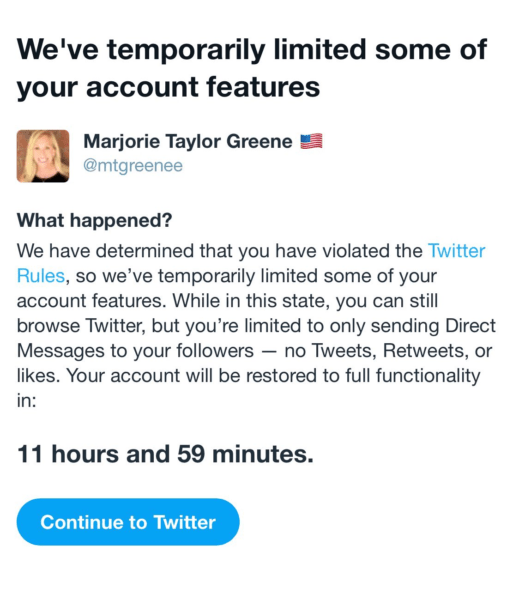
On Gab, Greene wrote, “After tweeting, “He is risen! Happy Easter!” I was suspended this morning for 12 hours! Was it my Christian faith? My never ending demand to an end to murdering God’s creation in the womb? Is it my fight to protect our greatest right to defend ourselves, come and take them? My willingness to Fire Fauci? Maybe my fight to stop mandated vaccine passports? Or how about calling out Ilhan Omar?”
“Or really… Fighting with every ounce of my body to Save America and Stop Socialism!!! Message to Big Tech: I’LL NEVER STOP!!! You can’t silence me. You can’t stop me. The People are with me. And so are the greatest conservatives especially President Trump!!!” Greene added.

Twitter has previously suspended Greene multiple times, most recently as the House of Representatives debated ejecting her from Congress. Twitter later admitted the action was taken by mistake, however, not until after Greene was left unable to use the platform to defend herself against charges levied by Democrats and anti-America First Republicans.
GOP Rep. Greene Introduces Bill to Cut Fauci’s $400,000 Salary to Zero Until He Is Replaced
The post GOP Rep. Greene Introduces Bill to Cut Fauci’s $400,000 Salary to Zero Until He Is Replaced appeared first on The Georgia Star News.
Rep. Marjorie Taylor Greene Says Democrat-Led Effort to Expel Her ‘Will Fail’
Rep. Marjorie Taylor Greene (R-Ga.) on Monday said that an attempt by some Democrats to expel her from Congress is “very foolish” because she has done “absolutely nothing wrong,” adding that she believes the effort will ultimately fall through. About 70 House Democrats led by Rep. Jimmy Gomez (D-Calif.) signed a resolution last week to expel the embattled lawmaker from office on the grounds that Greene “had previously supported social media posts calling for political violence against the Speaker of the House, members of Congress, and former President Barack Obama.” House Speaker Nancy Pelosi (D-Calif.) has since said that she doesn’t agree with the resolution. A two-thirds supermajority is needed to expel a Congress member, meaning that a significant number of Republicans would need to back the Democrat-led effort. “It would be very foolish for anyone in Congress to expel me when I have done absolutely nothing wrong,” Greene told …
‘What a coincidence?’ Marjorie Taylor Greene demands Twitter explain ‘error’ in suspending account

On Friday, Twitter inexplicably suspended Rep. Marjorie Taylor Greene’s account for 12 hours on their platform due to what they now claim was an error. This coincided […]
Continue reading ‘What a coincidence?’ Marjorie Taylor Greene demands Twitter explain ‘error’ in suspending account …
Coronavirus cases continue to trend upward despite productive vaccination days (LIVE UPDATES)
Latest
2,839 new COVID-19 cases in Illinois as Cook County faces ‘the beginning of another surge’
/cdn.vox-cdn.com/uploads/chorus_asset/file/22419935/CV_UPDATE_032421_08.jpg) Ashlee Rezin Garcia/Sun-Times
Ashlee Rezin Garcia/Sun-TimesA troubling rise in COVID-19 cases across the Chicago area and the rest of Illinois means another coronavirus “clamp-down” could soon be in store for businesses in suburban Cook County, officials warned Saturday.
The Illinois Department of Public Health reported 2,839 new cases of the deadly respiratory disease were diagnosed across the state, raising Illinois’ average testing positivity rate to 3.8%. That figure has almost doubled in just three weeks.
Hospitals statewide have seen a 32% increase in COVID-19 patients over that period, with 1,426 beds occupied Friday night.
And with about 600 people testing positive in Cook County each day — most of them young adults — suburban cases have more than doubled over the past month, according to Dr. Rachel Rubin, co-lead and senior medical officer for the Cook County Department of Public Health.
“We are in the beginnings of another surge now,” Rubin said during a virtual news conference. “Maybe this is as high as we’ll go, and maybe it’ll level out and go down. We can’t say. It’s very very hard to predict. But that’s one of the reasons we’re pushing out vaccine as quickly as we get it.”
The state reported its second-most productive vaccination day yet with 145,315 doses administered Friday. At a rolling average of 110,057 shots given per day, Illinois is vaccinating more people than ever — but still, only 18.2% of the population have been fully immunized.
Read the full story from Mitchell Armentrout here.
News
9:05 a.m. From child care to COVID-19, rising job market faces obstacles
WASHINGTON — A surge in hiring in the United States last month — 916,000 added jobs, the most since August — coincides with growing confidence that a blistering pace of job growth will continue as vaccinations increase and federal aid fuels economic growth.
The most optimistic economists even predict that between now and year’s end, the nation could produce as many as 10 million more jobs and restore the labor market to its pre-pandemic level.
Maybe so. Yet even in normal times, it would be hard to regain all those jobs so quickly. And these aren’t normal times.
Many people who’ve been thrown out of the labor force remain fearful of the coronavirus and reluctant to take face-to-face service jobs. Millions of women are still caring for children attending school online — and can’t take jobs because they can’t find or afford child care.
Extended unemployment aid has meant that some employers might have to pay more to attract workers, which they may feel unable to do. And some people will need new skills before they can land a job to replace the one they lost.
While few doubt that the trillions in federal money flowing through the economy will help accelerate hiring, the challenges are sure to endure. Here’s a look at some of them:
New Cases & Vaccination Numbers
- The Illinois Department of Public Health reported 2,839 new cases of the deadly respiratory disease were diagnosed across the state.
- The state reported 13 more COVID-19 deaths, including that of a Cook County woman in her 40s.
- Illinois’ pandemic death toll is up to 21,361, among almost 1.3 million who have tested positive over the past year.
- Public health officials announced Friday that more than 6 million COVID-19 vaccinations have now gone into Illinois arms.
Wisconsin Governor Asks Court to Force Sidney Powell, Trump to Pay Over $100,000 in Legal Fees
Wisconsin Gov. Tony Evers on March 31 asked a federal court to force lawyer Sidney Powell and her client to pay more than $106,000 in legal fees over a lawsuit regarding the state’s presidential election results, and he’s seeking $144,000 from former President Donald Trump and his lawyers, according to court filings. “A message must be sent that this type of behavior cannot be tolerated in the judicial system, and that attorneys should avoid these types of frivolous attempts to disenfranchise voters in the future,” attorneys for Evers said in court papers (pdf) filed last week. “This litigation imposed significant costs on the taxpayers of Wisconsin,” the attorneys said about Trump in separate court papers. “Those costs were needless, because Trump’s suit never had any merit, this litigation was precluded by exclusive state-court proceedings, and the costs were exacerbated by strategic choices made by Trump and his lawyers.” Powell and …