
Cynthia Phillips was mesmerized when she saw the latest pictures of her favorite moon. Here at last was a fresh look at Europa, an icy satellite of Jupiter. The moon resembles a truffle drizzled haphazardly with strips of melted white chocolate, as if the universe had rushed to finish a baking-show challenge. The images gave us a new sense of Europa’s topography, its collection of ridges and troughs appearing more intricate than ever. The lighting was different this time, Phillips told me, and the shadows brought out dramatic shapes in the terrain.
The images were taken by a Jupiter-observing spacecraft as it swept past Europa last week, coming within just 222 miles (358 kilometers) of the frozen surface. Phillips, a planetary geologist at NASA’s Jet Propulsion Laboratory, immediately reached for the Europa globe on her desk and began comparing the real-world views with the topography stretched over the plastic orb. The last probe to come this close to Europa was disposed of in 2003, when NASA deliberately plunged it into Jupiter’s atmosphere after the mission started running low on fuel. “We haven’t seen Europa’s surface in this level of detail for 20 years,” Phillips said.
Europa might be the best place to search for life elsewhere in the solar system. Scientists are almost certain that beneath the Jovian moon’s frozen surface is a salty ocean with more water than all of Earth’s oceans combined. And such a watery subsurface environment could provide a comfortable home for small Europan life forms.
[Read: Jupiter’s frozen moon is studded with 50-foot blades of ice]
Two years from now, another NASA spacecraft will depart for the Jupiter system, specifically designed to study Europa. The probe will swing past the moon dozens of times, sometimes coasting just 16 miles (25 kilometers) above the surface. Each pass will bring scientists closer to understanding the workings of this celestial truffle and its mysterious interior. Beneath that frosty coating could be the answer to one of our biggest questions: Is there life anywhere else in the universe?
Europa is enveloped in a thick coat of water ice. (Some other moons in our solar system have ice made of methane and nitrogen—the cosmos is a weird place.) The criss-crossing lines visible in the new pictures are actually cracks and fissures in that frozen exterior. Scientists suspect that they’re caused by the stretching and squashing that Europa experiences as it orbits giant Jupiter. The moon’s terrain is sprinkled with chemical compounds such as sodium chloride and magnesium sulfate—more commonly known to Earthlings as table salt and Epsom salt—and they could indicate briny waters below.
A close-up view of Europa’s textured surface (NASA / JPL-Caltech / SWRI / MSSS
Scientists got their best evidence that a Europan ocean might exist two decades ago, when that earlier NASA spacecraft detected a magnetic connection between Europa and Jupiter that could easily be explained by the presence of a salty, global sea. This deep into the solar system, Europa’s underground ocean wouldn’t feel the warmth of the sun; it would stay liquid because of Jupiter’s gravitational tugging. In recent years, telescopes have detected signs of plumes of water vapor spewing out of the cracks and into space. Scientists believe that Europa’s ocean could be as old as the moon itself, about 4 billion years or so, which would give life plenty of time and a stable environment in which to evolve, Phillips said.
[Read: Europa’s mysterious glow]
The data suggest that Europa has a rocky mantle—the layer between the moon’s crust and core—and when rock and water come together, magical things can happen: Chemical interactions between them are known to produce hydrogen-rich materials for tiny creatures to metabolize. “On our own planet, hydrothermal systems at the seafloor provide energy for communities of microorganisms,” Samantha Trumbo, a planetary scientist at Cornell who studies icy ocean worlds like Europa, told me.
The upcoming NASA mission, named Clipper—a nod to the speedy, lightweight vessels favored by 19th-century merchants—will study nearly every bit of the Europan surface. If it gets lucky, the spacecraft could fly through some plume particles, take a sip, and analyze the contents. Alyssa Rhoden, a planetary geophysicist at the Southwest Research Institute who studies Europa, is most excited about a Clipper instrument designed to detect warmer-than-usual spots on the moon’s surface. “When you look at Europa’s surface, you can see a lot of pits where the surface seems to have dropped down a little bit, places where the surface has been disrupted,” Rhoden told me. “We think that that’s happening from heating coming from below.” That signature could simply indicate the presence of melted bits of ice near the frigid crust—or it could mean a roiling sea has floated toward the surface, perhaps bringing any tiny inhabitants with it.
[Read: Exploring the oceans of the outer solar system]
The Clipper mission is not meant to find definitive proof that life exists on Europa, only explore whether the moon has the right conditions and chemistry to make life possible. Evidence of life will require more missions, guided by Clipper’s data, that could land on the Europan surface and drill into the ice. NASA is also searching for life elsewhere in the solar system, notably on Mars, where a rover is collecting samples from a dried-up river delta. But Europa is a more tantalizing target, and so are the other ocean moons sprinkled across the solar system, such as Enceladus and Titan, which orbit Saturn, and Triton, around Neptune. The Mars mission is designed to search for signs of fossilized life that existed several billion years ago, when water once flowed on the planet. “It’s quite possible that Mars could have had life in the past, in a warmer-weather era, and it’s possible that there are subsurface pockets on Mars that could have remnants of this living biosphere,” Phillips said. “But on somewhere like Europa, life could exist there now.”
And what might humanity, by way of carefully engineered machines, find on Europa, once we’ve figured out which melty bits to inspect? “I would love for there to be Europan whales swimming around in that ocean,” Phillips said with a laugh. But alien life, if it exists, is likely to be small and simple. Energy sources are limited in the Europan depths, and scientists don’t think the environment can support the development of more complex organisms, Phillips said. Still, even the discovery of a single microbe would mark an explosive event in human history. It would mean that life had managed to spring up in two different places around the same star—in a universe absolutely brimming with stars. If it happened more than once here, in our own solar system, it’s likely happened elsewhere in the cosmos, around someone else’s sun. This is why scientists are so eager to catch a glimpse of Europa, and prepare as much as they can for the exploration to come. “We all want it to be water,” Rhoden said. “We all want it to be a cool plumbing system in the shell with lots of activity, and someday we’ll get down there and find little Europan sea urchins clinging to the bottom of the ice.”
Skip The Scoop | Seek Understanding
Judge Arrested for Child Porn Headed Drag Queen Story Hour Club
by Mary Margaret Olohan
A gay Milwaukee judge arrested on child pornography charges formerly served as the president of a Drag Queen Story Hour club.
Police arrested 38-year-old Brett Blomme Tuesday and held him overnight in Dane County Jail, according to the Milwaukee Journal Sentinel. He was charged Wednesday with seven counts of possession of child pornography showing abuse of young boys, the publication reported, noting that each count carries a minimum of three years in prison and a maximum sentence of 15, plus 10 years of supervised release.
 Last fall, Blomme allegedly uploaded as many as 27 images and videos of sexual abuse of children using the messaging app Kik under the username “DomMasterbb,” the Sentinel reported from the criminal complaint.
He reportedly uploaded the child porn from his Cottage Grove, Wisconsin home that he shares with his husband and their two adopted children, the Sentinel reported. Blomme’s children are not featured in the child pornography and Child Protective Services is working to place the children in another home, the Sentinel reported.
From our family to yours, Happy Holidays!
pic.twitter.com/R0XA3hZ50l
— Judge Brett Blomme (@JudgeBlomme) December 22, 2020
From June 2017 to August 2020, Blomme served as the president and CEO of Cream City Foundation, an organization that offers [ they have deleted their page – Here is the archive ] Drag Queen Story Hours among other services intended to mobilize “philanthropic resources by harnessing the pride, passion, and commitment of lesbian, gay, bisexual, and transgender people and their allies.”

Blomme’s name has been removed form the Cream City Foundation website, but a version of the page archived Tuesday lists him as a past president.
He left the post in August 2020 when Gary A. Balcerzak was selected to lead Cream City Foundation.
Cream City Foundation did not immediately respond to a request for comment from the Daily Caller News Foundation regarding Blomme’s departure or about the child pornography charges against him.
Drag Queen Story Hours started out as niche events on the West Coast but have spread to libraries and schools across the U.S. The official Drag Queen Story Hour website boasts over 40 independently operated chapters across the U.S., including in New York City, D.C. and Chicago, as well as international chapters in Tokyo, Australia, Europe, and Mexico.
The events are designed to be about 45 minutes long for children aged 3 to 8 years old and intend to capture children’s imagination and help explore their gender fluidity through “glamorous, positive, and unabashedly queer role models,” according to the Drag Queen Story Hour’s official website.
The organization did not immediately respond to a request for comment from the DCNF.
A court commissioner set a signature bond requiring Bloome not have unsupervised contact with any children, except for his own, and that he not use social media or file sharing services, the Sentinel reported. He was released by 4 p.m. Wednesday, and a preliminary hearing is set for May 29.
The Wisconsin Supreme Court also announced later Wednesday that Blomme is suspended without pay from judicial duties, the Sentinel reported.
– – –
Mary Margaret Olohan is a reporter at Daily Caller News Foundation.
Photo “Drag Queen Story Hour” by San Jose Public Library. CC BY-SA 2.0.
Amazon Won’t Sell Books Framing LGBTQ+ Identities as Mental Illnesses
Amazon . com Inc. said it recently removed a three-year-old book about transgender issues from its platforms because it decided not to sell books that frame transgender and other sexual identities as mental illnesses.
The company explained its decision in a letter Thursday to Republican Sens. Marco Rubio of Florida, Mike Lee of Utah, Mike Braun of Indiana and Josh Hawley of Missouri, which was reviewed by The Wall Street Journal. The senators had written last month to Chief Executive Jeff Bezos requesting an explanation of why “When Harry Became Sally: Responding to the Transgender Moment” was no longer available on Amazon nor on its Kindle and Audible platforms.
“As to your specific question about When Harry Became Sally, we have chosen not to sell books that frame LGBTQ+ identity as a mental illness,” Amazon said in the letter, which was signed by Brian Huseman, Amazon’s vice president of public policy, referring to sexual identities that include lesbian, gay, bisexual and transgender, among others.
“When Harry Became Sally,” written by the conservative scholar Ryan T. Anderson, was published in February 2018. The book focuses on a variety of issues including gender identity. . . .
Author Says Amazon Used Lie to Justify Censoring His Book
The author of a book that criticizes transgender ideology, has said Amazon banned the book from its inventory based on a false argument.
Amazon quietly removed the book, titled “When Harry Became Sally,” last month without explanation. When probed for the reason by several Republican senators, the online retail giant said it has chosen to not sell books “that frame LGBTQ+ identity as a mental illness,” in a March 11 letter to the lawmakers obtained by The Wall Street Journal (pdf).
But the book does no such thing, author Ryan Anderson told The Epoch Times.
“Nowhere have I ever said or framed LGBTQ+ identity as a mental illness,” he said via email. “The phrase ‘mental illness’ does occur in the book twice—but not in my own voice: once quoting a ‘transwoman’ writing in The New York Times, and once quoting the current university distinguished service professor of psychiatry at Johns Hopkins.”
Anderson makes a distinction between transgenderism, which he describes as a belief system that’s in major part political, and gender dysphoria, an established mental condition of extreme and persevering discomfort with one’s biological sex. He acknowledges that the discomfort is genuine, not imagined.
“The book also discusses the American Psychiatric Association’s classification of gender dysphoria in the most recent edition of its Diagnostic and Statistical Manual of Mental Disorders. Amazon, curiously, still sells that. Gender dysphoria is listed in the most widely respected and consulted book on psychiatric disorders because it is a serious condition that causes great suffering,” he said. . . .
Mississippi governor signs bill to ban transgender athletes from women’s sports

Mississippi is the first state this year to enact such a ban, after a federal court blocked an Idaho law last year. Mississippi’s Senate Bill 2536 is set to become law July 1, although a legal challenge is possible.
More than 20 states are proposing restrictions on athletics or gender-confirming health care for transgender minors this year. Conservative lawmakers are responding to an executive order by Democratic President Joe Biden that bans discrimination based on gender identity in school sports and elsewhere. Biden signed it Jan. 20, the day he took office.
“But for the fact that President Biden as one of his first initiatives sat down and signed an executive order — which, in my opinion, encourages transgenderism amongst our young people — but for that fact, we wouldn’t be here today,” Reeves said during a ceremony in the Mississippi Capitol, where he was joined by legislators who supported the bill. . . .
No Prison For Transgender Neo-Nazi After Threatening Black, Jewish Journalists
SEATTLE — A federal judge declined to impose prison time Wednesday on a former member of a neo-Nazi ring that threatened journalists, finding that the 21-year-old — who concealed his transgender identity from his co-conspirators — had already suffered enough in his young life.
Taylor Parker-Dipeppe, of Spring Hill, Florida, was charged in early 2020 along with three other members of the Atomwaffen Division, a white supremacist group.
Investigators said they left or attempted to leave Swastika-laden posters with messages like “You have been visited by your local Nazis” at the homes of journalists in Florida, Arizona and Washington state.
Parker-Dipeppe pleaded guilty in September to conspiracy to mail threatening communications and to commit cyberstalking. . . .
Arkansas governor signs transgender sports ban into law

The Republican governor approved the measure despite objections from medical and child-welfare groups that it would have devastating impacts on transgender youth.
LITTLE ROCK, Ark. — Arkansas Gov. Asa Hutchinson on Thursday signed a law banning transgender women and girls from competing in school sports teams consistent with their gender identity, making the state the second to approve such a restriction so far this year.
The Republican governor approved the measure despite objections from medical and child-welfare groups that it would have devastating impacts on transgender youth. Hundreds of college athletes have also urged the NCAA to refuse to hold championships in states that enact such bans.
“This law simply says that female athletes should not have to compete in a sport against a student of the male sex when the sport is designed for women’s competition,” Hutchinson said in a statement released by his office. “As I have stated previously, I agree with the intention of this law. This will help promote and maintain fairness in women’s sporting events.”
Republicans in at least 20 state legislatures have been pushing for similar bans this year. Mississippi’s governor signed a prohibition into law earlier this month. South Dakota Gov. Kristi Noem had initially said she would sign similar legislation sent to her but has since pushed for changing it to exclude college sports.
Arkansas’ law covers K-12 as well as collegiate sports.
Only one state, Idaho, has enacted a law curtailing transgender students’ sports participation, and that 2020 measure is blocked by a court ruling as a lawsuit plays out.
Arkansas’ law, if it isn’t blocked by a legal challenge, would take effect this summer. Under the new law, a student or school who suffers “direct or indirect harm” could take a school to court for violating the ban.
The measure is among several targeting transgender people advancing through the majority-Republican Legislature this year. Another bill on Hutchinson’s desk would allow doctors to refuse to treat someone for moral or religious reasons, a measure opponents says would allow LGBT patients to be turned away.
A final vote is also expected next week on legislation that would ban gender confirmation surgery or treatment for minors.
The measures have won support as a hate bill measure backed by Hutchinson has stalled, facing conservative resistance. The current version of the bill would impose additional penalties for committing a crime against someone because several characteristics, including gender identity or sexual orientation.
Arkansas is one of three states without a hate crimes law. . . .
Transgender actor Elliot Page knew he ‘wanted to be a boy’ at age NINE
Transgender actor Elliot Page knew he ‘wanted to be a boy’ at age NINE: Juno star says he had to ‘compromise’ his true gender identity to become a child actor and reveals he’s undergone top surgery as he appears on TIME cover
- The 34-year-old Juno star came out as transgender in December, when he shared an emotional statement on social media while revealing his name change
- Elliot, who was born in Nova Scotia and began acting at age 10, has now revealed that he first realized he ‘wanted to be a boy’ when he was nine years old
- He cut his hair short and began embracing a male identity – however months later he landed his first acting role and had to make ‘a difficult compromise’
- The Umbrella Academy star is currently filming the third season of the Netflix show, in which he stars as queer female character Vanya Hargreeves
- In his first interview since coming out as trans, Elliot told TIME that isolating during the pandemic gave him time to focus on his gender identity
- He revealed that he has undergone top surgery, which is a subcutaneous mastectomy during which the breasts and breast tissue are removed
- Elliot uses he/him and they/them pronouns, and identifies as non-binary, however TIME referred to him as a transgender man, and he called himself a ‘guy’
- ‘It’s a complicated journey and an ongoing process,’ he said of the labels
- Elliot also discussed his relationship with ex-wife Emma Portner; they split in summer 2020, and divorced early this year but ‘remain close friends’
Mississippi Becomes First State to Ban Transgender Students from Women’s Sports
by Andrew Trunsky
Mississippi Republican Gov. Tate Reeves signed a bill into law Thursday barring transgender athletes in public schools and colleges from competing in women’s sports.
The bill, SB 2536, is the first of such legislation to be signed into law this year, though similar initiatives have appeared in other states across the country. South Dakota’s Senate sent a similar bill to the desk of Republican Gov. Kristi Noem on Monday.
The legislation’s supporters have argued that such bills are necessary to ensure fairness in women’s sports, saying that trans women have a physical advantage over biological women in athletics.
“This important piece of legislation will ensure that young girls in Mississippi have a fair, level playing field in public schools,” Reeves said at a bill signing event.
The bill sailed through the state’s Republican-dominated legislature, passing the state House by a vote of 81-28 and the state Senate 34-9.
I never imagined dealing with this, but POTUS left us no choice. One of his first acts was to sign an EO encouraging transgenderism in children. So today, I proudly signed the Mississippi Fairness Act to ensure young girls are not forced to compete against biological males. pic.twitter.com/INZgKQRMJr
— Tate Reeves (@tatereeves) March 11, 2021
Critics of the bill, however, have argued that it is discriminatory against transgender students.
Alphonso David, the president of the Human Rights Campaign, the nation’s largest LGBTQ rights group, called Reeves’ anti-transgender push “appalling,” and said the law is “a solution in search of a problem,” according to a statement.
Mississippi lawmakers have not “provided any examples of Mississippi transgender athletes gaming the system for a competitive advantage because none exist,” he said in a statement following its signing.
Other critics likened the bill to Republican-led bathroom bills several years ago, which sought to mandate that people use restrooms corresponding to their biological sex.
“Just like it was never about restrooms, this bill is not about sports,” Chase Strangio, the American Civil Liberties Union deputy director for trans justice, told Law and Crime. “It’s about pushing trans people out of public life.”
– – –
Andrew Trunsky is a reporter at Daily Caller News Foundation.
Trans Model Leyna Bloom Lands Spot In 2021 Sports Illustrated Swimsuit Issue
Model Leyna Bloom has become the first transgender of color to appear in the Sports Illustrated Swimsuit magazine after landing a spot in the 2021 issue.
“I’m promoting something that has been missing in the world: trans beauty in all shapes and all sizes,” the black and Filipino model told The New York Times on Tuesday.
“I’m representing Filipina, I’m representing Black, I am representing people who have been immigrants,” she added. “For them, I’m a vessel of change.” . . . .
Rachel Levine Becomes First Openly Trans Person to Win Senate Confirmation
(AP) — Voting mostly along party lines, the U.S. Senate on Wednesday confirmed former Pennsylvania Health Secretary Rachel Levine to be the nation’s assistant secretary of health. She is the first openly transgender federal official to win Senate confirmation.
The final vote was 52-48. Republican Sens. Lisa Murkowski of Alaska and Susan Collins of Maine joined all Democrats in supporting Levine.
Levine had been serving as Pennsylvania’s top health official since 2017, and emerged as the public face of the state’s response to the coronavirus pandemic. She is expected to oversee Health and Human Services offices and programs across the U.S.
President Joe Biden cited Levine’s experience when he nominated her in January.
Levine “will bring the steady leadership and essential expertise we need to get people through this pandemic — no matter their zip code, race, religion, sexual orientation, gender identity or disability,” Biden said. . . .
Transgender teen Stella Keating receives viral praise after testifying before Congress on Equality Act
Keating then spoke about movement she launched three years ago called the GenderCool Project, which she said aims to “help replace opinions with real experiences meeting transgender and nonbinary youth who are thriving.”
After explaining the program, Keating took the opportunity to reintroduce herself to lawmakers, this time disclosing that she is transgender.
Keating said she is testifying to represent “the hundreds of thousands of kids, just like me, who are supported and loved by their family, friends, and communities across the country.” . . .
Women’s rights groups back transgender athletes competing in female sporting events
On the first day of his administration, President Biden issued an executive order saying student-athletes should compete under the sex they identify as.
His action spurred a tug of war, pitting those who oppose allowing transgender women to compete in women’s sports against those who support it.
Some of the nation’s largest and oldest women’s rights groups were quick to establish which side of the line they fall on, declaring that transwomen rights are women’s rights and drawing questions about whether they are backing what some say is an uneven playing field.
“As courts and scientists overwhelmingly have stated, transgender girls and women are girls and women,” the National Organization for Women (NOW) said in a statement following the House’s passing of the Equality Act. “Unfortunately, transgender girls’ and women’s participation in school sports consistent with their gender identity has become a cudgel used to attack the [Equality] Act.” . . .
BREAKING: Arkansas House Overrides Governor’s Veto Of Bill Banning Trans Puberty Blockers For Children
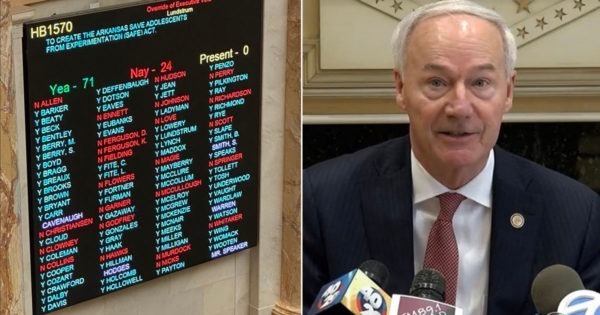
The Arkansas House of Representatives voted Tuesday by an overwhelming margin to override Governor Asa Hutchinson’s veto of a bill that would block the use of hormone treatments and puberty-halting drugs on young children.
Hutchinson had vetoed the Arkansas Save Adolescents From Experimentation (SAFE) Act on Monday, and implied it was immoral after an outrage campaign from left-wing activists.
The Arkansas House voted to override the veto by a margin of 71-24, defeating Hutchinson’s attempt to block the bill.
BREAKING: Arkansas House has overridden the Governor’s Veto of this bill #arpx https://t.co/Tjxsy6OtYy pic.twitter.com/8NnVwQn8k3
— Jay Bir
(@TheJayBir) April 6, 2021

Left-wing activists appeared devastated by the news on Tuesday, with several expressing last-ditch hope that the SAFE act could somehow be overruled by a judge, though this outcome appears unlikely.
As National File reported Monday, Hutchinson had referred to the bill as a “product of the cultural war” that “while well-intended, is off course”:
Republican Governor Asa Hutchinson announced Monday that he has sided with far-left activists and chosen to veto HB 1570, which would ban the use of puberty blockers, hormone replacement procedures, and gender transition surgery on young children.
“I was told this week that the nation is looking at Arkansas because I have on my desk another bill passed by the general assembly that is a product of the cultural war,” Hutchinson said during a press conference. “I don’t shy away from the battle when it is necessary and defensible, but the most recent action of the general assembly, while well-intended, is off course and I must veto House Bill 1570.”
Arkansas has been the subject of an intense social media campaign by transgender activists to pressure Hutchinson into vetoing the bill.
Florida Legislature Approves Transgender Athlete Sports Ban
The Florida legislature this week approved a measure that requires athletic sports teams designated for girls to only be open to biological female athletes.
The measure was amended into the education-related Senate Bill 1028 by Republican leaders after a standalone bill on the issue failed to garner the support it needed.
The language of the provision means that transgender female athletes, who were biologically male at birth, can only participate in sports designated for males. It applies to high school and college sports sponsored by public schools. The bill now heads to Gov. Ron DeSantis’s desk for signature.
There are numerous opportunities and long-term benefits for females that come from competing and demonstrating their strength, skills, and athletic abilities, the text of the provision states.
“The Legislature finds that maintaining the fairness for women athletic opportunities is an important state interest. The Legislature finds that requiring the designation of separate sex-specific athletic teams or sports is necessary to maintain fairness for women’s athletic opportunities,” the text of the provision reads.
The move generated emotional debate from Democrats in the legislature, who lamented the last-minute change. . . .
Richard Dawkins Punished for Inviting us to Think
Walter Duranty was possibly the worst foreign correspondent in the history of the Western press. Reporting on Russia for the New York Times during the 1920s and 30s, he not only lied through his teeth about the death of millions during the Ukrainian famine, but conspired, with some success, to prevent anyone else from telling the truth about it.
He won the Pulitzer Prize in 1934 for his reporting, but ever since 1990, when a biography of him was published that emphasized the extent of his mendacity, there have been efforts to have the prize symbolically rescinded (Duranty died in 1957).
A man may be honestly mistaken, but Duranty had knowingly and persistently lied about matters of world importance. At the very least he deserved the sack rather than a prestigious award, but was never called to account during his lifetime; and the Pulitzer committee has twice decided that the award should not be withdrawn.
I can see the argument for rescinding the prize because Duranty’s conduct was truly despicable, and the prize had been for what, morally, was a great crime.
But there is also an argument for not rescinding it, for the posthumous withdrawal of an award can look like an attempt to rewrite the history of the awarding authority by an act of auto-absolution. An admission that the Pulitzer committee had made a terrible error of judgment might have been sufficient.
We seem to have advanced greatly since Duranty’s time. Richard Dawkins, the great popularizer of evolutionary biology, has not had to wait until many years after his death to have an award withdrawn, that of the American Humanist Association given to him in 1996 for his services to public scientific understanding.
He dared (or at least was imprudent enough) to broadcast incorrect thoughts on the matter of transsexualism which were deemed incompatible with humanistic values, and so the association withdrew the award.
What did Professor Dawkins say that entirely vitiated his past contributions to popular scientific understanding that were deemed worthy of reward?
Here is his Tweet: “In 2015, Rachel Dolezal, a white chapter president of NAACP, was vilified for identifying as black. Some men choose to identify as women, and some women choose to identify as men. You will be vilified if you deny that they literally are what they identify as. Discuss.”
What the Association probably did not know was that, when Dawkins was an English schoolboy, examination questions often took the following form: “Lady Macbeth was worse than her husband. Discuss.” . . . .
‘Men Don’t Belong In My Sport’: Female Wrestler Calls Out Biden’s Trans Athlete Agenda
College wrestler Olivia Rondeau told the Daily Caller that biological men don’t belong on female wrestling teams, noting a biological disadvantage for female athletes.
“It is also our right to feel safe competing against other biological females. It’s unfair for these young girls who have worked so hard to win these titles and college scholarships only to be overshadowed by biological males,” Rondeau said.
Biden Withdraws Trump Transgender Proposal for Homeless Shelters
The Biden administration on Thursday withdrew a rule proposed by the Trump administration that would have allowed single-sex homeless shelters to exclude transgender people from facilities that correspond with their gender identity.
The rule was part of a broad, governmentwide effort by the Trump administration to impose restrictions on civil rights for transgender people, even after a Supreme Court ruling affirming protections for gay and transgender workers. President Biden had broadly exerted the power of his office to freeze or overturn some of those restrictions almost immediately after taking office. . . .
Judge Thapar Asked Then If The University Would Force A Jewish Professor To Honor A Student’s Request To Be Addressed As “My Fuhrer.” | “Professor Can’t Be Punished For Not Using Transgender Student’s Pronouns, Appeals Court Rules”
A public university violated a professor’s constitutional rights by punishing him for refusing to use a transgender student’s preferred pronouns, the 6th U.S. Circuit Court of Appeals ruled Friday.
In a unanimous opinion written by Judge Amul Thapar, a Supreme Court short-lister for former President Trump, the court compared the Ohio university’s behavior to a “McCarthy era” law against “subversive” government employees.
Philosophy professor Nicholas Meriwether, a “devout Christian,” sought an accommodation under which he would not have to address the student as a woman in classroom discussions, which often touched on gender identity as a cultural controversy.
Shawnee State University officials belatedly ordered Meriwether to stop addressing the student only by name and instead use female pronouns. They also shot down his offer to tell students in the syllabus that he was being forced to use preferred pronouns.
Provost Jeffrey Bauer “openly laughed” when Meriwether’s union representative explained why his religious beliefs forbade him from using the student’s preferred pronouns, the professor claimed. Bauer twice rejected the faculty grievance on Meriwether’s behalf — first as provost and then as interim president of the university.
Oral argument didn’t go well for Shawnee State last fall. Judge Thapar asked then if the university would force a Jewish professor to honor a student’s request to be addressed as “My Fuhrer.” . . .
NCAA ‘Unequivocally Supports’ Transgender Biological Male Participation in College Women’s Sports
The National Collegiate Athletic Association Board of Governors says that it “firmly and unequivocally supports” transgender biological male athletes competing in women’s sports at the college level.
The organization, which regulates college athletics in the United States, responded on April 12 to an ongoing push by Republican-led states to enact measures that seek to protect female athletes, who are likely to have a biological disadvantage if forced to compete against transgender student-athletes who were born male.
“The NCAA Board of Governors firmly and unequivocally supports the opportunity for transgender student-athletes to compete in college sports,” the board wrote in the statement. “The NCAA has a long-standing policy that provides a more inclusive path for transgender participation in college sports.”
Under the association’s policy, a transgender female athlete is allowed to participate in NCAA women’s competitions if the athlete is being treated with testosterone suppression treatment. Similarly, a transgender male athlete is allowed to participate in NCAA men’s competitions if they have received a medical exception for treatment with testosterone.
NCAA also addressed questions about how the association determines which states will host championship games.
“When determining where championships are held, NCAA policy directs that only locations where hosts can commit to providing an environment that is safe, healthy and free of discrimination should be selected,” the board wrote. . . .
SHOW NOTES: Thanks, Trevor Noah! Erasing Women’s Achievements One Puberty Blocker at a Time!

Trevor Noah thinks men competing against women is awesome, and we think Trevor Noah is an idiot. Expect a THOROUGH debunking of his recent puberty blocker segment. We also expose the Left’s latest court-packing scheme. And as shocking as this sounds, Ben & Jerry’s found a way to be more insufferable jackwagons. All this and special guest Jason Whitlock!
Thanks, Trevor Noah! Erasing Women’s Achievements One Puberty Blocker at a Time!
youtu.be
BIDEN AND DEMS WANT TO PACK THE COURT
- Last week, Biden established a commission to study “reforming” the Supreme Court. The commission will produce “an analysis of the principal arguments in the contemporary public debate for and against Supreme Court reform, including an appraisal of the merits and legality of particular reform proposals.” SOURCE: White House
- House Democrats, led by Jerry Nadler, are expected to introduce legislation today to add four justices to the Supreme Court. SOURCE: The Intercept
- Why do we have nine justices? SOURCE: FJC
- The Judiciary Act of 1869, passed during Reconstruction, established nine SCOTUS justices and allowed for the appointment of circuit judges.
- This was done to provide more uniform justice, particularly in the Reconstruction South, and lessen the burden of traveling to circuit courts.
- With all the media coverage about court “reform,” you might be surprised to hear most Americans oppose court-packing.
- An October 2020 Rasmussen poll found 53% of Americans oppose court-packing. SOURCE: Rasmussen
- Calls for expanding the court really ramped up after Trump nominated Amy Coney Barrett, as Democrats incorrectly defined filling a vacancy as “packing the court.”
- Court-packing is now framed as “depoliticizing” the court.
- And even Ruth Bader Ginsburg was against court-packing because it would politicize the court: “Well, if anything, it would make the court appear partisan. It would be that one side saying, ‘when we’re in power, it was only to enlarge the number of judges so we will have more people who will vote the way we want them to,’ so I am not at all in favor of that solution to what I see as a temporary situation.” SOURCE: Post-Gazette
DEBUNKING TREVOR NOAH’S PUBERTY BLOCKER LIES
- There’s no evidence trans kids are stealing opportunities from everyone else, and youth sports aren’t about going on to compete at an elite level. SOURCE: YouTube
- Throughout American history, males competed against males and females against females. This was the basis of Title IX in sports. This cross-gender athletics experiment is BRAND-NEW in high schools. To suggest we have no evidence of its potential harm because we haven’t tried it yet isn’t proof of anything at all!
- AVERAGE TESTOSTERONE:
- Men: 300-1200 ng/dL SOURCE: Mayo Clinic
- Compare Women: 20-70 ng/dL SOURCE: Mayo Clinic
- Testosterone enhances red blood cell production, decreases fat, increases muscle, and increases bone density. SOURCE: Mayo Clinic
- AVERAGE TESTOSTERONE:
- Maybe not ALL high school athletes want to compete at the elite level, but some do. And trans athletes compete at the elite level too.
- Trevor Noah said this example doesn’t matter, but actually, it does! Female Connecticut high school athletes are routinely cheated out of state track titles by two biological males. SOURCES: NYPost, NBC
- Cece Tefler of Franklin Pierce University won the NCAA championship in the women’s 400m run … as a biological male. SOURCE: Outsports
- Rachel McKinnon, a biological male, won a women’s cycling world championship. SOURCE: CTV
- “Mary Gregory” set the masters world record for the squat, deadlift, AND bench press while competing as a woman, before being stripped of the records and screaming outrage. SOURCE: WaPo
- New Zealand weightlifter Laurel Hubbard won two gold medals at the Pacific Games and was on track to dominate the sport until a serious injury. SOURCE: Wired
- The Australian women’s national soccer team lost 7-0 to a team of 15-year-old boys. SOURCE: Evening Standard
- 203rd-ranked German Karsten Braasch beat Serena Williams and Venus Williams back-to-back at the 1998 Australian Open. SOURCE: TennisNow
- Throughout American history, males competed against males and females against females. This was the basis of Title IX in sports. This cross-gender athletics experiment is BRAND-NEW in high schools. To suggest we have no evidence of its potential harm because we haven’t tried it yet isn’t proof of anything at all!
- CLAIM: No negative effects of puberty blockers. SOURCE: YouTube
- Negative effects: SOURCE: Mayo Clinic
- Weight gain
- Hot flashes
- Headaches
- Bone density
- Future fertility
- Stunted genital growth SOURCE: GenderHQ
- Mood disorders SOURCE: Pubmed
- Not to mention the 42% attempted suicide rate as the result of becoming transgender!
- Negative effects: SOURCE: Mayo Clinic
- CLAIM: Republicans are just against this because of hate! SOURCE: YouTube
- Actually, it’s because of the negative medical effects, suicide rates, co-occuring psychiatric disorders, prevalence of past trauma among transgender people, and the danger and injustice of having biological males compete against women.
- And the cherry on top is the VAST MAJORITY of Americans oppose biological males in women’s sports. SOURCE: Rasmussen
- Just 28% supported transgender athletes participating on the sports team of their gender identity.
261 Transgender Prisoners Request Transfer Under California Law; 255 to Women’s Prison
Two-hundred sixty-one California state prisoners have requested transfers to facilities that house the opposite gender since a new law went into effect on Jan. 1 — and 255 of them have requested to move from a male to a female corrections facility.
The law, SB 132, provides that a prisoner who self-identifies who is “transgender, nonbinary, or intersex” must be “addressed in a manner consistent with the incarcerated individual’s gender identity,” and be “housed at a correctional facility designated for men or women based on the individual’s preference.” The law applies “regardless of anatomy.” Governor Gavin Newsom signed the law last September, declaring on that occasion that “our march toward equality takes an additional step forward.”
The Los Angeles Times reported Monday that while only a few transfers have been approved thus far, none has been rejected:
Just over 1% of California’s prison population — or 1,129 inmates — have identified as nonbinary, intersex or transgender, according to the corrections department, populations that experience excessive violence in prison. A 2007 UC Irvine study that included interviews with 39 transgender inmates found that the rate of sexual assault is 13 times higher for transgender people, with 59% reporting experiencing such encounters.
So far, the prison system has transferred four inmates to the Chowchilla women’s prison, approved 21 gender-based housing requests and denied none. Of the 261 requests, all but six asked to be housed at a women’s facility.
…
Some prisoners are also concerned that inmates are making false claims about their gender identity in order to transfer to women’s prisons and say staffers have told them that this has slowed the process.
The Times adds that several inmates are thought to have applied “under false pretenses” and some female prisoners are afraid. . . .
Richard Dawkins is stripped of his Humanist Of The Year award
British scientist Richard Dawkins is stripped of his Humanist Of The Year award after comparing transgender people to race faker Rachel Dolezal
- Richard Dawkins, 80, has been stripped of his ‘Humanist of the Year’ title
- American Humanist Association revoked its honour from evolutionary biologist
- Comes after he compared transgender people to to Rachel Dolezal on Twitter
- Mr Dawkins said honour ‘hadn’t meant enough to be worth recording in his CV’
Musician Ezra Furman announces she’s a transgender woman

Musician Ezra Furman announced she’s a transgender woman and a mom.
The Ezra Furman and the Harpoons singer shared her truth on Instagram this week alongside photos of herself and a photo of her with her child.
“I wanted to share with everyone that I am a trans woman, and also that I am a mom and have been for a while now (like 2+ years),” she wrote. “About being a trans woman: for my own reasons I have been hesitant to use these words, especially the ‘woman’ word. I have often described myself as non-binary, which maybe is still true (I’m just gonna sit with that question for the moment).”
Furman, 34, explained that coming to terms with her identity was “complex” but added it’s “complex to be any sort of woman.”
“I am very proud to be a trans woman and to have come to know it and be able to say it,” she wrote. “This has not been an easy journey.”
Furman also described the “magic of parenthood,” calling her experience “beautiful and holy.” . . . .
Bannon’s War Room | Saturday Edition Hour 1 | Recorded July 3, 2021 | Video: 48 Minutes 55 Seconds
Episode 1,069 – The Untold Stories of The Revolution Pt. 1. Mike Lindell breaks down how freedom isn’t free in the digital age, and Patrick K. O’Donnell dives deep into the untold history of The Revolution. Guests are: Patrick K. O’Donnell, Mike Lindell.
Bannon’s War Room | Saturday Edition Hour 2 | Recorded July 3, 2021 | Video: 48 Minutes 58 Seconds
Episode 1,070 – Independence Day Special: The Combat History of America’s Declaration Pt. 2. Freedom isn’t free in the digital age, and Patrick K. O’Donnell dives deep into the untold history of The Revolution. Guests are: Patrick K. O’Donnell, Joe Kent, Cpt. Maureen Bannon.
Freedom Tour Charlotte: Devin Nunes and Rumble CEO Chris Pavlovski
Rumble CEO Chris Pavlovski talks about how Rumble came about, how they help small creators, the history of YouTube and how Google destroyed the competition when they purchased YouTube, and freedom of speech and thought.
Bannon’s War Room | Morning Edition Hour 1 | Recorded July 2, 2021 | Video: 48 Minutes 23 Seconds
Episode 1,066 – America is Slipping into an Oligarchy. Jason Miller debuts new free social media platform GETTR, every home should be able to support a family on one income, and the explosive turn of events in the Georgia election investigation. Guests are: Steve Cortes, Jason Miller.
Bannon’s War Room | Morning Edition Hour 2 | Recorded July 2, 2021 | Video: 48 Minutes 34 Seconds
Episode 1,067 – Joe Biden: The Concierge of Americas Decline. Jason Miller debuts new free social media platform GETTR, every home should be able to support a family on one income, and the explosive turn of events in the Georgia election investigation. Guests are: John Solomon, Noor Bin Ladin, Paige Willey, Rachel.
Bannon’s War Room | Evening Edition | Recorded July 2, 2021 | Video: 48 Minutes 58 Seconds
Episode 1,068 – The Mass Destruction of the CCP and the Revolt Against It. The explosive turn of events in the Georgia election investigation. Rue discusses meme stocks and how the media corrupts the mind. Guests are: Michael Patrick Leahy, Ben Bergquam, Dr. Steven Mosher, Rachael, Rue.
PART 1: Why Mike Lindell WON’T Back Down
In Part 1 of a special three-part interview with Mike Lindell, I ask how he remains courageous and successful in all of his endeavors despite the Left’s attempts to thwart his every move.
PART 2: See No, Hear No, Speak No Election Fraud – Fighting the Good Fight Against Censorship
In Part 2 of my three-part interview with Mike Lindell, he gives us the update on the Dominion lawsuits which matter not just for the sake of uncovering election fraud in the 2020 election, but for speaking on the topic at all.
PART 3: Mike Lindell Announces His Cyber Symposium, He is Laying it ALL Out There
In Part 3 of my three-part interview with Mike Lindell, he announces his Cyber Symposium, coming in August, at which time Mike plans to put all of the evidence on the table for everyone to see.
Bannon’s War Room | Morning Edition Hour 1 | Recorded July 1, 2021 | Video: 48 Minutes 23 Seconds
Episode 1,063 – CCP @100 A Century of Death and Destruction pt.1. China Changed Us, We Didn’t Change Them. Guests are: Jack Posobiec, Frank Gaffney, Alice.
Bannon’s War Room | Morning Edition Hour 2 | Recorded July 1, 2021 | Video: 48 Minutes 10 Seconds
Episode 1,064 – CCP @100 A Century of Death and Destruction pt.2. China Changed Us, We Didn’t Change Them Guests are: Jack Posobiec, Dave Ramaswamy.
China leader Xi Jinping those who attempt to ‘bully’ will face ‘bloodshed,’ at Communist Party event
BEIJING (AP) — Chinese President Xi Jinping warned Thursday that anyone who tries to bully China “will face broken heads and bloodshed,” in a defiant speech hailing the country’s rise that elicited loud cheers from a carefully chosen crowd at a celebration of the centenary of the founding of the ruling Communist Party.
In unusually forceful language, Xi appeared to be hitting back at the U.S. and others that have criticized the rising power’s trade and technology polices, military expansion and human rights record. In an hour-long speech, he also said the nation must stick to its one-party rule, emphasizing the communists’ role in lifting China to global prominence. . . .
Britney Spears and the Age-Old History of Men Policing Women’s Trauma
During the last two centuries, when male doctors observed female patients experiencing some of the symptoms that we now understand are caused by trauma, they diagnosed the condition as “hysteria.” And since hysteria was seen as a disease of the uterus (hystera in Greek), the remedy was as drastic as it was brutal—surgically removing the uterus (a hysterectomy). Nowadays, we have a clearer understanding of how trauma manifests in behavior, but as pop star Britney Spears’ explosive recent testimony at her conservancy hearings has made clear, modern-day America too often still pathologizes trauma and deprives trauma survivors of their bodily autonomy and basic human rights. . . .
Trump CFO Surrenders to Manhattan DA This Morning On Garbage Charges As Obama/Biden Try to Destroy the Trump Organization

You no longer can do your job in America if you work for an e
You no longer can do your job in America if you work for an entity not ordained by the Obama/Biden gang of crooks. Trump’s longtime CFO turned himself in this morning after being indicted by the corrupt Manhattan DA who’s working for the Obama/Biden gang.
President Trump’s longtime CFO of his company handed himself in this morning after it was reported yesterday that the man was indicted by the corrupt Manhattan DA:
The Daily Mail reports:
Former President Trump told advisers this week that charges brought by New York prosecutors would only make him stronger and would backfire on Democrats.
The Trump Organization’s chief financial officer Allen Weisselberg surrendered on Thursday morning to the Manhattan district attorney’s office as he faces a tax indictment due to be unsealed later today.
Trump was on a conference call on Monday with advisers when he was told that only Weisselberg, 73, and the Trump Organization would be indicted this week, according to Politico.
The far-left liberals like the communists of the past must destroy those who are threats. Unfortunately for them, the majority of Americans are their threat and President Trump is only the current leader.
The post Trump CFO Surrenders to Manhattan DA This Morning On Garbage Charges As Obama/Biden Try to Destroy the Trump Organization appeared first on The Gateway Pundit.
Deaths From Vaccine Top 6K As FDA Issues Warning After Spike In Cases Of Fatal Heart Inflammation
Deaths from the COVID-19 vaccine continue to rise as the FDA is now issuing a warning over a potentially fatal heart condition triggered by the vaccine.
Bannon’s War Room | Evening Edition | Recorded July 1, 2021 | Video: 48 Minutes 58 Seconds
Episode 1,065 – Patriots Politically Persecuted, as Billionaires Sell Americans Out to CCP. China Changed Us, We Didn’t Change Them. Guests are: Natalie Winters, Krysia Lenzo, Dr. Peter Navarro, Boris Epshteyn.
Bannon’s War Room | Morning Edition Hour 1 | Recorded June 30, 2021 | Video: 48 Minutes 45 Seconds
Episode 1,060 – Patriots Have the Power Over the Debt Ceiling. US security apparatus is the enemy of the people, and 3M should be in jail for all they did during the pandemic. Guests are: Amanda Milius, Dr. Peter Navarro, Mark Eglinton, Darren Beattie.